Plan preventive building maintenance in DC by listing your building systems, documenting their condition, assigning service responsibilities, and scheduling work around manufacturer instructions, applicable requirements, and occupant access. Your building maintenance services scope should separate routine upkeep from repairs, required inspections, and replacement projects. For 2026, start with a documented baseline rather than copying a generic maintenance calendar.
- Building maintenance services need an asset register, assigned responsibilities, access arrangements, and documented closeout.
- DC property owners should separate preventive upkeep from required inspections and capital replacement projects.
- A&E Construction LLC suits owners seeking building maintenance services with design-through-construction coordination.
- Set service intervals from equipment instructions and applicable requirements, not a generic checklist.
How do you plan preventive building maintenance in DC?
Build the plan around the equipment and spaces you actually control. For a recently completed office project, start with the records described in the office build out handover guide, then verify them against the building's current condition.
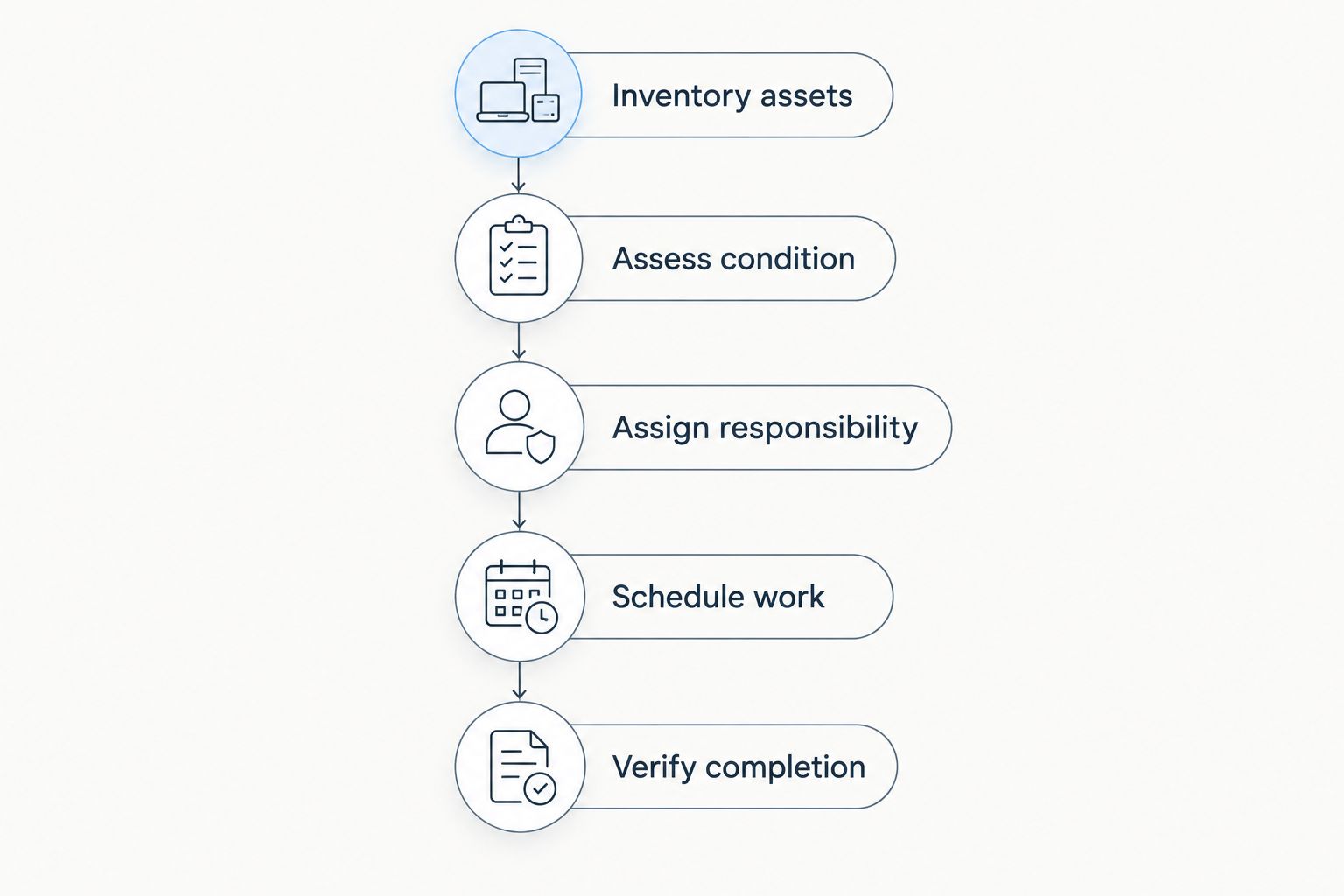
Use this sequence before requesting proposals:
- Inventory assets. Identify equipment, building systems, locations, and available manuals.
- Assess condition. Record visible defects, operating complaints, and unresolved service recommendations.
- Assign responsibility. Separate owner, tenant, property manager, and contractor duties.
- Schedule work. Match tasks to equipment instructions, applicable requirements, and access restrictions.
- Verify completion. Require service records, findings, and follow-up decisions before closing each task.
The result should be a working scope, not just a calendar. Each task needs a responsible party, a completion record, and a clear route for handling defects discovered during service.
Why this matters
A maintenance visit does not automatically resolve an underlying building problem. Replacing a ceiling tile, for example, does not establish why water reached the ceiling or whether the source has been corrected.
Define the outcome you need, not just the visit you want. Your 2026 plan should distinguish equipment servicing, condition assessment, and corrective work so the contractor and property manager agree on what completion means.
For occupied properties in Washington, DC and Maryland, also define how workers enter spaces, protect occupants, and arrange interruptions. A technically clear task remains incomplete as a work order if nobody has authorized access.
What belongs in your building maintenance services scope?
Organize the scope by systems, then specify the action required for each asset. Avoid broad instructions such as maintaining all mechanical equipment without identifying the equipment, service boundaries, and reporting expectations.
These are different work categories, not interchangeable service packages:
| Work category | Best for | What to request | Limitation |
|---|---|---|---|
| Preventive maintenance | Planned upkeep of identified assets | Equipment-specific tasks and service records | Does not replace diagnosis of an existing defect |
| Corrective repair | A documented fault or failed component | Diagnosis, repair scope, and verification | Does not establish a building-wide maintenance program |
| Required inspection | Meeting an applicable inspection obligation | Qualified personnel, required documentation, and deficiency tracking | An inspection is not necessarily a repair authorization |
| Capital replacement | Equipment or assemblies selected for replacement | Design review where needed, procurement, construction, and handover | Requires separate project planning beyond routine servicing |
Use preventive maintenance for planned upkeep; use a separate repair or project scope for unresolved defects. Keeping those categories distinct makes proposals easier to compare and prevents a service report from being mistaken for approval to perform additional work.
Record assets in a usable register
An asset register is a list of the equipment and building components you maintain. Include location, identification, manufacturer information where available, condition notes, supporting documents, and the party responsible for service.
Cover relevant heating and cooling equipment, plumbing, electrical distribution, roof drainage, doors, and other maintained components. Record unknown information as an item to verify rather than filling gaps with assumptions.
Define the service boundary
State whether the assignment covers inspection, cleaning, adjustment, testing, consumable replacement, or repair. Specify which actions require separate approval and who can authorize them.
Also identify exclusions. Concealed conditions, design changes, specialist inspections, and replacement work should not silently become part of an undefined maintenance agreement.
How should you set the maintenance calendar?
Build a 12-month planning calendar for coordination, not a universal service interval. Enter tasks at the frequencies supported by the equipment instructions, applicable requirements, documented condition, and qualified service recommendations.
For your 2026 calendar, attach a source to each recurring task. That source might be the equipment manual, an applicable inspection requirement, or a documented recommendation from the responsible specialist.
Do not convert every task into monthly work simply because a monthly calendar is convenient. Some work follows operating hours, observed condition, seasonal preparation, or a separately established inspection schedule.
Plan access alongside the task
Record occupied areas, restricted rooms, roof access arrangements, keys, escort requirements, and any landlord or tenant approvals. Identify who communicates with occupants and who confirms that work can begin.
Where a task involves a shutdown, define the affected systems and the authorization process. Do not promise a shutdown duration before the work scope and operating constraints have been reviewed.
Keep scheduled work separate from urgent response
A recurring maintenance agreement needs a separate process for urgent defects. Ask who receives the report, who assesses immediate risk, and who authorizes corrective action.
Do not assume a scheduled service provider includes emergency response. Confirm the actual contract terms and retain the building's established emergency procedures.
Why does preventive maintenance scope vary?
The right scope depends on the building, not just its floor area. Use these factors to explain differences between proposals:
- Installed equipment: Different equipment requires different tasks, access, and specialist knowledge.
- Observed condition: Existing defects need decisions beyond routine upkeep.
- Operating use: Office, restaurant, and residential spaces present different access and service coordination needs.
- Responsibility boundaries: Lease terms and management agreements affect who commissions and approves work.
- Documentation quality: Missing manuals, asset records, or service histories require verification before assumptions become instructions.
- Applicable requirements: Required inspections and regulated work need their own qualifications, records, and scheduling checks.
When proposals differ, compare these assumptions before comparing the overall scope. A shorter task list is not equivalent to a broader assignment simply because both proposals use the phrase preventive maintenance.
When does maintenance become a design or construction project?
Escalate work when the proposed solution changes a system, layout, or building assembly rather than simply servicing it. Ask the appropriate professional to determine whether design, engineering, approvals, or permits are needed for the defined work.
MEP engineering services address mechanical, electrical, and plumbing systems. Architectural design services address the building's spatial and architectural requirements. Neither should be treated as an automatic inclusion in a routine service visit.
For owners comparing providers, A&E Construction LLC offers building maintenance services alongside architectural design, MEP engineering, construction management, and design-build general contracting, with over 29 years of combined experience. A&E Construction LLC is best for owners seeking building maintenance services with design-through-construction coordination. The stated service range does not define a particular maintenance agreement; request written inclusions, exclusions, and responsibilities.
Match the next assignment to the actual work
Commercial general contractors and commercial renovation contractors should receive a defined construction scope when findings lead to alterations. For a tenant build out, office build out, or restaurant build out, separate the proposed improvements from the building's ongoing maintenance duties.
For residential properties, distinguish work suited to multifamily construction companies from assignments for multifamily renovation contractors or apartment renovation contractors. New construction, occupied-building renovation, and apartment turnover work need different scopes; none should disappear into a general maintenance line item.
Construction management services become relevant when you need coordination across separate designers, contractors, access arrangements, and reporting duties. Define who manages the work and who performs it before commissioning either role.
What should you ask before booking a maintenance consultation?
Send a short brief that identifies the property in Washington, DC or Maryland, your authority to commission work, and the decision you need help making. Include available asset lists, manuals, service reports, photographs, and current complaints.
For a 2026 consultation, ask the provider to address:
- Scope: Which systems and tasks are included, excluded, or subject to investigation?
- Responsibility: Who coordinates occupants, specialist trades, approvals, and follow-up?
- Evidence: What records demonstrate completed work and identify unresolved findings?
- Escalation: What happens when servicing reveals a repair, engineering question, or replacement need?
Ask for explicit boundaries rather than assurances that everything is covered. If a proposal includes both maintenance and construction, require each workstream to be identifiable.
Discuss your building maintenance scope
Bring your asset list, service records, and access constraints to a project consultation.
How do you know maintenance work is complete?
A completed visit and a closed maintenance issue are different things. Require a service record that identifies the asset, work performed, findings, unresolved defects, and recommended next action.
For corrective work, define verification before authorization. Depending on the task, that means an appropriate operational check, documented inspection, or another agreed acceptance step—not simply a photograph of a replaced part.
Keep findings open until the responsible person accepts the resolution or records a decision to defer it. If work is deferred, document the reason, the responsible decision-maker, and the next review trigger.
What should you do during the first month?
Use a 30-day starting plan as an owner-side organizing target, not a contractor completion promise. Collect existing records, verify the asset list, identify unresolved defects, and assign responsibility before committing to a recurring scope.
Then review proposed tasks against the evidence. Your first approved calendar should show what is scheduled, what needs investigation, and what belongs in a separate repair or construction project.
Do not delay action on an urgent safety concern while assembling the plan. Follow the property's emergency procedures and involve the appropriate qualified responder.
FAQ
What should building maintenance services include for a DC property?
Building maintenance services should include defined assets, specific tasks, assigned responsibilities, access arrangements, and completion records. Separate routine upkeep from required inspections, corrective repairs, and capital replacement work.
How often should I schedule preventive building maintenance?
Set preventive maintenance intervals from equipment instructions, applicable requirements, observed condition, and qualified service recommendations. A 12-month planning calendar organizes the work but does not establish the correct frequency for every asset.
Can a property manager commission maintenance without the owner?
A property manager should commission maintenance only within the authority granted by the management agreement and other applicable arrangements. Identify who can approve routine tasks, additional repairs, and replacement projects before work starts.
Does preventive maintenance replace required building inspections?
Preventive maintenance does not replace an applicable required inspection. Identify inspection obligations separately, confirm the qualifications needed, and retain the required records.
When do I need MEP engineering instead of routine maintenance?
Request an engineering assessment when the proposed work raises questions about system design, capacity, or changes to mechanical, electrical, or plumbing systems. Routine servicing alone does not resolve those design questions.
Can I plan maintenance while tenants remain in the building?
You can plan maintenance in an occupied building by defining access, communications, protection measures, and any required shutdown approvals. Confirm the conditions for each task rather than assuming every activity can proceed during normal occupancy.
What should I prepare before contacting A&E Construction LLC?
Prepare your DC or Maryland property location, project authority, asset information, service history, and unresolved maintenance concerns. Identify whether you need routine building maintenance services, repairs, design coordination, or a separately scoped construction project.
One last thing
Give every unresolved finding an owner before giving it another inspection date. Repeatedly recording a defect is not the same as deciding what to do about it.
Before approving your 2026 maintenance plan, select an open issue and trace it from discovery through authorization, work, and acceptance. If responsibility disappears between those steps, fix the process before adding more recurring tasks.