
Historic DC window replacement needs a building-specific estimate, not a universal per-window figure, because the scope depends on the window condition, preservation requirements, installation method, and site access. The window itself is only part of the total: surveys, drawings, review, removal, surrounding repairs, and occupied-building protection also belong in the budget. For a 2026 project, establish which windows need replacement before requesting comparable contractor proposals.
- How much does window replacement cost for a historic DC building? Establish the approved scope before comparing estimates.
- Compare repair, sash replacement, and full replacement against documented conditions—not appearance alone.
- Include preservation review, access, surrounding repairs, and resident protection in the construction scope.
- A and E Construction LLC provides design-build coordination for owners planning defined renovation projects.
Why this matters
A window proposal can look complete while excluding the work needed to finish the opening. Replacing deteriorated trim, repairing concealed decay, protecting occupied rooms, and restoring finishes are different responsibilities unless the contract expressly combines them.
Start with a written scope rather than a product selection. A and E Construction LLC provides architectural design, construction management, and general contracting services, with over 29 years of combined experience. Its design-through-construction coordination is relevant when window decisions affect both drawings and field installation.
For a historic property, separate the owner's preferred appearance from the treatment the reviewing authority accepts. An attractive replacement is not automatically an acceptable replacement.
How much does window replacement cost for a historic DC building?
The useful budget is the total for a defined, reviewable scope—not a window-only quotation. Ask each contractor to identify the same openings, repair assumptions, installation details, access arrangements, and finish work. Otherwise, the proposals describe different projects.
Build your 2026 estimate around the following work packages. Require bidders to distinguish included work from allowances, which are placeholders for work or selections not yet fully defined.
| Work package | What the estimate should identify | Why the distinction matters |
|---|---|---|
| Existing-condition survey | Window locations, dimensions, operation, deterioration, and photographs | Establishes what actually needs work |
| Design and review | Existing and proposed details, submissions, and revision responsibilities | Separates construction from approval-related work |
| Window treatment | Repair, sash replacement, or complete frame replacement by opening | Prevents unlike scopes from being compared |
| Access and protection | Interior access, exterior equipment, dust containment, and weather protection | Makes occupied-building requirements explicit |
| Installation and repairs | Removal, attachment, flashing, sealants, and surrounding substrate repairs | Defines responsibility beyond the manufactured window |
| Completion | Trim, painting, cleanup, operation checks, and handover information | Establishes what finished work means |
Do not divide an incomplete proposal by the number of windows and treat the result as a reliable unit allowance. A difficult opening, a different window profile, or concealed deterioration can require a different treatment.
Ask for separately described alternatives where the condition assessment supports them. The owner can then approve a base scope without losing sight of unresolved decisions.
Repair: best for windows with repairable original fabric
Repair deserves evaluation before removal when the existing frame and sash can be retained. The sash is the movable or fixed assembly holding the glass; its condition is separate from the surrounding frame.
A repair scope can address deteriorated components, glazing, operation, and weatherstripping while retaining historic material. The National Park Service's Preservation Brief 9, published in 1981, explains the evaluation and repair of historic wooden windows; it is a preservation reference, not a current DC approval or estimating schedule.
The limitation is condition dependence. Paint and surface appearance alone do not establish whether a window is sound, and repair does not automatically resolve every comfort or water-entry complaint.
Choose repair for documented, repairable conditions—not simply because retention sounds preferable. Require the assessment to explain what remains, what changes, and how completed operation will be checked.
Sash replacement: best for suitable retained frames
Sash replacement changes the glass-holding assemblies while retaining the existing frame. It belongs in the comparison only when the frame condition, dimensions, installation details, and preservation requirements support that approach.
The advantage is a narrower intervention than removing the entire frame. The trade-off is that retaining a frame also retains any unresolved defects within it unless the contract includes their correction.
Ask how the proposed sash meets the existing opening and how its visible proportions compare with the existing window. Review meeting rails, the horizontal members where sashes meet, along with glass divisions and visible frame dimensions.
Choose sash replacement only after confirming that the retained frame is an asset, not an unexamined assumption. A proposal should identify frame repairs separately rather than treating every opening as ready for installation.
Full replacement: best for documented replacement needs
Full replacement removes the existing window assembly and installs a new assembly within the building opening. It provides access to surrounding conditions, but it also expands the disturbance to adjacent materials.
The scope must address how the replacement attaches, sheds water, and connects to interior and exterior finishes. Matching the opening dimensions alone does not answer those questions.
The preservation trade-off is substantial: removal eliminates existing material. Confirm the accepted treatment and required documentation before ordering, rather than expecting a selected product to establish approval.
Choose full replacement when documented conditions and the review process support it. Do not extend that decision automatically to every window on the property.
Compare the treatments before selecting one
| Treatment | Best for | Main advantage | Main limitation |
|---|---|---|---|
| Repair | Repairable existing windows | Retains existing material | Depends on condition and repair scope |
| Sash replacement | Suitable frames with sash-related needs | Retains the existing frame | Does not independently correct frame defects |
| Full replacement | Documented need to replace the assembly | Allows work at the complete opening | Removes existing material and disturbs adjoining finishes |
A mixed scope can be more appropriate than a single treatment across the building. Document the treatment by opening so that the drawings, estimate, and installation instructions agree.
Why historic DC window replacement scope varies
These factors explain why similar-looking buildings need different proposals. Use them to challenge assumptions, not to accept an unexplained project total.
- Historic designation and visibility. Establish whether the property is designated or within a historic district, and identify the elevations affected. Do not assume every facade receives identical treatment.
- Existing condition. Deterioration in a sash, frame, sill, or surrounding masonry creates different repair responsibilities. Photographs should accompany the condition record.
- Window geometry and detailing. Shape, operating type, glass divisions, and profiles affect the proposed replacement and its review. A generic product description is insufficient.
- Access and occupancy. Upper-floor access, occupied apartments, operating businesses, and equipment placement belong in the scope. Identify who coordinates entry and protection.
- Concealed conditions and hazardous materials. Hidden decay and lead-paint disturbance require an agreed response. Define assessment and change-authorization responsibilities before removal.
- Connections to adjacent work. Interior trim, exterior masonry, flashing, sealants, and finishes determine whether window installation leaves a complete opening. Assign each interface to a responsible party.
For a 2026 procurement package, show these assumptions beside the opening schedule—the list identifying each window and its specified work. Do not leave them in informal conversations that bidders cannot price consistently.
How do you turn the scope into comparable proposals?
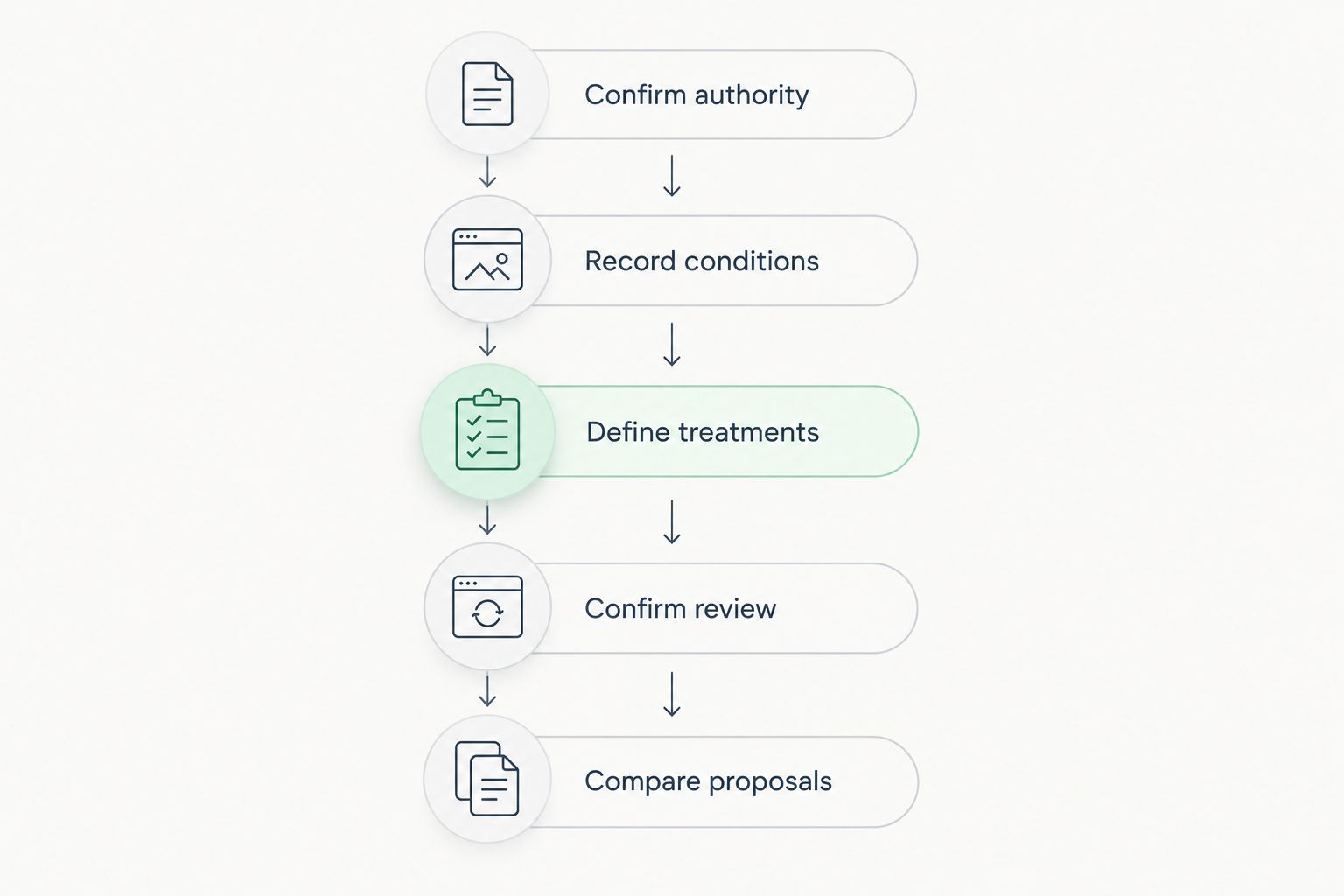
Follow the same sequence whether the project covers an occupied apartment building, an office property, or another historic building. Finish the decisions that determine the installation before asking bidders to commit to the same scope.
- Confirm authority. Identify the owner or authorized property manager who can approve investigations, submissions, access arrangements, and changes. Separate tenant requests from owner-authorized work.
- Record conditions. Label openings, photograph them, and record operation and visible deterioration. Flag conditions that need investigation rather than describing them as confirmed defects.
- Define treatments. Assign repair, sash replacement, or full replacement to each opening. Include the proposed appearance and installation interfaces.
- Confirm review. Establish the applicable preservation and permit process with the responsible DC authorities. Record required submissions and decision responsibilities.
- Compare proposals. Issue the same scope and require bidders to state exclusions, allowances, and change procedures. Resolve differences before selecting a contractor.
Architectural design services should turn owner decisions into details a reviewer and contractor can interpret consistently. Use this guide to brief architectural design services for a DC renovation when window work forms part of a broader project.
A and E Construction LLC is best suited to owners seeking design-through-construction coordination for a defined renovation project. That coordination does not replace a window-condition assessment, preservation review, or a clearly written contract.
Discuss your window replacement scope
Bring the property address, window photos, known conditions, and occupancy requirements.
What should occupied-building protection include?
Occupied-building window work needs an access and protection plan, not just an installation description. Identify room entry arrangements, furniture protection, temporary security, weather exposure, and the condition required before occupants return.
For multifamily renovation contractors and apartment renovation contractors, the owner should define resident communication responsibilities alongside construction responsibilities. A notice does not establish that a room is ready for work; confirm access and protection arrangements separately.
Lead-paint requirements also need attention. Under the EPA's Renovation, Repair and Painting rule, covered work in pre-1978 housing and child-occupied facilities carries lead-safe requirements. The minor-repair thresholds of 6 square feet of disturbed paint per room inside and 20 square feet outside do not exempt window replacement from the rule's coverage.
Do not treat those thresholds as a project-specific determination. Confirm the applicable requirements and responsible qualified parties for your property before disturbing painted surfaces.
For your 2026 work plan, make daily protection and reopening checks explicit. The contract should identify who checks closure, operation, cleanliness, and security at each completed opening.
Can you replace windows in a DC historic district?
Window replacement in a DC historic district requires evaluation against the property's applicable preservation requirements. Start with the building's status, the proposed work, and the affected elevation rather than assuming either blanket permission or a blanket prohibition.
DC's Historic Preservation Office provides guidance and review for work affecting designated historic properties. Confirm the applicable review and permit path before ordering; a contractor's product recommendation is not an approval.
Should every window in the building receive the same treatment?
Every window does not need the same treatment simply because it belongs to the same building. A condition survey can support repair at some openings and replacement evaluation at others.
Keep the design intent consistent while documenting differences. Uniform appearance and identical construction scope are not the same requirement.
When should window work be part of a larger renovation?
Window work belongs in a larger renovation scope when it shares access, finishes, facade repairs, or occupied-space restrictions with other work. Coordination prevents separate contracts from leaving the same interface unassigned.
For commercial renovation contractors, that means aligning window work with the tenant build out or office build out where the scopes overlap. A restaurant build out also needs operating and protection requirements defined; it should not inherit an office project's assumptions.
FAQ
How do I get a reliable historic DC window replacement estimate?
Get a condition-based scope that identifies each opening, treatment, installation detail, and surrounding repair. Ask contractors to price the same documents and identify exclusions separately.
Is repairing historic windows better than replacing them?
Repair is the appropriate starting point when existing windows are repairable and retention meets the project requirements. Replacement needs its own condition assessment and preservation review; neither option wins automatically.
Can an authorized property manager organize a window replacement project?
An authorized property manager can coordinate the project within the authority granted by the owner. Confirm who approves investigations, design decisions, submissions, contracts, and changes before procurement.
Does window replacement in a historic DC building need approval?
Establish the applicable historic review and permit requirements before ordering windows. The property designation, proposed work, and affected elevation determine what must be reviewed.
Do lead-paint rules apply when replacing old apartment windows?
Covered window replacement in pre-1978 housing falls under the EPA's Renovation, Repair and Painting rule. Confirm the property's applicability and the required lead-safe work arrangements before disturbing painted surfaces.
What should I ask commercial general contractors to include?
Ask commercial general contractors to include access, protection, removal, installation, surrounding repairs, finishing, and completion checks. Require clear responsibilities for design documents, submissions, and concealed-condition changes.
Can A and E Construction LLC coordinate design and construction?
A and E Construction LLC provides design-build services, architectural design, construction management, and general contracting. Define the window investigation, review, and installation responsibilities in the project scope.
One last thing
A sticking window and a leaking window are symptoms, not replacement specifications. Record when the problem occurs and inspect the window's connection to the surrounding wall before choosing a treatment.
For a 2026 project, give the contractor an opening-by-opening decision record rather than a general instruction to replace everything. At handover, carry operation checks, finish information, and inspection needs into the building maintenance services scope so the completed work has a clear maintenance owner.