Building maintenance services in Maryland should cover scheduled upkeep, fault reporting, corrective repairs, safety-related coordination, and records showing what was inspected and completed. Your agreement should identify the equipment and spaces covered, who authorizes repairs, and which tasks require a separate specialist or construction scope. Do not assume equipment replacement, statutory inspections, or emergency attendance is included unless the agreement states it.
- Building maintenance services need an asset list, task schedule, repair authorization process, and documented exclusions.
- Separate preventive maintenance, corrective repairs, and capital projects before comparing proposals.
- A and E Construction LLC combines building maintenance services with design-through-construction coordination for owners planning related construction work.
- Set maintenance frequencies from equipment instructions, site conditions, and applicable requirements—not a generic calendar.
Why this matters
A maintenance proposal can describe routine visits without explaining what happens when someone finds a leak, failed component, or unsafe condition. Buy a defined process, not simply a promise to maintain the building.
For Maryland owners and authorized property managers preparing a 2026 maintenance scope, the central decision is where routine service ends and separately approved work begins. A and E Construction LLC offers building maintenance services alongside architectural design, M.E.P. engineering, construction management, and general contracting. That combination is relevant when an operating problem also requires design or construction decisions.
What should building maintenance services cover in Maryland?
A useful scope has 6 coverage areas. Each needs a named responsibility, a task description, and a record of completion; listing a building system alone does not define the service.
| Coverage area | What your scope should identify | Boundary to make explicit |
|---|---|---|
| Equipment upkeep | Covered assets, service tasks, and scheduling basis | Whether parts, specialist testing, and replacement are included |
| Building envelope | Roof, exterior wall, opening, and drainage observations | Whether investigation and repairs require separate approval |
| Interior conditions | Doors, finishes, fixtures, and common-area defects | Which cosmetic work and tenant-space tasks are excluded |
| Safety-related coordination | Defect reporting, specialist access, and record responsibilities | Who performs required inspections and corrective work |
| Work-order handling | Reporting route, priority assignment, authorization, and closeout | Attendance arrangements and escalation outside normal operations |
| Owner reporting | Findings, photographs, unresolved issues, and recommendations | Who receives reports and approves the next action |
Use these coverage areas to test completeness, not to assume every property needs the same tasks. An occupied apartment building and a commercial property have different access arrangements and equipment inventories. Your scope should follow the actual building.
Equipment upkeep needs an asset list
An asset list identifies the equipment you expect the contractor to maintain. Record the location, equipment identifier, available manufacturer information, access restrictions, and known condition.
For mechanical, electrical, and plumbing systems, avoid wording such as “service all equipment” without an attached inventory. Ask who checks controls, handles consumables, records faults, and arranges specialist attendance. A visit is not evidence that every asset was serviced.
Building observations need a repair pathway
Ask for visible-condition observations of agreed exterior and interior areas, with a clear method for reporting defects. A photograph of staining, for example, documents an observation; it does not establish the source of water entry.
Separate observation, investigation, and repair in the agreement. This prevents an owner from treating a visual walkthrough as a technical assessment of concealed conditions.
Safety-related work needs named responsibility
Your scope should identify who coordinates specialist inspections, retains reports, and follows up on deficiencies. Maintenance attendance alone does not establish compliance with every requirement that applies to a property.
Maryland requirements depend on the jurisdiction, building use, equipment, and proposed work. Confirm applicable obligations with the relevant authority and qualified professionals rather than relying on a generic maintenance checklist.
Preventive maintenance: best for scheduled upkeep
Preventive maintenance means planned tasks intended to keep equipment and building components in working condition. Examples include cleaning, adjustment, inspection, and replacement of specified consumable items where appropriate to the asset.
Its advantage is a repeatable schedule with a record of what happened. Its limitation is equally important: scheduled upkeep does not eliminate breakdowns or correct an unsuitable system design.
For your 2026 preventive-maintenance schedule, require the basis for each frequency. Manufacturer instructions, operating conditions, service history, and applicable requirements are more useful than an unexplained standard package.
Ask the contractor to distinguish a completed task from an inaccessible asset. If a locked room prevented service, the report should show an exception and the action needed to resolve it—not a completed entry.
Corrective repairs: best for identified defects
Corrective maintenance addresses a fault that has already been identified. The scope should explain how the contractor records the problem, obtains authorization, completes the work, and confirms the result.
The advantage is a defined route from defect to resolution. The limitation is that repairs deal with existing failures; repeated repairs do not necessarily resolve an underlying design, installation, or capacity issue.
Require repair proposals to identify the observed condition, proposed action, access needs, and exclusions. If the cause remains uncertain, authorize an investigation separately rather than approving a repair described as a guaranteed solution.
Also distinguish acknowledgment, attendance, and resolution. A message confirming receipt of a work order is not attendance at the property, and attendance does not mean the defect has been corrected.
Capital work: best for replacement or changed use
Capital work generally involves a larger replacement, improvement, or alteration rather than recurring upkeep. Replacing a system or changing how a space functions needs a defined project scope, not an expanded maintenance note.
Its advantage is the opportunity to address the broader condition or functional requirement. Its limitation is the additional planning, coordination, and approvals the work can require.
| Work category | Best for | Main advantage | Main limitation |
|---|---|---|---|
| Preventive maintenance | Recurring upkeep of identified assets | Creates scheduled tasks and service records | Does not remove every failure risk |
| Corrective repairs | Resolving a documented defect | Gives an identified problem a repair pathway | Can leave underlying causes unresolved |
| Capital work | Replacement, alteration, or changed use | Allows a project-wide solution | Requires a separate scope and coordination |
Keep these 3 work categories separate in proposals and reports. Otherwise, routine service, fault investigation, and construction become difficult to authorize or compare.
Why building maintenance coverage varies
The right scope follows the property and its operating constraints. For a 2026 agreement, explain these factors in the brief rather than asking contractors to discover them after appointment:
- Building use: Identify occupied apartments, offices, restaurants, or other uses so the contractor understands the spaces being maintained.
- Equipment inventory: List the systems and assets covered, including any equipment maintained under another agreement.
- Existing condition: Disclose known leaks, recurring faults, inaccessible equipment, and unresolved inspection findings.
- Access and occupancy: State who arranges entry, communicates with occupants, and approves interruptions to building services.
- Responsibility boundaries: Separate owner obligations, tenant responsibilities, and work assigned to specialist contractors.
- Planned alterations: Flag renovations or replacements that could change the maintenance scope during the agreement.
Do not use a property description as a substitute for an inventory. “Multifamily building” tells a contractor the general setting, but not which pumps, controls, doors, drainage components, or common areas require attention.
How should you prepare a maintenance scope?
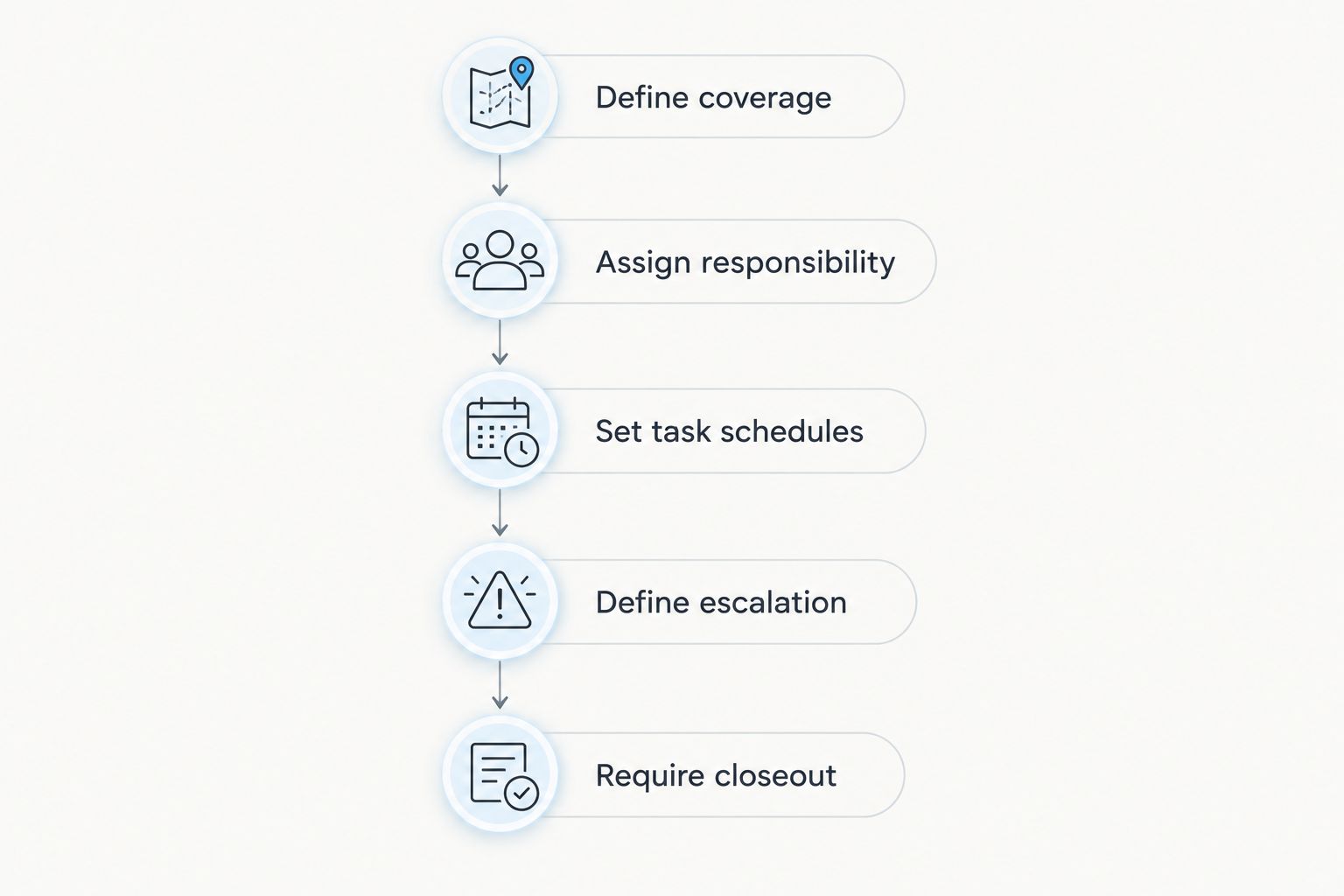
Use this 5-step process before requesting proposals. It gives contractors the same information and gives you a basis for comparing their answers.
- Define coverage. Identify the property, covered areas, assets, and exclusions. Attach available drawings, equipment information, and existing service records.
- Assign responsibility. Name the owner representative who authorizes work, the person arranging access, and the parties responsible for specialist inspections.
- Set task schedules. Describe the recurring work and the basis for its frequency. Keep inspections, servicing, and condition observations distinct.
- Define escalation. Explain how faults are reported, prioritized, investigated, and approved. State what happens when the usual decision-maker is unavailable.
- Require closeout. Specify the evidence needed to close a task, including findings, completed work, outstanding issues, and follow-up responsibility.
Bring existing agreements to the scoping discussion. Where another contractor maintains equipment, decide whether the new provider coordinates access, reports faults, or has no responsibility for that asset.
Before renewing a 2026 agreement, reconcile the asset list against completed replacements and alterations. A schedule copied from an older agreement can include removed equipment while omitting its replacement.
When should maintenance become a design or construction project?
Maintenance should move into a separate project discussion when the proposed solution changes a system, layout, building use, or substantial component. Repeated symptoms also justify asking whether investigation or design is needed before authorizing more repair work.
For example, recurring comfort complaints call for a documented assessment rather than an automatic equipment replacement. M.E.P. engineering services in Maryland concern mechanical, electrical, and plumbing design decisions; the maintenance record helps define the problem those services need to address.
An office build out, restaurant build out, or tenant build out belongs in a construction brief when the work alters the space. Architectural design services address the proposed layout and design, while commercial general contractors and commercial renovation contractors need a defined construction scope.
The same distinction applies when comparing multifamily construction companies, multifamily renovation contractors, or apartment renovation contractors: recurring service records inform the project, but they are not construction documents. Construction management services address project coordination rather than replacing the underlying design or trade scopes.
A and E Construction LLC is best suited to owners who need building maintenance services coordinated with design and construction planning. The company describes over 29 years of combined experience and design-through-construction coordination. That service range does not establish that every maintenance task or specialist inspection is included; confirm the written scope.
Discuss your building maintenance scope
Bring your Maryland property details, equipment list, known defects, and planned work to the discussion.
What should a completed maintenance report show?
A useful maintenance report connects an observation to an action and a responsible person. Require the asset or location, date of attendance, task performed, finding, supporting photographs where useful, and the next action.
The report should distinguish completed work from recommendations, inaccessible areas, and unresolved defects. Do not close a work order merely because someone visited. Ask what evidence shows the authorized task was finished.
At your 2026 review, use unresolved items to decide what needs investigation, repair authorization, or a separate project brief. A recurring issue deserves a visible history, not disconnected entries that hide the pattern.
FAQ
What should building maintenance services include for a Maryland property?
Building maintenance services should include a defined asset list, scheduled tasks, defect reporting, repair authorization, and completion records. The agreement should also identify exclusions, specialist responsibilities, and access arrangements.
Are emergency repairs automatically included in building maintenance?
Emergency repairs are not automatically included in a maintenance agreement. Confirm attendance arrangements, authorization rules, exclusions, and how the contractor handles a fault that needs specialist support.
How often should my building receive preventive maintenance?
Maintenance frequency should follow the equipment instructions, operating conditions, service history, and applicable requirements. Require a task-specific schedule rather than assuming every asset needs the same visit interval.
Does a maintenance contractor handle every required building inspection?
A maintenance agreement does not automatically include every required inspection. Identify the qualified party responsible for each applicable inspection, the records required, and who resolves reported deficiencies.
How do I compare building maintenance proposals fairly?
Compare proposals against the same asset list, task schedule, authorization process, and reporting requirements. Ask each contractor to identify exclusions and separately approved work so differences remain visible.
Can A and E Construction LLC coordinate maintenance with renovation planning?
A and E Construction LLC offers building maintenance services alongside architectural design, M.E.P. engineering, construction management, and general contracting. For a Maryland or Washington, DC project, confirm which services and responsibilities belong in the proposed agreement.
One last thing
Ask for a sample completed service report before signing. It shows whether the proposed reporting format separates findings, completed work, exceptions, and decisions still waiting for your approval.
Then choose a known unresolved issue from your own property and ask how it would move through that process. The answer should identify who investigates, who authorizes work, and what closes the record—not simply promise another visit.