
An office build out handover in Washington, DC should include project-specific approval records, an agreed punch list, updated drawings, equipment manuals, warranty documents, access credentials, operating instructions, and written responsibility for unfinished work. Receiving keys does not establish that the space is approved for its intended use or that every contractual obligation is complete. Before accepting your 2026 handover, separate occupancy authorization, physical completion, and contract closeout into distinct checks.
- An office build out handover needs approval records, operating documents, access, training, and assigned responsibility for outstanding work.
- Separate permission to occupy from punch-list completion and final contractual acceptance.
- A and E Construction LLC provides design-through-construction coordination for owners and authorized property managers.
- Make building maintenance responsibilities explicit before accepting the completed tenant build out.
What should an office build-out handover include in DC?
Your handover should let you answer three questions: Can you use the space as intended? Can your team operate it? Who remains responsible for anything unresolved? Organize the documents around those decisions, not around whichever files arrive first.
Start with the lease and construction agreement. For shared responsibilities, the guide to dividing landlord and tenant build-out duties provides a useful planning framework; DC projects still need their own lease and approval review.
| Handover item | What you should receive | What to verify |
|---|---|---|
| Approval records | Applicable permit, inspection, and occupancy documentation | Records match the suite, work scope, and intended use |
| Completion record | Walkthrough notes and an agreed punch list | Every open item has an owner and acceptance criteria |
| Drawings | Contract-required record drawings and relevant approved revisions | Changes affecting operations are identifiable |
| Equipment records | Manuals, equipment schedules, test reports where required, and warranty documents | Documents correspond to installed equipment |
| Access transfer | Keys, credentials, control permissions, and an access register | Your authorized staff can enter and operate assigned systems |
| Operating instruction | Demonstrations and written procedures | The receiving team understands normal operation and escalation |
| Contract closeout | Required releases, payment documentation, and acceptance records | Outstanding obligations remain visible |
Accept evidence of completion, not a verbal assurance that the office is ready. A tidy suite is useful, but it does not replace documented approvals or working system controls.
Why this matters
An owner and a property manager face different handover risks. An owner needs a clear record of contractual completion; a property manager also needs enough information to respond when equipment fails or an occupant reports a problem.
For your 2026 move-in plan, distinguish the occupancy decision from the contractor's closeout process. Some minor finish corrections can be tracked separately, but an unresolved condition affecting safe use, required approval, or essential operation deserves its own decision before occupancy.
Keep these decisions separate
- Occupancy: Confirm the documentation required for the proposed use and work scope with the responsible DC authority and project professionals.
- Substantial completion: Read the contract's definition of the stage when the work is sufficiently complete for its intended use.
- Final acceptance: Check the agreement's requirements for completed corrections, documents, and payment administration.
Do not assume those milestones occur together. Record what each sign-off means and who has authority to give it.
Approval records: confirm what the space is authorized to do
Ask the project team for a project-specific approval register showing each applicable permit, inspection, status, and unresolved condition. Confirm occupancy requirements with the DC Department of Buildings and the responsible design professionals rather than treating the handover checklist as a legal determination.
For a 2026 office project, review the actual records against the completed layout and intended use. A document for another suite, an earlier configuration, or a different use is not evidence for the current arrangement without further verification.
Check these points before signing:
- The address and suite identification match your premises.
- The completed scope aligns with the relevant approved documents.
- Required inspection outcomes are documented.
- Any conditions, exclusions, or outstanding submissions have an assigned responsible party.
- The landlord's separate acceptance requirements are identified.
Keep landlord approval and government approval in separate checklist fields. Neither should be used as shorthand for the other.
Punch list: make unfinished work actionable
A punch list is the written record of corrections or incomplete work identified near completion. Walk the office with the contractor and an authorized owner or property-management representative; involve the architect or engineers where their review is required by the agreement or the issue.
Record the room or location, the defect, the responsible party, the agreed correction, the target date, and the method of verification. Photos help identify the issue, but the written description should still explain what must change.
Separate open items by consequence:
- Use or approval concerns: Escalate conditions affecting safe use, required approvals, or essential system operation.
- Functional corrections: Identify items such as doors that do not latch or controls that do not perform as specified.
- Finish corrections: Record paint, trim, flooring, and similar workmanship issues against the contract requirements.
- Missing documents: Track absent manuals, drawings, credentials, and warranty information as closeout work.
Avoid signing an unconditional completion statement while relying on a separate informal promise to finish corrections. Have the contract administrator or legal adviser confirm wording where acceptance affects payment or remaining obligations.
Drawings and equipment documents: preserve usable information
Request record drawings to the extent required by your agreement. Often called as-builts, these documents record reported construction changes; clarify who prepared them, what they cover, and whether concealed conditions were verified.
Architectural design services should have a defined closeout role where the contract includes one. Ask for the relevant final layouts, approved revisions, finish information, and accessible-route details needed to understand the completed office.
Mechanical, electrical, and plumbing information serves a different purpose. For MEP engineering services, identify the required equipment schedules, controls information, test records, and system documentation rather than accepting an undifferentiated folder of technical files.
Your receiving team should be able to find:
- Equipment identity and location.
- Normal operating instructions and control access.
- Relevant test, balancing, or commissioning records required by the project.
- Maintenance instructions and service contacts.
- Warranty terms and supporting installation records.
A manufacturer's general brochure is not a substitute for the correct installed model's manual. Match the documents to equipment labels during the walkthrough.
Access and training: prove that your team can operate the office
Test access with the people who will actually manage the premises. That includes the landlord's representative where building systems or entry permissions remain under landlord control.
For your 2026 handover, create an access register that distinguishes physical keys, electronic entry permissions, equipment controls, and administrator accounts. Record who receives each item, who controls changes, and how access is removed when personnel change.
Ask your receiving team to demonstrate the tasks they will perform: adjust an authorized temperature setting, find a relevant shutoff, follow an alarm escalation procedure, and request service. Keep technical work with qualified personnel; orientation does not authorize staff to repair electrical or mechanical equipment.
A demonstration is complete when the receiving person can repeat the task, not merely watch it. Document unresolved training needs alongside the punch list.
Use a clear handover sequence
Set the sequence before the final walkthrough. Construction management services should identify who collects records, who reviews technical material, and who can accept work on the owner's behalf; those responsibilities should not emerge during move-in.
- Collect records. Assemble the approval register, drawings, equipment documents, warranties, and contract-required closeout material.
- Walk the space. Compare visible work with the agreed scope and record corrections by location.
- Test operation. Demonstrate relevant systems and confirm that authorized staff have working access.
- Assign actions. Give every unresolved item a responsible party, target date, and verification method.
- Record acceptance. State what is accepted, what remains open, and which obligations continue under the agreement.
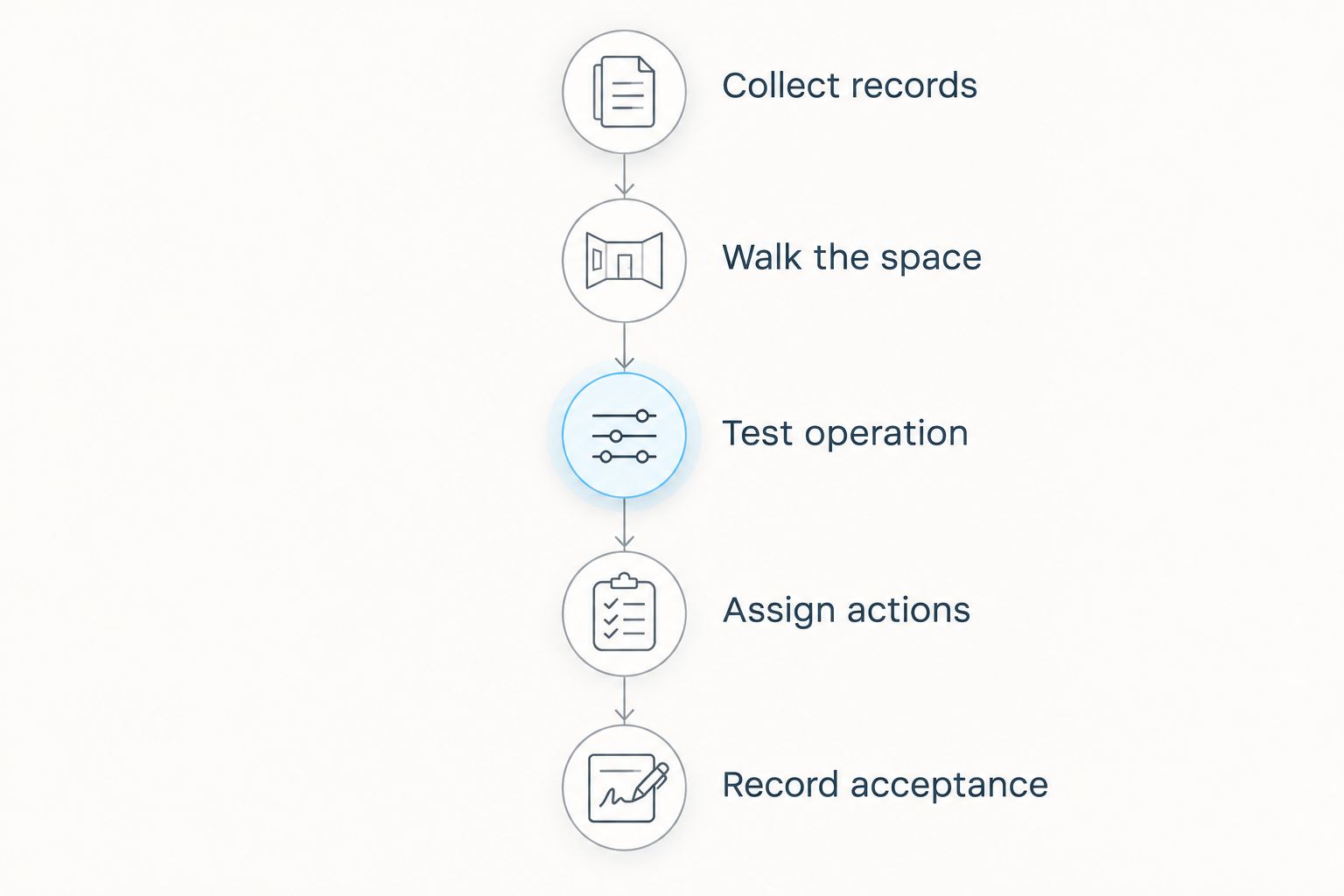
Keep the acceptance record and open-item register together. When someone later asks whether a correction was included, your team should not need to reconstruct the decision from scattered emails.
Why office handover requirements vary
The right handover package follows your project, not a generic template. These factors determine what you should request:
- Contract scope: Commercial general contractors owe the closeout deliverables established in their agreements; define them before signing.
- Existing conditions: Commercial renovation contractors need clear instructions for documenting retained systems and changes to existing work.
- Lease boundaries: Landlord-controlled systems require different access and service arrangements from tenant-controlled equipment.
- Installed systems: Controls, specialty equipment, and altered mechanical systems create different documentation and instruction needs.
- Approval pathway: Your permitted work and intended use determine which approval questions the project team must resolve.
- Operating responsibility: An owner-managed office and a professionally managed building need different recipient lists and escalation contacts.
Do not add irrelevant documents simply to make the package look larger. Require material your contract calls for and your operating team needs.
Who should lead the handover?
A and E Construction LLC is a fit for DC and Maryland owners seeking design-through-construction coordination for a defined office build out. The company offers general contracting, construction management, architectural design, MEP engineering, and building maintenance services, supported by over 29 years of combined experience.
When discussing an office build out with A and E Construction LLC, ask which handover deliverables, demonstrations, and closeout responsibilities will appear in the proposal. Coordinated delivery helps organize responsibility, but it does not replace written scope, owner decisions, landlord requirements, or applicable approvals.
That is also the boundary to assess: a broad service offering alone does not establish what your specific agreement includes. Request named responsibilities rather than assuming every service continues after acceptance.
Define your office handover scope
Discuss a defined DC or Maryland project with A and E Construction LLC.
Can I move in before every punch-list item is finished?
Unfinished minor corrections and permission to occupy are separate questions. Before moving in, confirm applicable occupancy authorization, safe operation, landlord conditions, and the contract's treatment of outstanding work with the responsible professionals.
Who handles problems after the contractor leaves?
Responsibility follows the contract, warranty terms, equipment requirements, and landlord-tenant boundaries. Assign a contact for reporting defects and distinguish corrective work from routine building maintenance services before handover.
Should final payment wait until all documents arrive?
Final payment follows your agreement, not a universal handover rule. Have the contract administrator verify required closeout submissions, remaining work, and payment conditions before authorizing release.
FAQ
What should I bring to an office build-out handover?
Bring the agreed scope, relevant drawings, lease responsibility schedule, and an open-item checklist. Include someone authorized to make acceptance decisions and someone responsible for operating the office.
Does getting the keys mean my DC office is approved for occupancy?
Getting the keys does not establish occupancy authorization. Confirm the applicable requirements and project records with the responsible DC authority and project professionals.
Do I need as-built drawings for an office renovation?
Request the record drawings required by your contract and clarify their coverage. Ask who prepared them and whether they document reported changes or verified installed conditions.
What belongs on an office build-out punch list?
A punch list should identify incomplete work, defects, missing documents, and unresolved demonstrations. Each item needs a location, responsible party, agreed correction, and verification method.
Who should receive equipment manuals and warranties?
The owner or authorized property manager should receive the required manuals and warranties, with usable copies available to the operating team. Match each document to the installed equipment.
Can a contractor handover replace landlord approval?
A contractor handover does not replace landlord approval. Review the lease and building requirements separately from construction acceptance and government approvals.
What should I check before accepting controls access?
Check that authorized staff can sign in, perform permitted tasks, and identify who manages account changes. Transfer credentials securely and document responsibility for future access.
One last thing
The easiest handover defect to overlook is missing information. A functioning thermostat still leaves your property manager stuck if nobody knows who controls its schedule or handles a fault.
For a 2026 handover, ask the person who will manage the office to locate a manual, identify a service contact, and demonstrate an authorized control task before acceptance. That practical check exposes gaps a visual walkthrough misses.