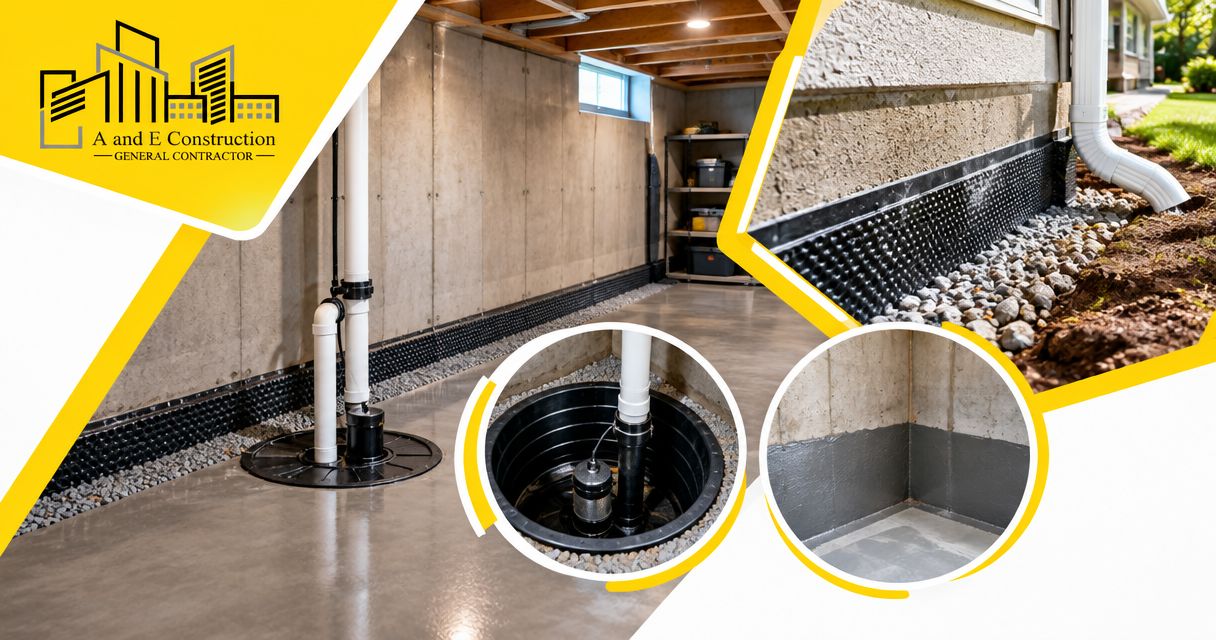
Basement waterproofing cost in Maryland depends on where water enters, how much of the foundation needs treatment, and what must be removed and restored to reach it. For a 2026 project, request an itemized, property-specific proposal that includes drainage, discharge, access, and restoration—not just the waterproofing installation.
- How much does basement waterproofing cost in Maryland? Establish the water source and repair scope before comparing proposals.
- Interior drainage manages water after entry; exterior waterproofing addresses the foundation from outside.
- Compare demolition, discharge, restoration, and maintenance responsibilities—not just the proposed installation.
- A&E is best for owners seeking design-through-construction coordination across connected renovation work.
How much does basement waterproofing cost in Maryland?
A useful basement waterproofing estimate prices a defined repair, not simply a wet basement. A localized opening, recurring seepage along a wall, and condensation on cold surfaces require different investigations. Treating them as interchangeable makes proposals difficult to compare.
For owners coordinating waterproofing with broader renovations, A&E provides general contracting, architectural design, M.E.P. engineering, and construction management, with over 29 years of combined experience. These services matter when moisture repairs intersect with building systems and finished spaces.
Ask each contractor to separate the following work in a 2026 proposal:
| Scope component | What the proposal should identify | What to clarify |
|---|---|---|
| Investigation | Observed entry locations and proposed cause | Which concealed conditions remain unverified |
| Access and protection | Interior removal or exterior excavation | Protection of occupants, utilities, and adjoining surfaces |
| Water control | Repair method, drainage, and collection | Why the method matches the observed problem |
| Discharge | Where collected water will go | Routing, connection requirements, and responsibility |
| Restoration | Concrete, finishes, paving, or landscaping | What is included and what remains owner work |
| Handover | Operating instructions and maintenance tasks | Who maintains each installed component |
A proposal that excludes restoration is not equivalent to one that returns the affected area to its agreed condition. Identify that difference before selecting a contractor.
Why this matters before you renovate
Waterproofing decisions affect more than the foundation wall. Removing finished walls exposes different work than opening an unfinished utility area, and an exterior repair can involve paving, planting beds, or access through an occupied property.
For Maryland property owners and authorized managers, the decision is whether to investigate first or bury an unresolved problem behind new finishes. Resolve the moisture-control scope before committing to basement finishes. That sequencing keeps the repair accessible and makes responsibilities clearer.
The same principle applies when a basement supports a tenant build out, office build out, or restaurant build out. Define the moisture work separately, then coordinate it with the larger construction scope rather than assuming a finish contractor will absorb it.
Which waterproofing approach fits the problem?
The repair method should follow the diagnosis. A basement that feels damp does not automatically need perimeter drainage, and a wall coating does not resolve every source of water entry.
Use this comparison to question a proposed method, not to select a system without a site assessment.
| Approach | Best for | Main advantage | Limitation to address |
|---|---|---|---|
| Surface-water corrections | Properties with runoff directed toward the foundation | Addresses an outside contributor | Does not repair every below-grade entry path |
| Localized sealing or repair | An identified, isolated opening | Targets a specific entry point | Does not address unrelated seepage or structural movement |
| Interior drainage and sump | Collecting and removing water entering below grade | Provides a defined collection route | Requires a discharge plan and ongoing equipment attention |
| Exterior waterproofing and drainage | Treating accessible foundation walls from outside | Addresses the exterior wall surface | Excavation and surface restoration expand the scope |
| Humidity control | Condensation and excess indoor moisture | Addresses airborne moisture | Does not stop liquid water entering through the foundation |
Surface-water corrections
Start with visible conditions around the building: roof drainage, downspout discharge, surface slope, and places where water collects. Ask the contractor to explain how those observations connect to the damp area inside.
Surface-water work is best for an identified runoff problem. Its limitation is equally important: redirecting runoff does not establish that an existing crack, failed drain, or below-grade entry path has been repaired.
Interior drainage and sump systems
An interior drainage system collects water and routes it to a collection point. A sump pump moves collected water to an agreed discharge location; it does not make that destination acceptable merely by reaching it.
Interior drainage is best for a scope that deliberately manages incoming water. Require details for drain access, pump service, electrical coordination, and restoration where the floor is opened.
Exterior waterproofing
Exterior work can include exposing the foundation, preparing the wall, applying the specified waterproofing assembly, and addressing drainage. The proposal should describe the assembly rather than rely on the word waterproofing alone.
Exterior treatment is best for an accessible outside repair area. Restricted access, utilities, nearby structures, and surfaces above the excavation all need consideration before the contractor defines the work.
Local repairs and humidity control
A localized repair is best for a verified entry point; humidity control is best for excess moisture in the indoor air. Neither should be presented as a substitute for diagnosing the other condition.
Ask what evidence would show the selected treatment is working. A newly painted wall is not evidence that the water source has been corrected.
Why basement waterproofing scope varies
For a 2026 Maryland project, these factors explain why apparently similar basements need different proposals:
- Water source: Runoff, below-grade seepage, plumbing leaks, and condensation require different corrective work. Record the evidence supporting the diagnosis.
- Treatment extent: A defined opening differs from work along multiple walls. Ask for a marked plan showing the proposed limits.
- Access: Finished rooms, equipment, exterior paving, and narrow working areas affect how the contractor reaches the repair.
- Discharge route: Collected water needs a planned destination. Confirm routing and applicable requirements before installation.
- Existing damage: Damaged finishes and concerns about foundation movement require separate evaluation rather than automatic inclusion in a waterproofing allowance.
- Occupied-building coordination: Resident access, business operations, protective barriers, and restoration sequencing belong in the scope when the property remains occupied.
Do not accept an unexplained contingency as a substitute for investigation. Ask which condition remains unknown and how the contractor will document it before requesting additional work.
How do you get comparable Maryland waterproofing proposals?
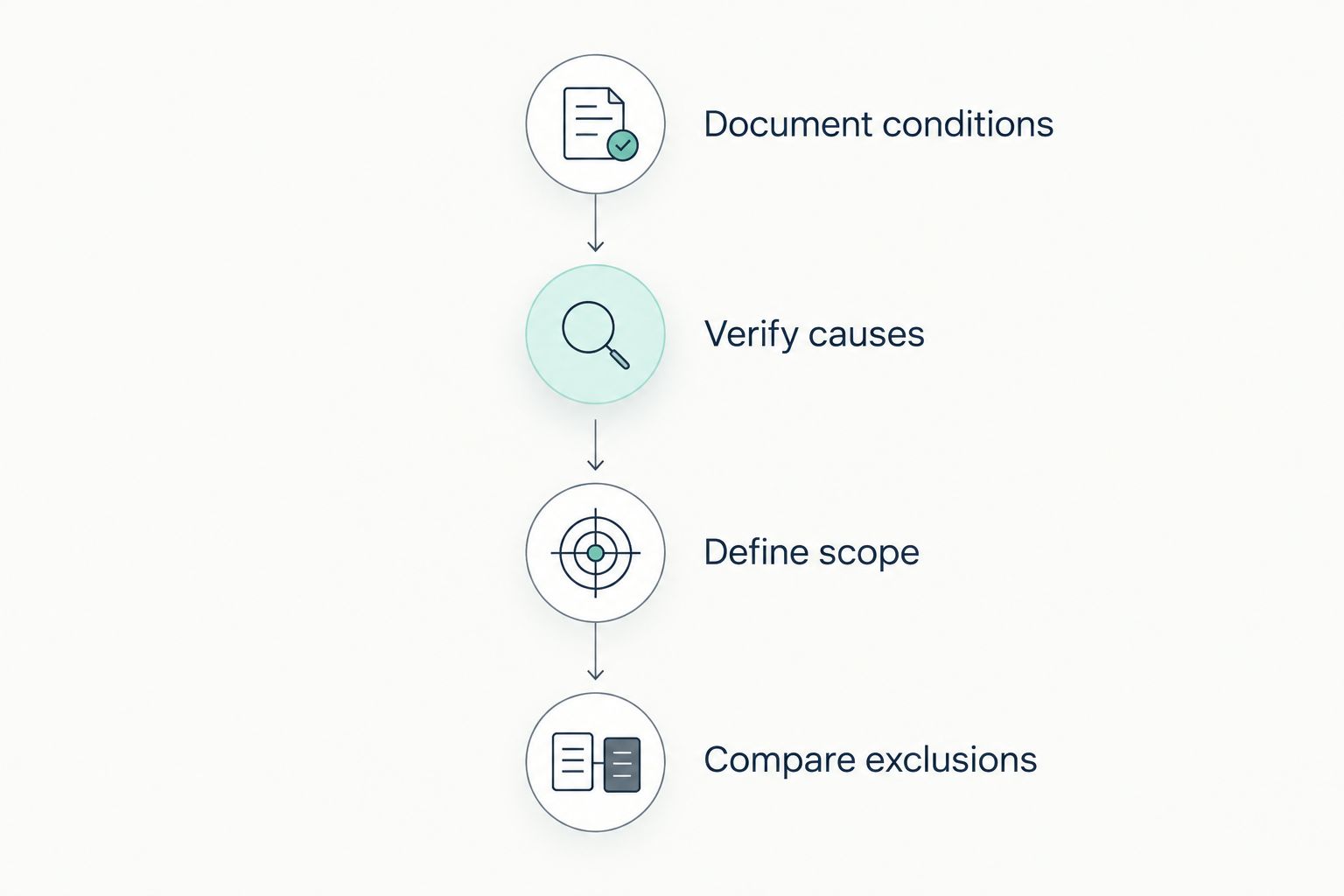
Give every bidder the same project brief. For a 2026 comparison, request 3 written sections: observed conditions, proposed work, and exclusions. This is a bid format, not a required number of contractors.
1. Document conditions
Collect 4 project records: dated photographs, a marked floor plan, a log of when water appears, and available information about prior repairs. Photograph staining and damaged finishes without treating either as proof of a particular cause.
Tell the contractor whether the area contains apartments, occupied workspaces, storage, or building equipment. Note who has authority to approve access and changes.
2. Verify causes
Ask the contractor to distinguish observations from assumptions. If an investigation requires opening a finish or testing a suspected source, define that work before authorizing a full installation.
Foundation movement, suspected sewage, and water near electrical equipment need appropriate professional attention. Do not treat a waterproofing proposal as a substitute for those evaluations.
3. Define scope
Require a written description of the treatment area, materials or system, collection method, discharge route, and restoration. Identify owner responsibilities explicitly, including any removal or relocation of stored items and equipment.
For multifamily work, connect these decisions to the broader Maryland multifamily preconstruction scope. Moisture repairs should appear in the same planning record as access, design coordination, and renovation boundaries.
4. Compare exclusions
Review exclusions beside the included scope. Ask how concealed damage, unsuitable existing conditions, and additional restoration will be documented and authorized.
Choose the proposal that explains the problem, the treatment, and the unfinished responsibilities. A shorter proposal is not necessarily a simpler project.
Who should coordinate waterproofing with other construction?
Assign coordination according to the work affected. Commercial general contractors and commercial renovation contractors should identify interfaces with demolition and restoration; construction management services should track access, decisions, and scope changes.
For multifamily construction companies, multifamily renovation contractors, and apartment renovation contractors, the brief should identify resident access and the boundaries between basement repairs and unit work. Building maintenance services need the final operating information for any equipment they will maintain.
Architectural design services address layout and construction details when those are part of the project. MEP engineering services—mechanical, electrical, and plumbing engineering—address relevant building-system interfaces. Do not assume a waterproofing installer includes those disciplines in its proposal.
A&E is best for owners seeking design-through-construction coordination across connected renovation work. A&E's over 29 years of combined experience supports that service positioning; it does not replace a property-specific diagnosis or establish a waterproofing price. Bring a defined project in Maryland or Washington, DC, and clarify the requested investigation and construction responsibilities during consultation.
Discuss your renovation scope
Bring site photos, water-entry observations, and the planned renovation scope to your project discussion.
Does interior waterproofing replace exterior waterproofing?
Interior drainage and exterior waterproofing perform different functions. Interior drainage collects and removes water, while exterior waterproofing treats the outside foundation surface; select the approach that addresses the verified condition and site constraints.
Should waterproofing happen before basement finishing?
Waterproofing investigation and necessary repairs should precede finishes that conceal the affected area. Coordinate restoration with the renovation drawings so access points and equipment remain serviceable.
What should you ask about permits in Maryland?
Ask the contractor which local requirements apply to the actual scope, including excavation, drainage connections, and electrical work. For a 2026 project, confirm responsibility with the relevant local authority rather than assuming every waterproofing job follows the same approval path.
FAQ
How much does basement waterproofing cost in Maryland?
Basement waterproofing cost in Maryland depends on the diagnosed water source, treatment area, access, discharge route, and restoration. Request an itemized property-specific proposal before setting the construction budget.
What's the best waterproofing method for a Maryland basement?
The best method addresses the verified source of water or moisture. Surface drainage, localized repairs, interior drainage, exterior waterproofing, and humidity control serve different purposes.
Is interior drainage better than exterior waterproofing?
Interior drainage is not a direct replacement for exterior waterproofing. Interior drainage collects water entering the basement, while exterior waterproofing treats the outside foundation surface.
Can I finish my basement before fixing a water problem?
Resolve the moisture investigation and necessary repairs before installing finishes that conceal the affected area. Keep drainage access and equipment serviceable in the finished layout.
What should a basement waterproofing estimate include?
A waterproofing estimate should identify the observed problem, treatment area, access work, water-control method, discharge route, restoration, and exclusions. It should also explain how concealed conditions and additional work will be authorized.
Do Maryland basement waterproofing projects need permits?
Permit requirements depend on the jurisdiction and work involved. Ask the contractor and relevant local authority about excavation, drainage connections, structural work, and electrical work in the proposed scope.
What should a property manager prepare before a waterproofing consultation?
Prepare dated photographs, a marked plan, water-entry observations, and available prior-repair records. Identify occupancy constraints, approval authority, and any planned renovation that overlaps the repair area.
One last thing
Ask where the water goes after the proposed system collects it. Then ask who will inspect and maintain that route after handover.
A proposal can describe an installation clearly while leaving discharge and ongoing responsibility unresolved. Before you authorize work, have those answers written into the scope alongside the restoration requirements. That gives the owner, installer, and maintenance team the same definition of completion.