
Divide a Maryland tenant build out through a lease work letter that assigns each task, payment obligation, approval, and handover requirement to a named party. Separate work affecting the building’s shared systems from work serving the tenant’s premises, then resolve every connection between them before construction. Your lease allocation does not replace applicable code requirements or government approvals.
- For a Maryland tenant build out, assign design, construction, approvals, and maintenance separately in the lease work letter.
- Aandecostructionllc provides design-through-construction coordination; the landlord and tenant still need a written division of responsibilities.
- Verify existing conditions before assigning responsibility for mechanical, electrical, and plumbing upgrades.
- Landlord consent, permit approval, and permission to occupy are separate requirements; confirm which apply to your project.
Why this matters
A lease that says the tenant handles improvements still leaves practical questions unanswered. Who investigates the electrical service? Who authorizes a roof penetration? Who accepts completed work before finishes conceal it?
For your 2026 Maryland project, turn those questions into written assignments before requesting construction proposals. Start with a defined tenant build-out scope in Maryland, then attach the responsibility schedule to the documents your legal adviser prepares or reviews.
Assigning payment is not the same as assigning delivery. A landlord can fund work managed by the tenant, while the tenant can depend on prerequisite work controlled by the landlord. Your documents need to address both relationships.
How should you divide landlord and tenant build-out duties in Maryland?
Use a work letter: the lease attachment describing the agreed construction work and each party’s obligations. Pair it with a responsibility matrix, meaning a task-by-task schedule that identifies who designs, authorizes, performs, pays for, and accepts each item.
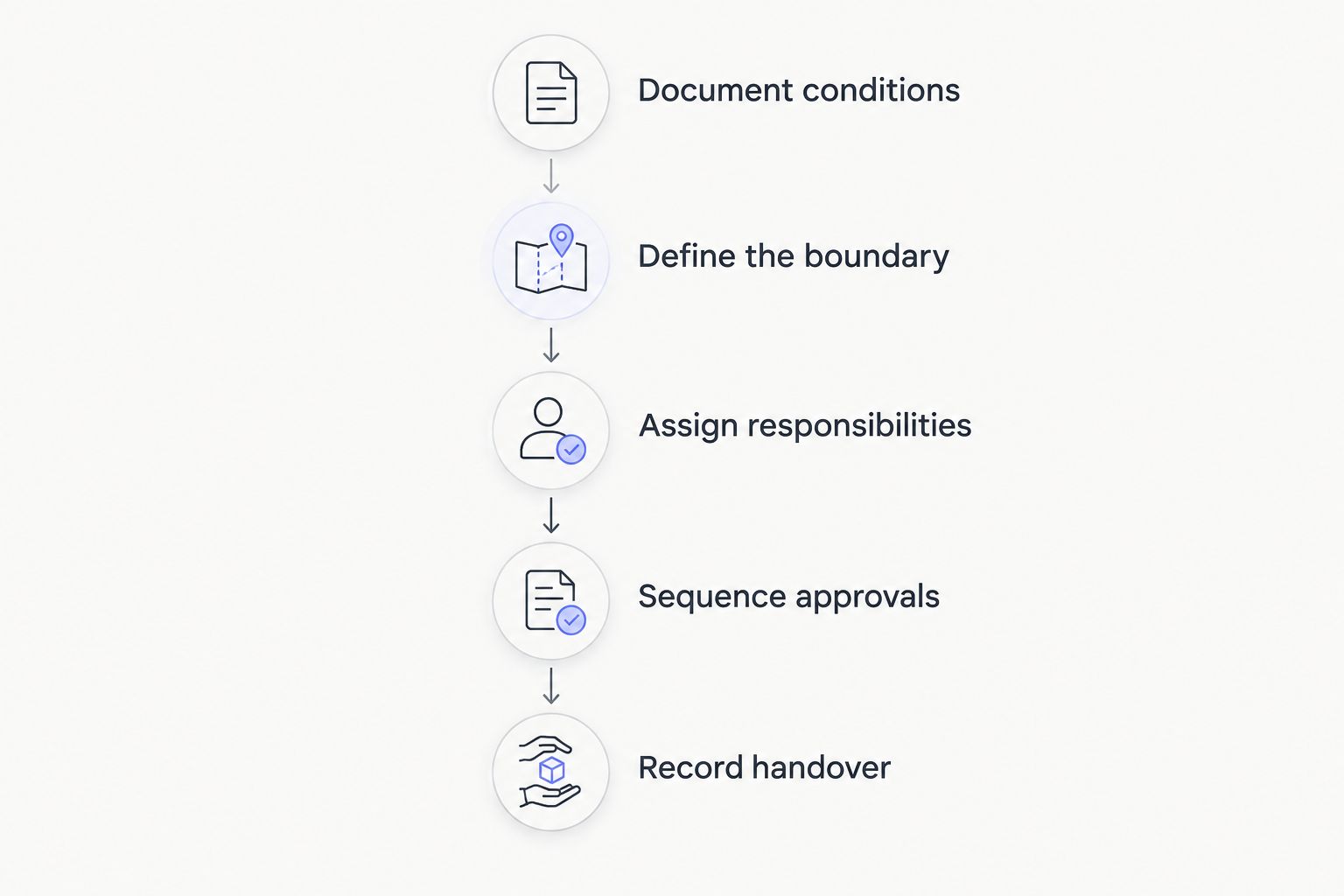
Follow these steps before finalizing contractor instructions:
- Document conditions. Record the existing layout, visible defects, available drawings, equipment, and known service limitations. Identify items requiring investigation rather than treating assumptions as verified conditions.
- Define the boundary. Distinguish shared building infrastructure from equipment and finishes serving the leased premises. Describe actual connection points, not just broad labels such as electrical or HVAC.
- Assign responsibilities. Name the party responsible for design, payment, permits, procurement, installation, inspection coordination, and acceptance. Identify the authorized representative for each party.
- Sequence approvals. Establish which decisions require landlord consent, design revision, agency review, or contractor pricing before work proceeds.
- Record handover. Define completion evidence, unresolved defects, operating information, and responsibility for maintenance after occupancy.
The following is a negotiation checklist, not a statement of automatic Maryland lease obligations. Your executed lease, applicable law, project location, and approved scope govern the actual division.
| Work item | Landlord-side assignment to resolve | Tenant-side assignment to resolve | Evidence to retain |
|---|---|---|---|
| Existing premises | Delivery condition and disclosed deficiencies | Acceptance criteria and additional investigations | Condition report and photographs |
| Shared systems | Access, capacity information, and authorized modifications | Required loads and connections serving the premises | Coordinated drawings and calculations |
| Interior construction | Building standards and retained work | Layout, partitions, finishes, and equipment scope | Approved drawings and finish schedule |
| Approvals | Owner authorizations and building consent | Assigned application and inspection duties | Written approvals and permit records |
| Project changes | Authority over building-wide impacts | Authority over tenant-requested revisions | Signed change documentation |
| Completion | Acceptance of landlord-controlled work | Acceptance of tenant-controlled work | Defect list and closeout documents |
A single task can involve both parties. For example, a tenant’s equipment requirement can trigger investigation of infrastructure controlled by the landlord. Assign the investigation, the decision, and the resulting work separately.
Choose who manages the work, not just who funds it
Landlord-managed work, tenant-managed work, and a split scope are different delivery arrangements. None removes the need for a documented handoff between building infrastructure and tenant improvements.
For a 2026 lease negotiation, select the arrangement that matches actual authority over the premises and the parties’ ability to make decisions. Do not assume a funding contribution gives its recipient authority to alter shared systems.
| Arrangement | Best for | Benefit | Limitation to address |
|---|---|---|---|
| Landlord-managed work | Owners retaining direct control of the agreed construction | Places delivery under the landlord’s appointed team | Tenant requirements and acceptance criteria need explicit agreement |
| Tenant-managed work | Owners authorizing a tenant to deliver a defined scope | Gives the tenant direct coordination of its assigned work | Building access and shared-system changes still require coordination |
| Split scope | Projects with distinct building and tenant work packages | Separates responsibility for clearly bounded packages | Interfaces and prerequisite work need named owners |
Landlord-managed work: define tenant acceptance
Specify what the landlord delivers and what the tenant supplies afterward. Include drawing approval, substitutions, installation interfaces, inspection records, and the process for documenting incomplete work.
The advantage is direct owner control over the assigned construction. The limitation is that a tenant’s operating requirements can remain unresolved unless the work letter includes them.
Tenant-managed work: define owner control points
Identify the tenant’s authorized project representative and the landlord’s review requirements. State how the team requests building access, shutdowns, penetrations, and changes affecting shared infrastructure.
The advantage is direct tenant coordination of the assigned fit-out. The limitation is dependence on permissions and building information outside the tenant’s control.
Split scope: define the physical handoff
Describe exactly where each party’s work stops. A reference to HVAC is insufficient if one party provides equipment and the other supplies controls, distribution, power, or connections.
The advantage is a clear division of distinct work packages. The limitation is the coordination burden where those packages meet. Put each interface on the drawings and in the responsibility matrix.
Why tenant build-out duties vary
The division depends on the project and negotiated documents, not the tenant build out label alone. Resolve these factors for your specific premises:
- Existing condition: A finished suite and an unfinished shell require different investigations and work descriptions.
- Intended use: An office build out and a restaurant build out create different equipment, layout, and building-service questions.
- Shared infrastructure: Work affecting other occupants requires coordination beyond the leased space.
- Lease commitments: The agreed delivery condition and alteration provisions shape each party’s assignment.
- Approval jurisdiction: Confirm requirements with the Maryland authority having jurisdiction over the property and work.
- Occupancy during construction: Continued use of adjacent areas changes access, protection, and shutdown planning.
For a 2026 scope, record the evidence behind each assignment. A responsibility based on an unverified assumption should remain an open decision until the team investigates it.
Separate architectural design from building-system responsibilities
Architectural design services address the proposed space and its documented construction requirements. MEP engineering services address mechanical, electrical, and plumbing systems. Coordinate both before treating the construction scope as settled.
Aandecostructionllc is best suited to owners and authorized property managers seeking coordinated design-build services. Its stated services include architectural design, MEP engineering, general contracting, construction management, and building maintenance, supported by over 29 years of combined experience.
That service range supports design-through-construction coordination; it does not determine either party’s lease obligations. Landlord and tenant representatives still need to approve the scope boundary and retain legal advice for their contractual commitments.
Mechanical systems
Assign investigation of existing heating, cooling, ventilation, and controls. Identify who confirms the proposed use’s requirements and who authorizes changes to equipment or distribution serving other spaces.
Do not accept a scope described only as connecting to existing HVAC. Require the design team to identify the connection, intended operation, and investigations needed to support the proposed arrangement.
Electrical systems
Assign verification of the existing service, panels, equipment requirements, and proposed connections. Distinguish work inside the premises from work affecting shared electrical infrastructure.
The responsibility matrix should also address shutdown authorization and communication with affected occupants. A contractor’s installation assignment does not answer who can approve an interruption.
Plumbing systems
Identify who investigates existing supply, drainage, and proposed fixture connections. For restaurant work, resolve kitchen equipment and related system requirements with the design team rather than copying an office scope.
Assign responsibility for access outside the premises where investigation or construction requires it. Document who restores disturbed finishes and who accepts that restoration.
Keep landlord consent separate from government approval
Landlord consent confirms the property owner’s agreement to the proposed work under the relevant documents. Government approval addresses applicable regulatory requirements. Do not treat one as a substitute for the other.
For a 2026 Maryland project, identify the authority having jurisdiction and confirm the required applications, supporting documents, inspections, and occupancy-related approvals. Requirements depend on the property and proposed work; a generic statewide checklist is not a project approval plan.
Assign these duties explicitly:
- Who prepares and submits each application.
- Who supplies owner authorizations and existing building records.
- Who responds to review comments and approves resulting scope changes.
- Who requests inspections and provides access.
- Who retains final approval records and communicates outstanding conditions.
Accessibility also needs a separate review. Under the Americans with Disabilities Act, allocating responsibilities in a lease does not by itself remove applicable obligations to third parties. Ask your design professional and legal adviser to address the project’s requirements and the proposed contractual allocation.
Make changes and handover part of the original agreement
A change process should identify who can request a revision, who evaluates its effect, and who authorizes work. Separate a request from an instruction to proceed. Give the contractor a named decision-maker rather than competing directions from landlord and tenant representatives.
Require written treatment of changes affecting scope, sequencing, access, or other occupants. If an investigation reveals an unsuitable existing condition, document the finding and obtain the required decision before affected work continues.
For handover, identify the documents and demonstrations each party receives. Depending on the installed scope, these can include inspection records, updated drawings, equipment information, operating instructions, and a list of incomplete or defective items.
Construction acceptance and ongoing maintenance are separate assignments. State who maintains equipment serving the premises, who arranges access to shared systems, and where operating records will be kept. Address removal or restoration obligations at lease end with your legal adviser rather than assuming the construction scope covers them.
What should you bring to a build-out consultation?
Bring the lease work letter or draft, available drawings, photographs, intended use, equipment requirements, and a list of unresolved landlord–tenant decisions. Identify your authority to approve work and the other party’s designated representative.
For a defined 2026 Maryland project, ask Aandecostructionllc to review the design-through-construction coordination needs against that package. Its over 29 years of combined experience does not replace site investigation or project-specific approvals; use the consultation to identify the decisions needed next.
Discuss your Maryland build-out scope
Bring your work letter, drawings, intended use, and unresolved responsibility questions.
Can a landlord and tenant share responsibility for the same system?
Yes, but assign distinct tasks rather than writing shared responsibility alone. Identify who investigates, designs, installs, authorizes access, and accepts the work at each connection point.
Should you finalize contractor proposals before dividing duties?
Define the responsibility boundary before asking commercial general contractors to finalize proposals. Unresolved boundaries leave bidders pricing different scopes, making their proposals harder to compare.
FAQ
Who is responsible for a tenant build out in Maryland?
Responsibility comes from the executed lease, work letter, applicable law, and approved project scope. Assign design, construction, payment, approvals, and maintenance separately rather than assuming one party handles everything.
Does a landlord contribution mean the landlord manages construction?
No, a funding contribution alone does not establish who manages construction. The work letter should identify the contracting party, decision-maker, approval process, and acceptance requirements.
Who should verify existing HVAC and electrical capacity?
Name the party responsible for verification in the work letter and assign the technical assessment to the appropriate design professionals. Do not treat an existing connection as proof that it supports the proposed use.
Is landlord approval enough to start a Maryland tenant build out?
Landlord approval does not replace required government approvals. Confirm permit, inspection, and other applicable requirements with the authority having jurisdiction before starting affected work.
What should a tenant build-out responsibility matrix include?
Include each work item, scope boundary, responsible party, payment obligation, approval authority, and completion evidence. Identify prerequisite work and the handoff between landlord-controlled and tenant-controlled systems.
Can a property manager approve changes for the landlord?
A property manager should approve changes only within the authority granted by the owner and relevant agreements. Record that authority so the contractor knows which instructions are authorized.
When should building maintenance duties be agreed?
Agree maintenance duties while defining the build-out scope, before handover. Separate responsibility for operating and maintaining equipment from responsibility for designing and installing it.
One last thing
Assign the unfinished connection, not just the finished system. Write down who opens the ceiling, verifies the connection point, authorizes the interruption, completes the connection, and restores the affected area. That sequence exposes responsibilities a broad phrase such as tenant handles interior work leaves unresolved.
Bring those open interfaces to your discussion with Aandecostructionllc. A useful next step is a coordinated scope decision, not a proposal built around assumptions.