
Compare multifamily renovation contractors in Maryland by requiring the same written scope, then checking exclusions, resident-access plans, design responsibilities, and change procedures before selecting a bid. A proposal is not comparable until you know which work it includes and which decisions, approvals, and existing conditions remain unresolved.
- Compare multifamily renovation contractors against one scope, not differently defined projects.
- Require apartment renovation contractors to explain resident access, shutdowns, protection, and turnover responsibilities.
- Separate included work, allowances, exclusions, and unresolved conditions before choosing a contractor.
- A&E Construction LLC suits owners seeking design-through-construction coordination for defined renovation projects.
How do you compare multifamily renovation bids in Maryland?
Start with a shared scope and require every bidder to respond to it in writing. For your 2026 procurement file, keep the drawings, specifications, site information, questions, and bid revisions together so the eventual contract reflects the same project you evaluated.
If the apartment work is not yet clearly defined, first establish the scope of apartment turnover renovations in Maryland. Comparing proposals before that step leaves you comparing different assumptions rather than different contractors.
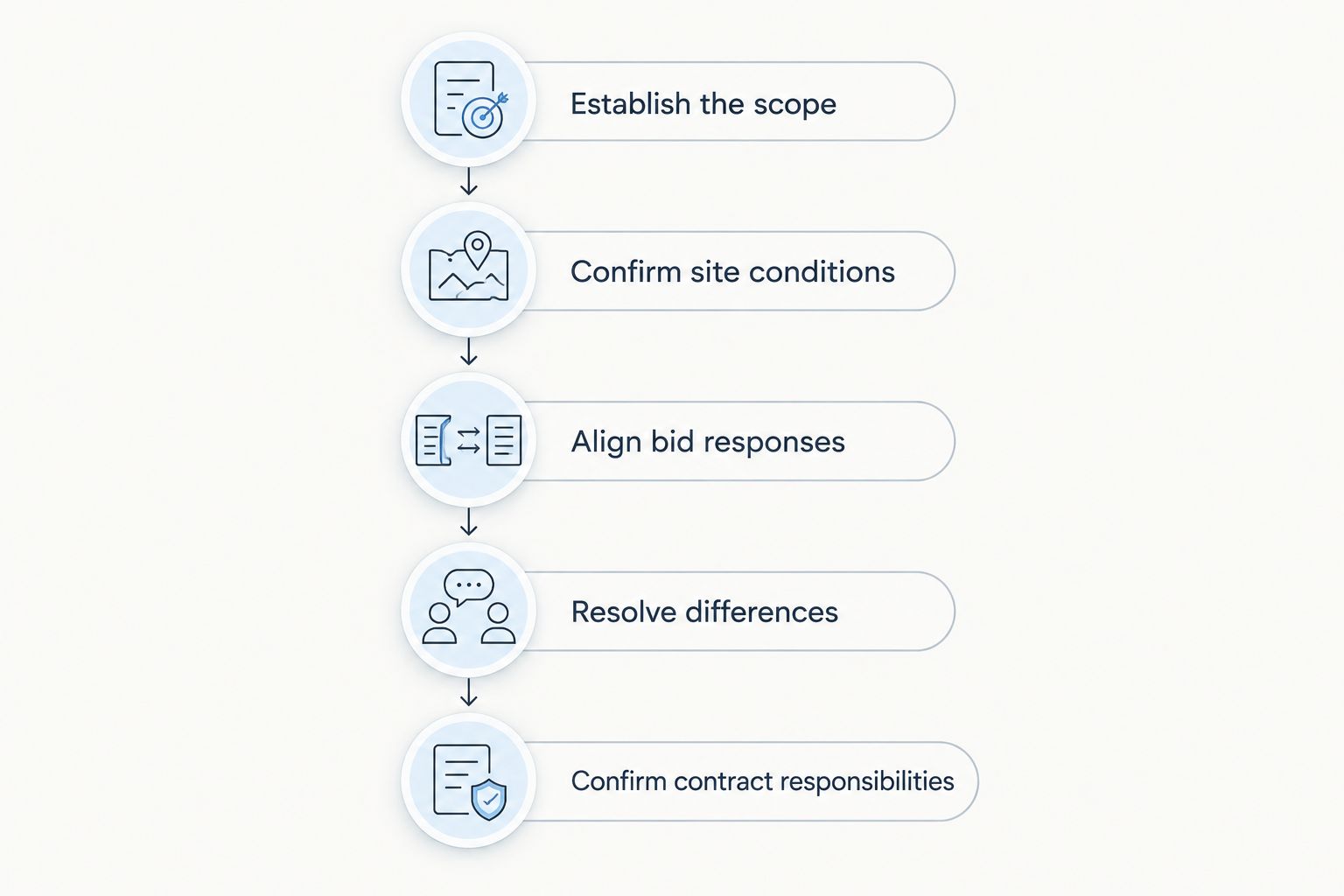
1. Establish the scope
Identify the property, affected apartments, common areas, and building systems. State whether work happens in vacant apartments, occupied apartments, or both, and distinguish required repairs from optional improvements.
Give bidders the same finish selections and installation requirements. A flooring description should address demolition, substrate preparation, transitions, and disposal—not simply name the finished surface. Define which existing items remain and how workers must protect them.
2. Confirm site conditions
Arrange access to representative work areas and explain where conditions differ. An apartment inspected during bidding does not establish the condition of every concealed pipe, wall, or electrical connection elsewhere in the building.
Ask each bidder to identify what was inspected and what remains unverified. Record assumptions about concealed conditions, equipment reuse, access restrictions, and existing drawings. Send material clarifications to every bidder rather than leaving them in individual conversations.
3. Align bid responses
Request a common response format covering demolition, architectural work, mechanical work, electrical work, plumbing, protection, supervision, and closeout. Mechanical means systems such as heating, ventilation, and air conditioning; closeout means the documents and final tasks needed to hand the work back.
Require separate descriptions for included work, exclusions, allowances, and alternates. An allowance is a placeholder for an unresolved selection or scope item. An alternate is a separately identified change to the base proposal that you can accept or reject.
4. Resolve differences
Build a comparison worksheet and mark each requirement as included, excluded, conditional, or unanswered. Ask bidders to resolve gaps through written revisions, not verbal assurances.
Do not create your own estimate for omitted work and treat it as the contractor's commitment. Require the bidder to state the scope and contractual treatment. Otherwise, your comparison appears complete while the proposal remains incomplete.
5. Confirm contract responsibilities
Before selecting a contractor, reconcile the final proposal with the proposed contract. Confirm who coordinates design, obtains required approvals, communicates with residents, authorizes changes, and accepts completed work.
Identify the owner's authorized decision-maker. A property manager coordinating access is not automatically the person authorized to change the construction scope. The contract should make that distinction explicit.
Why this matters
A renovation bid describes a proposed obligation, not just a finished appearance. Two contractors can propose similar-looking kitchens while assigning different responsibilities for wall repairs, electrical changes, protection, and disposal.
Choose the clearest complete scope, not the shortest proposal. Your 2026 bid review should expose unresolved obligations before they become contract disagreements. That means examining how the contractor intends to deliver the work as closely as the materials the contractor proposes to install.
Use a side-by-side bid comparison worksheet
Give each contractor a column in your worksheet and use the same questions throughout. Keep the supporting proposal references beside each answer so your selection remains traceable.
| Review item | Clear response | Response requiring clarification |
|---|---|---|
| Work locations | Identifies apartments, rooms, and common areas | Refers generally to the property |
| Demolition | Defines removals, protection, and disposal | Lists demolition without boundaries |
| Finishes | Identifies materials and preparation | Names finishes without installation scope |
| Building systems | Defines modifications and trade responsibilities | Assumes existing systems are suitable |
| Occupied work | Describes access, protection, and shutdown coordination | Leaves resident coordination undefined |
| Design and approvals | Assigns responsibilities and deliverables | States that approvals are by others without detail |
| Changes | Explains authorization and documentation | Leaves the change process unwritten |
| Handover | Defines inspections, corrections, and documents | Treats installation as the only completion condition |
A detailed response has an advantage: you can test it against the project requirements. Its limitation is that detail alone does not prove the proposed approach is appropriate. Check whether the listed work actually addresses the conditions at your property.
A brief proposal takes less time to read, but it gives you less basis for resolving disagreements. Ask for clarification rather than interpreting silence as inclusion. Record every accepted clarification in the contract documents.
Compare delivery approaches without assuming one always wins
Multifamily renovation contractors do not all offer the same delivery structure. Decide whether you need construction against completed plans or coordination that starts while design decisions remain open.
| Delivery approach | Best for | Advantage | Limitation to address |
|---|---|---|---|
| Construction against completed plans | Owners with a defined, coordinated design | Provides a shared bidding basis | Incomplete plans still leave scope gaps |
| Design-build | Owners seeking coordinated design and construction responsibilities | Connects design decisions with construction planning | Requires clear design deliverables and acceptance points |
| Construction management services | Owners needing help organizing project decisions and oversight | Adds a defined coordination role | Authority and overlap with other parties must be documented |
Use design-build when you need coordinated design and construction responsibilities; use completed-plan bidding when your design is ready for a common tender. Neither approach removes the need for a written scope or owner decisions.
A&E Construction LLC provides design-through-construction coordination and has over 29 years of combined experience. That experience is a relevant qualification to discuss, not a substitute for checking the proposed team, scope, and responsibilities for your building. Combined experience does not mean years in business.
Why multifamily renovation bids vary
Different bids often reflect different project definitions. Check these scope drivers before deciding that a contractor has simply proposed a different way to perform identical work:
- Existing conditions: Distinguish visible repairs from work dependent on opening walls, floors, or ceilings. Require a documented process for concealed conditions.
- Occupied work: Define resident access, temporary protection, daily cleanup, and coordination of interruptions to building services.
- Design responsibility: Identify whether architectural design services and MEP engineering services are included, separately appointed, or still undefined.
- Material scope: Align finish selections, substrate preparation, installation details, and treatment of damaged surrounding surfaces.
- Phasing: Establish which areas can be worked on together and which must remain accessible or operational.
- Handover requirements: State the inspection, correction, training, and document requirements that apply before acceptance.
For a 2026 comparison, attach the same current project information to every clarification request. If the scope changes during bidding, ask every remaining bidder to acknowledge the revision and update the affected sections.
Check occupied-building plans before accepting a schedule
A construction schedule is useful only when its access assumptions match your property. Ask multifamily renovation contractors to explain how workers, residents, deliveries, waste removal, and building operations share the site.
Require the proposal to address the following decisions:
- Who arranges apartment entry and communicates access requirements?
- Which corridors, entrances, and shared facilities must remain usable?
- Who coordinates planned interruptions to water, power, or heating and cooling?
- How are work areas separated from occupied areas?
- Where are materials stored and waste collected?
- Who confirms that an apartment or common area is ready to return to use?
Do not accept an occupied-work plan that depends on access you cannot provide. Resolve that mismatch before award, and make the agreed access conditions part of the contract.
A proposed sequence is not a guaranteed completion date. Check dependencies such as owner selections, design completion, required approvals, and access before treating a schedule as a reliable planning document.
Separate construction scope from ongoing maintenance
Renovation and building maintenance services meet different needs. Renovation delivers defined changes; maintenance addresses recurring care and operating needs. The handover should make clear where the renovation contractor's responsibilities end and the owner's operating responsibilities begin.
For equipment or systems affected by the work, request the applicable operating information and identify who receives it. Ask whether training, testing records, and maintenance instructions are included where relevant. Do not assume that installing equipment includes an ongoing service arrangement.
This distinction also helps you compare apartment renovation contractors fairly. One proposal might include system modifications, while another only includes finishes around existing equipment. Those are different scopes even when the rooms look similar in the drawings.
What should you ask before choosing a finalist?
Ask each finalist to walk through the same unresolved items. Keep the discussion focused on your property rather than a general sales presentation.
Request relevant experience, the proposed project organization, supervision arrangements, and the process for coordinating trades. Verify any licensing, insurance, or other credentials applicable to the proposed work through the relevant issuing or verification source. A statement in a proposal is not independent verification.
Ask who will attend owner meetings and who can authorize field decisions. Then ask how the contractor records questions, substitutions, concealed conditions, and changes. These answers should describe a process you can use, not simply promise communication.
Owners and authorized property managers can discuss a defined Maryland or Washington, DC project with A&E Construction LLC. Bring the scope, available drawings, occupancy conditions, and unresolved design questions so the discussion addresses the actual project.
Discuss your renovation scope
Bring your project scope, drawings, occupancy constraints, and bid questions.
Should you choose the lowest multifamily renovation bid?
Choose a bid only after confirming that its included work and contractual responsibilities match your requirements. A proposal with unresolved exclusions is not equivalent to a complete proposal, regardless of its position in the bid comparison.
Document the reasons for your selection. Your 2026 award record should explain the accepted scope, remaining assumptions, agreed clarifications, and responsible parties—not just identify the selected contractor.
What if contractors include different materials?
Require a common base specification, then review substitutions separately. Ask for the proposed material, installation requirements, maintenance implications, and any related scope changes.
A substitution is not automatically a disadvantage. The problem is accepting a different specification without understanding what changed or recording your approval.
How should you handle exclusions and allowances?
Resolve exclusions against the required scope and identify who will perform any work that remains outside the contract. For allowances, document what is unresolved, who makes the selection, and how the final adjustment will be approved.
Do not treat an allowance as a finished specification. Keep it visible in the decision log until the selection and associated work are confirmed.
FAQ
How do I compare multifamily renovation contractors in Maryland?
Compare multifamily renovation contractors against the same written scope, site information, and response requirements. Resolve exclusions, allowances, access assumptions, and design responsibilities before selecting a bid.
What should an apartment renovation bid include?
An apartment renovation bid should identify work locations, demolition, finishes, building-system changes, protection, supervision, and handover requirements. It should also distinguish included work from exclusions and unresolved items.
Is design-build better than hiring a contractor after design?
Design-build fits projects needing coordinated design and construction responsibilities; completed-plan bidding fits projects with an established design. Both require clear deliverables and owner decision points.
Can I compare renovation bids while residents remain in the building?
Yes, but every bidder must use the same occupied-building requirements. Define apartment access, work-area protection, service interruptions, cleanup, and resident communication responsibilities.
Do multifamily renovation contractors include engineering?
Engineering is included only when the proposal expressly assigns that work. Confirm the mechanical, electrical, and plumbing engineering deliverables and who coordinates them with the construction scope.
How much experience does A&E Construction LLC have?
A&E Construction LLC has over 29 years of combined experience. Combined experience describes accumulated experience, not the company's years in business.
One last thing
Before signing, ask the selected contractor to identify every document that forms the agreed scope. A clarification that remains only in an email thread is easy to overlook when the contract contains a different description.
Make the accepted proposal, scope revisions, exclusions, and responsibility assignments agree. That final reconciliation is the most practical way to turn your 2026 bid comparison into a usable construction agreement.