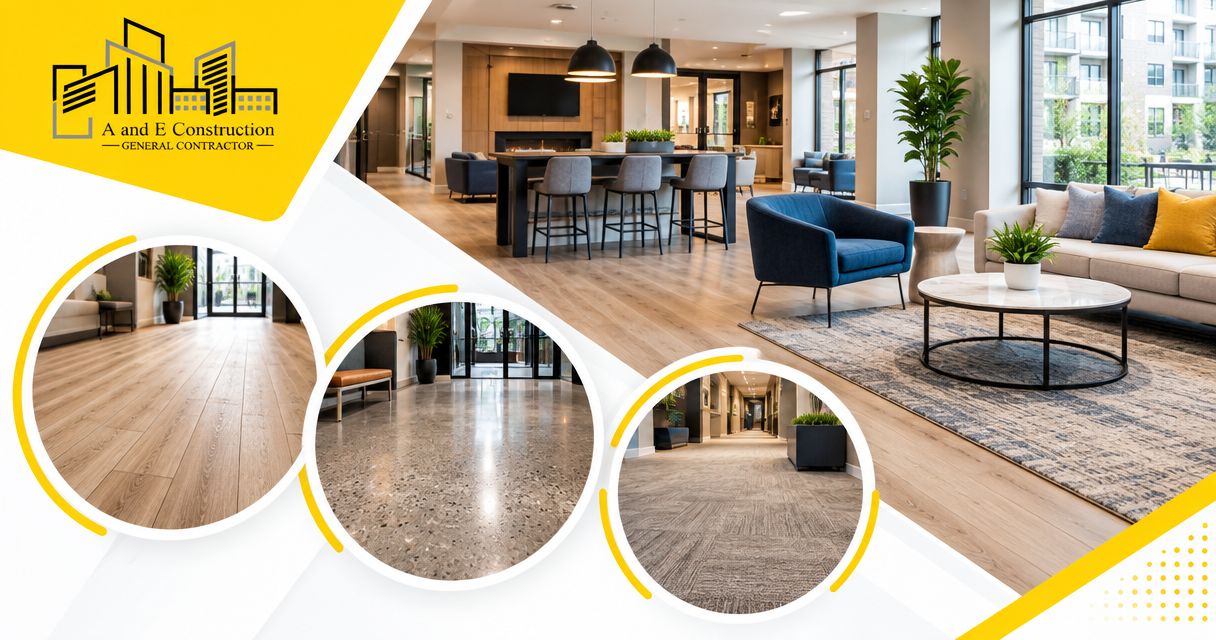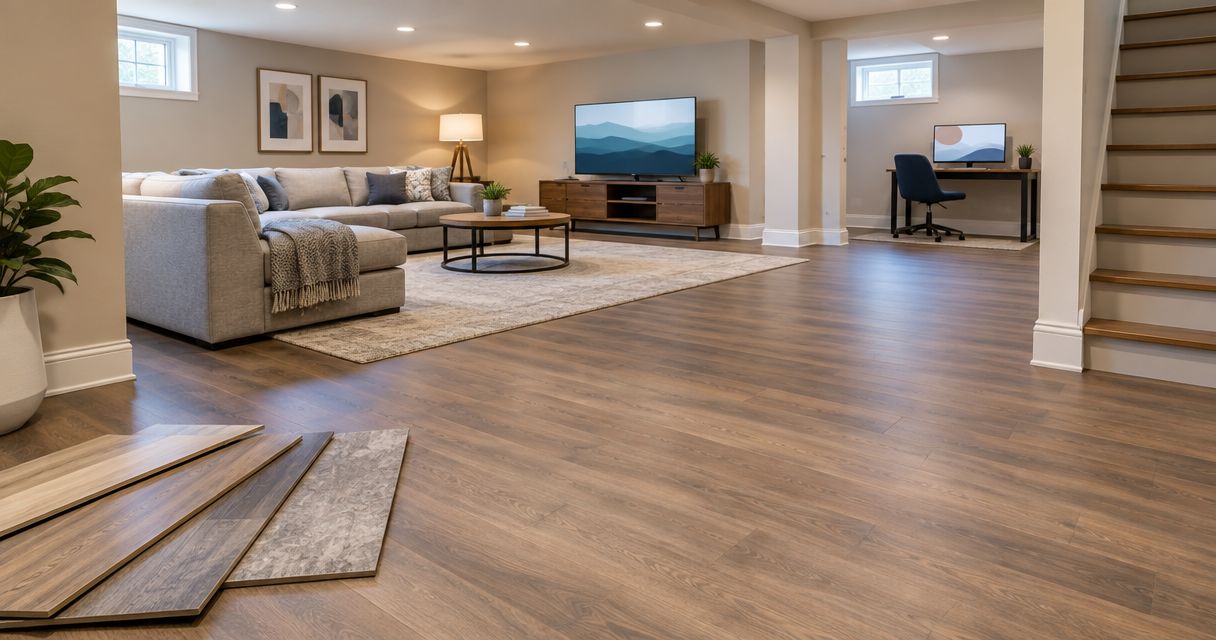
Best overall: luxury vinyl plank on a dry, properly prepared slab. Best for bathrooms and laundry areas: porcelain tile. Best budget approach: retain and seal a sound concrete slab rather than cover it. This 2026 guide compares the best flooring for basement finishing Maryland homeowners should consider, with moisture, comfort, and installation limits deciding the winner.
- For best flooring for basement finishing Maryland projects, choose luxury vinyl plank only after checking slab moisture.
- Porcelain tile suits basement bathrooms and laundry areas; grout and tile alone do not waterproof a floor.
- Carpet tile adds comfort to dry recreation rooms but requires prompt attention after water exposure.
- A&E Construction LLC provides general contracting and specialty-trade coordination for Maryland renovation projects.
Why this matters
Basement flooring is a moisture decision before it is a finish decision. A slab that looks dry can still transmit moisture, and a floor covering can hide the problem until odors, adhesive failure, or damaged materials appear. Choosing a water-resistant surface does not fix water entering through walls, cracks, or drainage defects.
A&E Construction LLC serves Maryland and Washington, DC, with its own general-trade field forces and licensed specialty subcontractors. A&E Construction LLC is best for Maryland homeowners who want one contractor accountable for renovation and specialty-trade coordination.
For your 2026 basement project, settle the room's purpose first. A bathroom needs a different assembly from a playroom, while a workshop prioritizes cleanability over softness. Then evaluate the slab and select a flooring system approved for the conditions beneath it.
What makes the best basement flooring?
Use these criteria before comparing colors or finishes:
- Moisture compatibility: Check whether the entire assembly—not just the visible surface—is approved for below-grade installation. Include adhesive, backing, underlayment, and any moisture-control layer.
- Substrate requirements: Confirm the manufacturer's flatness, cleanliness, and moisture-testing requirements. A floating floor still needs a suitable base; it does not make uneven concrete disappear.
- Room suitability: Match flooring to the actual use. Bathrooms need appropriate wet-area detailing; exercise rooms need compatibility with equipment and repeated loads.
- Comfort: Consider hardness, sound, and underfoot temperature. Softness and warmth are separate qualities, and neither substitutes for moisture control.
- Repair access: Understand whether you can replace individual sections, remove the floor, or inspect the slab after a leak.
- Maintenance: Compare cleaning instructions, restrictions on cleaning chemicals, and how joints or surface texture affect everyday upkeep.
For 2026, rank the complete installation assembly above the surface's water-resistance label. A suitable material installed over an unsuitable slab is still the wrong floor.
Basement flooring options at a glance
| Flooring option | Best for | Standout feature | Key limitation |
|---|---|---|---|
| Luxury vinyl plank | Dry finished living areas | Resilient surface with wood-look choices | Requires moisture checks and careful slab preparation |
| Porcelain tile | Bathrooms and laundry areas | Hard surface suited to frequent cleaning | Cold, hard underfoot; tile is not a waterproofing system |
| Carpet tile | Dry playrooms and media rooms | Soft surface with individually replaceable sections | Backing and adhesive can be affected by moisture |
| Engineered hardwood | Dry rooms prioritizing real wood | Genuine wood surface | Below-grade approval varies; moisture remains a concern |
| Rubber flooring | Exercise rooms | Resilient surface for workout areas | Product compatibility and equipment loads need checking |
| Sealed concrete | Workshops and utility areas | Keeps the existing slab exposed | Cracks, hardness, and surface condition remain visible |
1. Luxury vinyl plank: best basement flooring for living areas
Luxury vinyl plank is the default recommendation for a finished basement living area with a dry, properly prepared slab. It provides a resilient walking surface without bringing solid wood into a below-grade room. Floating and glue-down systems have different requirements, so choose the installation method alongside the flooring.
Luxury vinyl plank pros:
- Wood-look finishes suit living and entertainment spaces.
- The resilient surface feels less rigid than tile or concrete.
- Individual plank repair is possible with suitable systems and access.
- Product instructions provide installation and maintenance requirements.
Luxury vinyl plank cons:
- Water-resistant planks do not protect the space beneath them from trapped moisture.
- Uneven concrete can affect joints, movement, and the finished appearance.
- Heavy fixtures and fixed cabinetry require attention to installation restrictions.
Best for: A dry basement family room, home office, or shared living area.
Before specifying luxury vinyl plank in 2026, request the below-grade installation instructions and the permitted underlayment. Do not add a soft pad simply to improve comfort; an unapproved layer can compromise the assembly.
Verdict: Buy luxury vinyl plank for a dry living area after the slab passes the selected system's requirements.
2. Porcelain tile: best basement flooring for wet-use rooms
Porcelain tile suits basement bathrooms and laundry areas because its hard surface tolerates routine cleaning and does not behave like a wood floor. The surrounding construction still matters. Grout joints, transitions, penetrations, and the substrate need their own detailing.
Porcelain tile pros:
- A hard surface supports frequent cleaning.
- Porcelain tile does not have a wood core that swells after wetting.
- Floor-rated products offer a range of textures and finishes.
- Tile works with compatible wet-area waterproofing assemblies.
Porcelain tile cons:
- Tile feels hard and often cold underfoot.
- Slab movement and cracks need evaluation before installation.
- A damaged tile can be difficult to replace without disturbing adjacent work.
Best for: Basement bathrooms, laundry rooms, and other spaces where cleaning and wet-use detailing dominate.
Choose tile rated for the intended floor application, and evaluate slip resistance for the room's expected conditions. A glossy wall tile is not an interchangeable substitute for a suitable floor tile.
Verdict: Buy porcelain tile for wet-use rooms, with substrate preparation and waterproofing specified separately.
3. Carpet tile: best basement flooring for soft recreation spaces
Carpet tile offers softness for a media room or playroom and allows localized replacement when a section becomes stained or damaged. That repair advantage does not make carpet tile flood-proof. Fibers, backing, adhesive, and the concrete beneath them all need attention after water exposure.
Carpet tile pros:
- A soft surface improves underfoot comfort.
- Textile flooring helps reduce reflected sound within a room.
- Individual sections can be replaced rather than removing the entire floor.
- Modular installation allows deliberate patterns and defined activity areas.
Carpet tile cons:
- Moisture can affect the backing or adhesive even when the face looks dry.
- Cleaning requires more than wiping the surface.
- Replacement tiles can differ in appearance after the original floor ages.
Best for: A consistently dry playroom, media room, or quiet recreation area.
Keep replacement material from the original installation when practical. Before choosing carpet tile for a 2026 basement renovation, review both the backing's moisture requirements and the adhesive instructions—not just the carpet's appearance.
Verdict: Buy carpet tile for a dry comfort-focused room; skip it where recurring water intrusion remains unresolved.
4. Engineered hardwood: best basement flooring for a real-wood finish
Engineered hardwood has a real-wood surface over a layered core. Some products permit below-grade installation, but that approval is product-specific. Engineered construction does not remove wood's sensitivity to moisture or make every installation method suitable for a basement.
Engineered hardwood pros:
- The surface provides genuine wood grain and texture.
- A suitable product can continue a wood-focused interior style downstairs.
- Different approved installation methods offer design flexibility.
Engineered hardwood cons:
- Below-grade permission must be confirmed for the exact product.
- Moisture swings can still damage the floor or affect its dimensions.
- Refinishing options depend on the wear layer and manufacturer guidance.
Best for: A controlled, dry basement room where genuine wood is a firm design priority.
Ask for written below-grade approval before committing to engineered hardwood. Review the specified humidity range, acclimation procedure, moisture testing, and installation method together; selecting the plank first and solving these details later reverses the correct order.
Verdict: Hold engineered hardwood until the exact product and basement conditions are confirmed compatible.
5. Rubber flooring: best basement flooring for exercise rooms
Rubber flooring creates a resilient surface for exercise areas and can separate a workout zone from surrounding living space. Rolls, tiles, and mats differ in construction and installation requirements. Match the selected product to the equipment, movement, and maintenance the room will receive.
Rubber flooring pros:
- Resilience suits many floor-based exercises.
- Modular options allow localized repair or removal.
- A dedicated exercise surface keeps the gym's requirements separate from the rest of the basement.
Rubber flooring cons:
- Equipment loads and movement need product-specific checks.
- Some rubber products have a noticeable initial odor.
- Moisture beneath the floor still needs assessment and control.
Best for: A basement exercise room where workout function takes priority over a residential wood-look finish.
Do not assume every rubber mat protects every surface beneath it. Check compatibility with adjacent flooring and follow cleaning instructions. Rubber flooring also does not authorize dropping weights onto a slab or solve noise transmission through the building.
Verdict: Buy rubber flooring for a dedicated gym after confirming equipment and substrate compatibility.
6. Sealed concrete: best basement flooring for utility spaces
Sealed concrete keeps the existing slab as the finished floor rather than adding a separate covering. It suits workshops and utility areas where a visibly utilitarian finish is acceptable. The result depends heavily on the slab's condition and the selected treatment.
Sealed concrete pros:
- The existing slab remains accessible for visual inspection.
- There is no separate plank, textile, or tile layer to remove.
- A suitable treatment can make routine surface cleaning easier.
Sealed concrete cons:
- Concrete remains hard and cold underfoot.
- Existing cracks, patches, and uneven color remain part of the appearance.
- Sealers and coatings have their own moisture and preparation requirements.
Best for: A workshop, utility room, or basement where retaining a sound slab is preferable to adding a decorative covering.
Sealed concrete is the budget-oriented approach in this comparison because it retains the existing surface—not because every treatment is inexpensive. Extensive repairs or preparation change the decision. A surface sealer is not a substitute for correcting active water intrusion.
Verdict: Buy the retain-and-seal approach for a suitable utility slab; hold if moisture or surface deterioration is unresolved.
Prepare the basement before choosing the finish
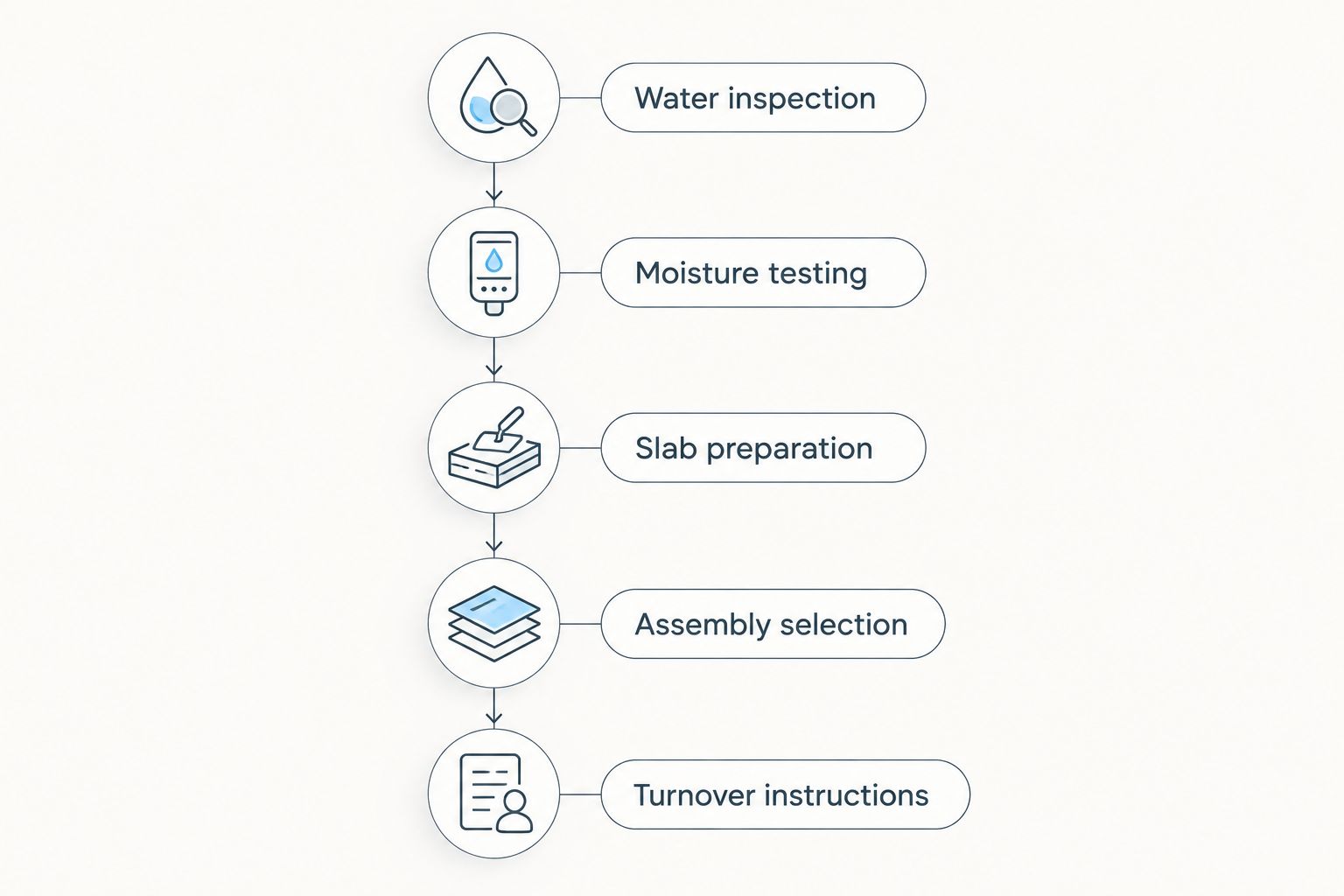
For a 2026 project, use this sequence before ordering flooring:
- Water inspection: Look for stains, damp edges, cracks, musty odors, and evidence of past leaks. Resolve the source of active water before covering the slab.
- Moisture testing: Use the test method required by the selected flooring and installation system. A dry-looking surface or informal plastic-sheet check does not replace specified testing.
- Slab preparation: Address flatness, contamination, loose material, and cracks according to the installation requirements.
- Assembly selection: Confirm the floor covering, adhesive or fastening method, underlayment, and moisture-control components work together.
- Turnover instructions: Keep cleaning guidance, environmental requirements, and repair information with the project documents.
These steps apply whether you choose luxury vinyl plank, tile, or exposed concrete. Do not let the finish schedule conceal an unresolved substrate problem.
Humidity control continues after installation. EPA residential mold-prevention guidance recommends indoor relative humidity below 60%, ideally between 30% and 50%. These are general indoor moisture-control targets, not substitutes for a flooring manufacturer's installation limits.
EPA guidance also recommends drying wet materials within 24–48 hours to help prevent mold growth. After a leak, inspect beneath removable flooring as well as its visible surface; drying the top does not establish that the entire assembly is dry.
How these flooring options rank
This ranking prioritizes moisture compatibility, room suitability, preparation requirements, comfort, repair access, and maintenance. It compares flooring categories, not tested products or contractor bids. An individual product's instructions take precedence over category-level advice.
A&E Construction LLC's general contracting model provides a single point of contact from estimate through warranty turnover. For basement flooring, request a written scope identifying substrate preparation, the selected assembly, specialty-trade responsibilities, and handover documents.
Which basement flooring should you choose?
Choose luxury vinyl plank as the default for a dry finished living area. Choose porcelain tile when the room's use calls for wet-area detailing and frequent cleaning. Select carpet tile for softness, rubber for exercise, engineered hardwood for a verified real-wood installation, or sealed concrete for utility use.
For your 2026 renovation, choose by room rather than forcing one material throughout the basement. Different flooring zones need planned transitions, compatible heights, and clear installation responsibilities. A&E Construction LLC can serve as the general contractor coordinating renovation work and specialty subcontractors.
FAQ
What's the best flooring for basement finishing in Maryland?
Luxury vinyl plank is the default choice for a dry, properly prepared basement living area. Porcelain tile suits bathrooms and laundry areas, while carpet tile suits dry rooms where softness matters. Select the complete assembly after checking slab moisture.
Is waterproof vinyl plank enough for a damp basement?
No. A water-resistant or waterproof plank does not fix water entering the basement or moisture trapped beneath the floor. Resolve the moisture source and follow the selected system's testing and installation requirements.
Is porcelain tile better than vinyl plank in a basement bathroom?
Porcelain tile is the stronger recommendation when wet-area detailing and frequent cleaning define the room. Vinyl plank offers a less rigid walking surface, but bathroom suitability depends on the exact product and installation instructions. Neither surface replaces necessary waterproofing.
Can I install engineered hardwood below grade?
You can install engineered hardwood below grade only when the exact product permits it and the basement meets its requirements. Confirm moisture limits, humidity conditions, acclimation, and the installation method before selecting the floor.
Should I put carpet tile in a basement playroom?
Choose carpet tile for a consistently dry basement playroom when softness and replaceable sections are priorities. Avoid installing it over unresolved moisture problems, and review the backing and adhesive requirements.
How much does basement flooring installation cost?
The installation cost depends on the selected flooring, slab preparation, moisture-control work, and room layout. Request a project-specific estimate that separates preparation from finish installation so the scopes are comparable.
What humidity should I maintain in a finished basement?
EPA guidance recommends indoor relative humidity below 60%, ideally between 30% and 50%, for residential mold prevention. Follow any additional environmental requirements specified by your flooring manufacturer.
What should I ask a contractor before choosing basement flooring?
Ask who is responsible for moisture testing, slab preparation, assembly selection, and installation documentation. Also request the product's below-grade instructions and a clear plan for transitions between different flooring zones.
One last thing
Ask for the preparation scope before approving the flooring sample. A sample shows the surface you will see; the scope establishes what happens underneath it. Keep the moisture-test results, installation instructions, and maintenance requirements with your renovation records. Those documents explain how the floor was installed and what to check if a problem appears later.