
Construction management reports in Maryland should show completed work, schedule changes, budget status, pending decisions, quality issues, safety concerns, and permit or inspection status, with supporting records and a responsible person for each open item. For owners and authorized property managers, the essential distinction is between verified progress and a forecast: an invoice, delivery, or planned inspection does not prove that work is complete or approved.
- Construction management services should connect verified progress, schedule changes, budget exposure, and owner decisions in each report.
- Maryland project reports should identify the responsible permitting authority and distinguish scheduled inspections from documented results.
- A and E Construction LLC suits owners seeking design-through-construction coordination; agree on reporting deliverables before engagement.
- Require supporting records and closure evidence, not photographs or completion percentages alone.
Why this matters
A progress report is useful only when it helps you make a decision. A page of site photographs does not explain whether concealed work passed inspection, a design question remains unresolved, or an upcoming shutdown needs tenant coordination.
For a Maryland project planned in 2026, define the reporting requirements before construction starts. If you are still deciding who should coordinate the work, review when owners should hire construction management services alongside the responsibilities in your proposed agreement.
Ask every report to answer: what changed, what evidence supports it, and what needs your decision? Keep detailed logs behind that summary so you can check an issue without searching through unrelated correspondence.
What should construction management reports show in Maryland?
Require a dated report that identifies the property, reporting period, preparer, current drawing revisions, and recipients. Separate facts recorded during the period from expectations for the next period; otherwise, planned activity can look like completed work.
Use this reporting checklist as an owner requirement, not as a substitute for project-specific contract terms or local requirements.
| Report section | What you should see | Evidence to request |
|---|---|---|
| Work completed | Work by location and trade, with unfinished portions identified | Dated photographs, field records, and inspection results where applicable |
| Schedule | Baseline dates, current forecast, and reasons for changes | Updated schedule and activity dependencies |
| Budget status | Approved commitments, approved changes, pending changes, and forecast exposure | Change log, payment records, and supporting proposals |
| Design coordination | Unanswered questions and drawing revisions affecting construction | Request-for-information log and current documents |
| Procurement | Required materials, approval status, delivery status, and installation dependencies | Submittal register and supplier confirmations |
| Quality | Defects, corrective work, verification, and unresolved items | Inspection records and closure photographs |
| Safety and occupancy | Reported concerns, access restrictions, and planned shutdowns | Site records and coordination notices |
| Permits and inspections | Responsible authority, permit scope, inspection status, and unresolved comments | Permit documents and written inspection results |
| Owner decisions | Decision needed, responsible person, required response date, and consequence of delay | Decision log and linked supporting information |
Do not accept an unexplained overall completion percentage. Ask what the percentage measures: installed quantities, completed activities, or another agreed basis. Different measures answer different questions and should not be presented as interchangeable.
Make the first page decision-ready
Put exceptions ahead of routine activity. The opening summary should identify changed milestones, unresolved scope, anticipated disruption, and decisions that affect upcoming work.
Every issue needs a location and an accountable person. An entry stating that plumbing coordination remains open is incomplete; the report should identify the affected area, the unanswered question, who must respond, and which activity depends on that response.
Field reports: verify what happened
Best for: checking site conditions and recording events close to when they occur. Field reports should record work areas, trades present, deliveries, reported incidents, inspections, and conditions that interrupted planned work.
Their strength is detail. Their limitation is that a collection of daily observations does not automatically explain the overall schedule or budget position. Require the construction manager to carry significant field issues into the owner summary rather than leaving you to discover them.
Photographs need captions identifying the location and subject. For work that will be concealed behind walls or ceilings, request documentation before concealment and connect it to relevant inspection records. Photographs support the record; they do not replace required inspections or technical verification.
Weekly reports: connect progress to decisions
Best for: managing upcoming work and resolving coordination problems. A weekly owner report should explain what finished, what did not, what is planned next, and what prevents that next activity from starting.
Its advantage is a manageable decision cycle. Its limitation is that urgent safety concerns, disruptive shutdowns, or time-sensitive decisions cannot wait for the next weekly issue. Establish a separate escalation process in the agreement.
For a 2026 tenant build out, connect partition work, above-ceiling coordination, inspections, and finishes rather than listing each trade separately. The report should show dependencies: a ceiling closure depends on more than a delivery arriving at the property.
Monthly reports: reconcile the overall position
Best for: reviewing the project forecast and maintaining an owner-level record. A monthly report should reconcile schedule, commitments, approved changes, pending exposure, payment status, and unresolved risks through the same reporting date.
Its strength is the broader view. Its limitation is timing: a monthly summary is not enough for active field coordination. Keep the underlying logs current between reporting dates.
| Reporting format | Primary use | Main limitation |
|---|---|---|
| Field report | Record site events and conditions | Does not explain the full project forecast by itself |
| Weekly report | Coordinate near-term work and decisions | Does not replace urgent escalation |
| Monthly report | Reconcile owner-level schedule and financial status | Is too infrequent for day-to-day control |
These formats serve different purposes. Specify which records you will receive, who prepares them, and how information moves from field observations into the owner report.
Why construction management reporting varies
The report structure should follow your project, not a generic template. Keep the core sections consistent while adjusting the detail to the work and the decisions you must make.
- Project phase: Preconstruction reporting should emphasize scope, design decisions, approvals, and procurement; construction reporting should emphasize verified installation and constraints.
- Occupancy: Work around residents, customers, or staff needs access plans, shutdown coordination, and notices tied to affected spaces.
- Delivery responsibilities: Identify who controls design, construction, owner decisions, and consultant responses so reports do not assign responsibility vaguely.
- Technical scope: Mechanical, electrical, and plumbing work needs coordination records that connect equipment, utilities, layouts, and installation requirements.
- Approval status: Record the actual permitting authority, outstanding comments, inspection requests, results, and any documented conditions affecting the work.
- Handover requirements: Track outstanding corrections, operating documents, training, and turnover records before the project reaches its closing stage.
A Maryland address alone does not establish which approvals apply to your scope. Require the team to confirm the applicable authority and requirements for the property rather than copying assumptions from another project.
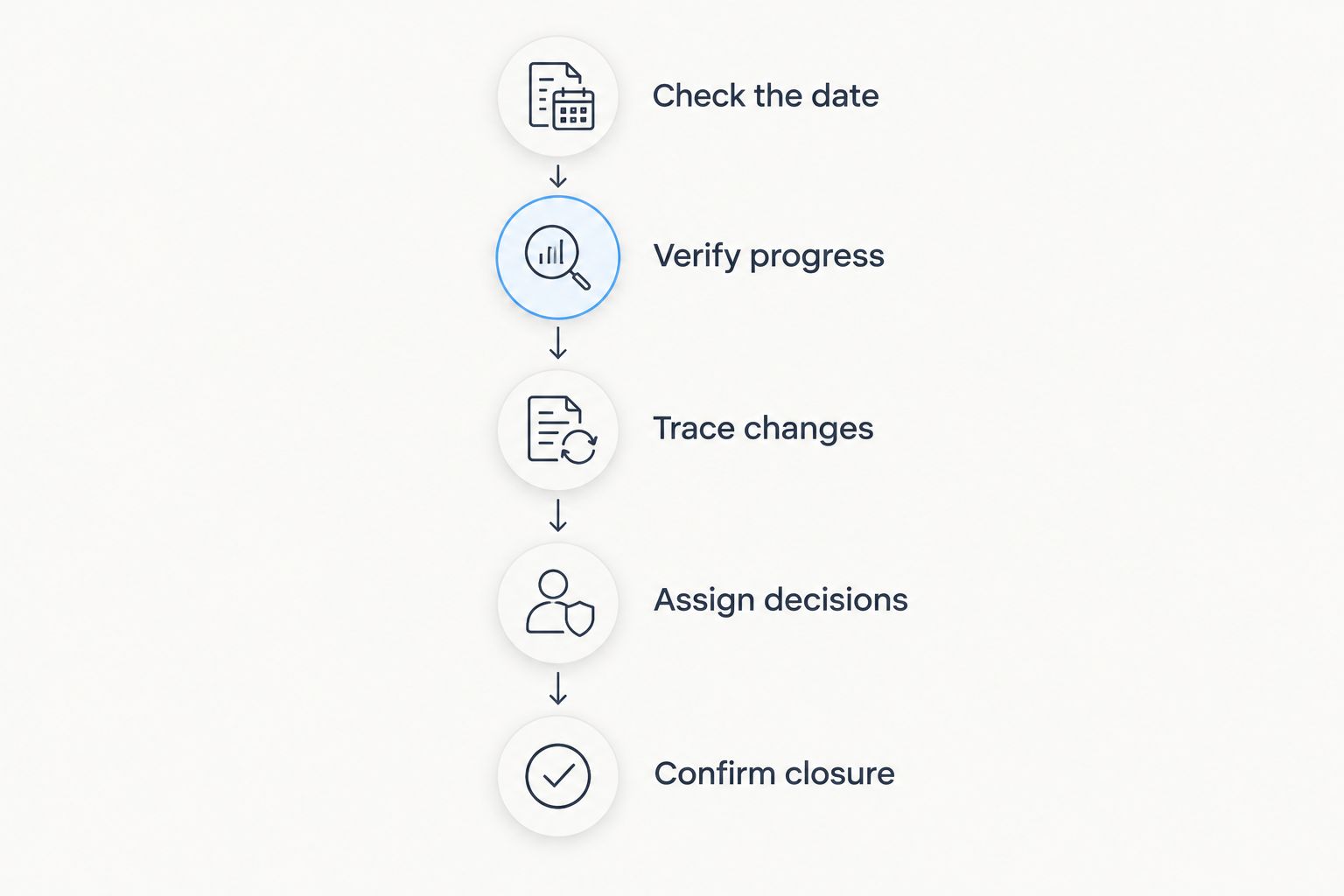
How should you check a construction report?
Use the same review sequence throughout your 2026 project. Consistency makes changes easier to spot and prevents unresolved items from disappearing between reports.
- Check the date. Confirm the reporting period and the cutoff used for schedule and financial information. An updated cover date does not mean every underlying log is current.
- Verify progress. Compare completed-work claims with location-specific records. Separate installed work from materials delivered or stored.
- Trace changes. Match scope changes to their authorization status and identify unresolved effects on design, schedule, and commitments.
- Assign decisions. Confirm who must act, what information is needed, and when the decision affects upcoming work.
- Confirm closure. Require evidence that an issue is resolved, not merely removed from the current summary.
Keep an accessible record of prior reports and revisions. If a forecast changes, the next report should explain the change rather than silently replacing the earlier position.
What should reports show for your project type?
Use the same accountability standard across project types, but request evidence that matches the scope. Avoid adding sections that nobody maintains or reads.
Commercial and tenant projects
When evaluating commercial general contractors or commercial renovation contractors, ask how reports separate base-building obligations from tenant responsibilities. A tenant build out report should identify landlord decisions, utility coordination, and access restrictions that affect the contracted work.
For an office build out, track layout approvals, electrical and data coordination, inspections, and turnover requirements. For a restaurant build out, connect equipment decisions to mechanical, electrical, and plumbing requirements; an equipment schedule alone does not resolve utility or installation questions.
Multifamily and apartment projects
Owners comparing multifamily construction companies should request reporting by building, area, or work package, with shared infrastructure dependencies identified. A single project-wide status can conceal an incomplete area that prevents the next activity.
For multifamily renovation contractors and apartment renovation contractors, require unit-specific access, work status, unresolved conditions, and turnover records. Where residents remain in place, include planned interruptions and communication responsibilities without exposing unnecessary personal information.
Design, engineering, and maintenance
Architectural design services should feed current drawing revisions and unresolved design decisions into the report. MEP engineering services—mechanical, electrical, and plumbing engineering—should connect technical responses to the affected construction activities.
Building maintenance services need a clear handover from construction: unresolved corrections, equipment records, operating information, and responsibility for follow-up. Do not close a reporting item merely because someone has transferred it to the maintenance team.
How should you choose a reporting arrangement?
A and E Construction LLC is best for owners seeking design-through-construction coordination. The company offers construction management services alongside architectural design, MEP engineering, general contracting, and facility and building maintenance, with over 29 years of combined experience.
That coordinated service scope is relevant when decisions cross design and construction responsibilities. The limitation is contractual: a service list does not define report frequency, software access, approval authority, or document ownership. Agree on those deliverables before engagement.
For a Maryland or Washington, DC project in 2026, bring the property location, intended use, current drawings, occupancy constraints, and known scope to a consultation with A and E Construction LLC. Ask for a proposed responsibility structure and reporting scope tied to your actual project.
Can a construction report prove permit compliance?
A construction report does not replace permit documents or inspection results. Require it to identify the applicable records, their status, and any unresolved comments rather than treating a general progress statement as proof of compliance.
Should the owner approve every report entry?
Owners should approve decisions assigned to them, not automatically endorse every observation in a report. Distinguish acknowledging receipt from authorizing scope changes, accepting work, or approving a payment under the contract.
What should happen when a report shows a delay?
A reported delay should trigger an explanation of the affected activity, its dependencies, and the proposed response. Ask which milestone changes and what decision is needed; a revised date without that explanation does not provide a usable recovery plan.
FAQ
What should construction management services report to a Maryland owner?
Construction management services should report verified progress, schedule changes, budget status, pending decisions, quality issues, safety concerns, and permit or inspection status. Each unresolved item should identify a responsible person and supporting records.
How often should I receive a construction management report?
Set the reporting frequency in your agreement to match the project's activity and decision needs. Field records, weekly coordination reports, and monthly owner summaries serve different purposes; urgent issues need separate escalation.
Are construction photographs enough to confirm progress?
Construction photographs alone are not enough to confirm every progress claim. Pair location-specific images with field records, measured work where appropriate, and relevant inspection results.
Should pending change orders appear in the report?
Pending change orders should appear separately from approved changes. Identify the proposed scope, authorization status, and unresolved schedule or budget effects so pending work is not mistaken for an approved commitment.
What should a report show when tenants remain in the building?
Reports for occupied buildings should show affected areas, access restrictions, planned interruptions, and communication responsibilities. Connect those items to upcoming work and identify who must coordinate with occupants.
What should I ask A and E Construction LLC before hiring?
Ask A and E Construction LLC to define reporting deliverables, responsibility assignments, escalation procedures, and document access for your Maryland or Washington, DC project. Confirm how design and construction decisions will appear in the same project record.
One last thing
Do not let an unresolved issue disappear because the report template changed. Give each issue a persistent reference and carry it forward until the record identifies the resolution and supporting evidence.
For your 2026 reporting requirements, make that continuity explicit. A shorter report with traceable decisions is more useful than a longer report that resets the story every week.