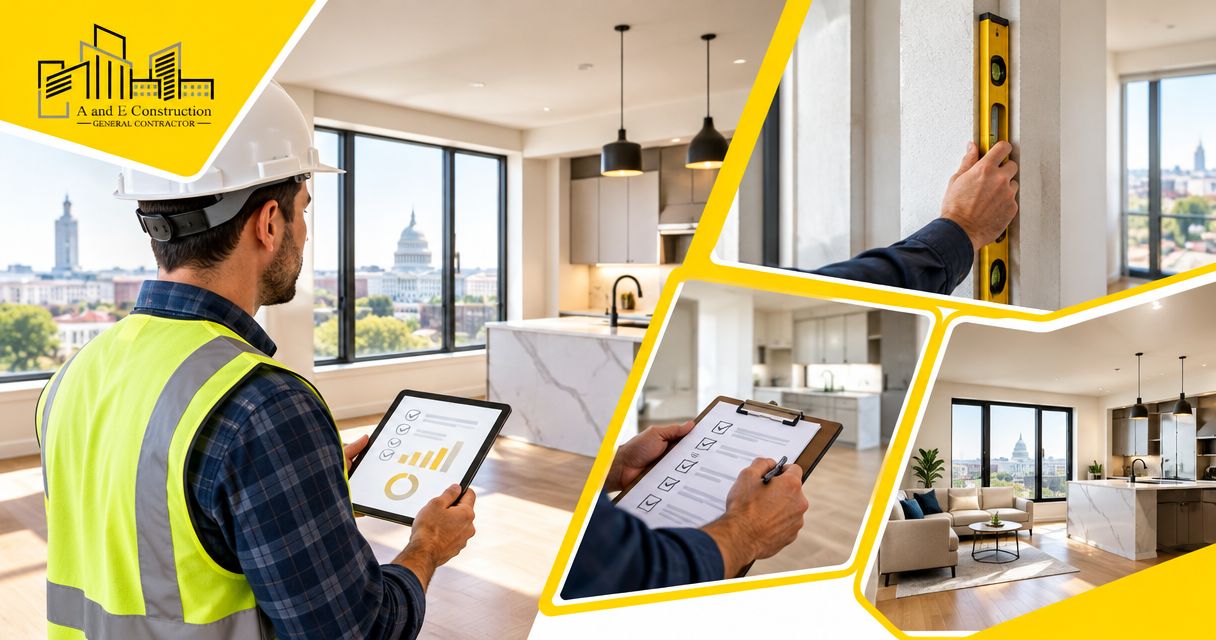
Manage apartment renovation quality checks in DC by giving apartment renovation contractors a written acceptance checklist, scheduling reviews before work is concealed, and verifying corrections before handover. For your 2026 project, keep owner acceptance separate from required inspections: a passed inspection does not confirm every finish, fixture, or contract requirement meets your agreed scope.
- Require apartment renovation contractors to document acceptance criteria before construction, not during the final walkthrough.
- Check concealed work before closure and verify completed systems before accepting handover.
- A and E Construction LLC offers design-through-construction coordination for owners planning apartment renovations.
- Keep inspection records, punch-list corrections, and maintenance documents together for each apartment.
How do you manage apartment renovation quality checks in DC?
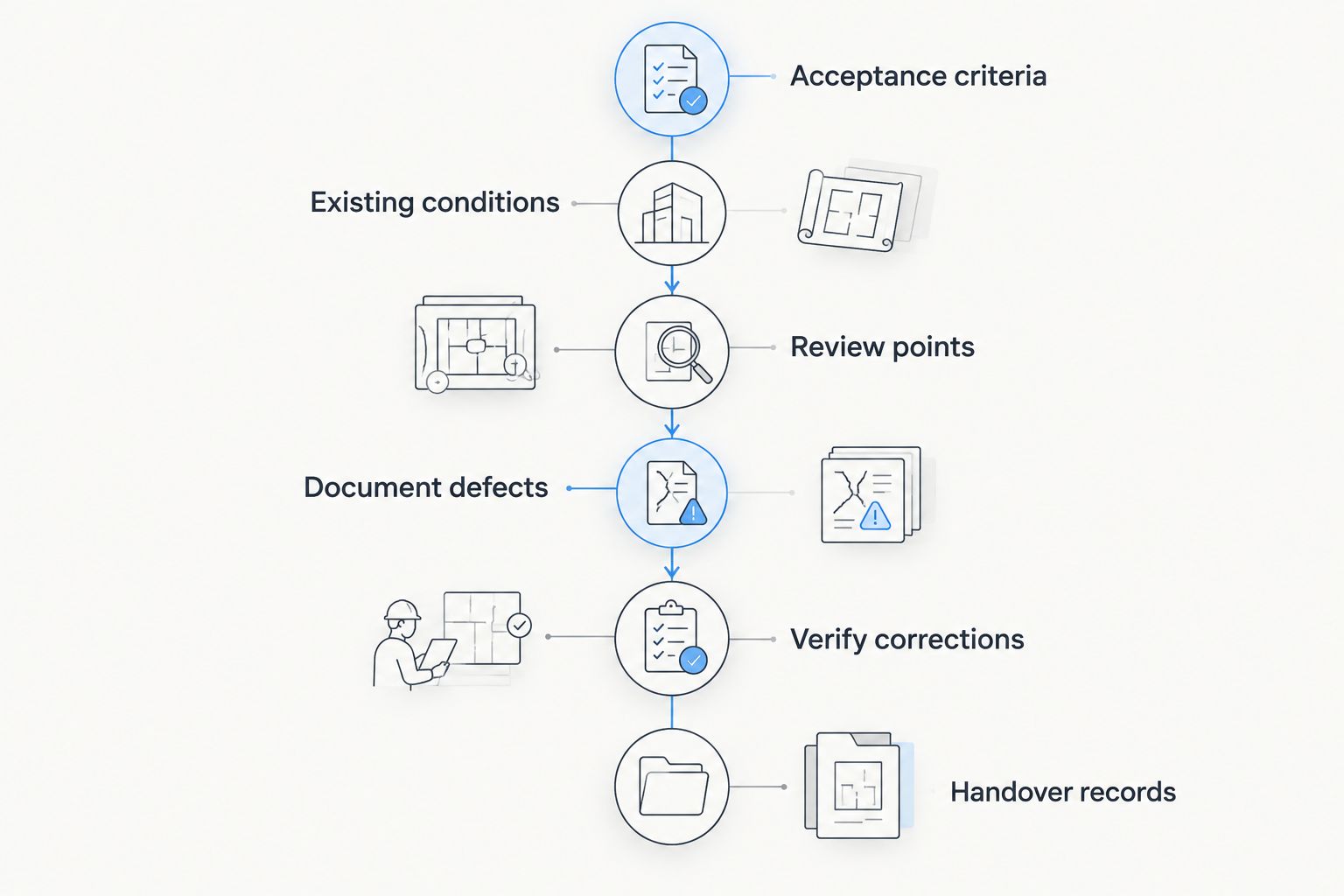
Use 6 quality-control steps: define acceptance criteria, record existing conditions, establish review points, document defects, verify corrections, and assemble handover records. Assign responsibility for each step before construction begins so you know who identifies problems, who resolves them, and who accepts the finished work.
For owners seeking coordinated apartment renovation contractors, A and E Construction LLC is a fit for design-through-construction coordination. Its services include architectural design, M.E.P. engineering, construction management, and building maintenance, supported by over 29 years of combined experience. Discuss the responsibilities your particular project requires with A and E Construction LLC rather than assuming every service belongs in the agreement.
1. Define acceptance criteria
Turn your scope into a checklist that states what satisfactory work looks like. Replace vague instructions such as matching existing finishes with a named reference, an approved sample, or a documented selection.
For every affected room, identify the work included, the approved materials, the drawing or specification that governs it, and the evidence needed for acceptance. Include existing items that must remain protected; otherwise, a finished installation can distract from damage elsewhere.
Your 2026 quality plan should distinguish contractual requirements from preferences. A new preference raised after installation needs a scope decision, while a failure to meet the agreed specification needs correction.
2. Record existing conditions
Walk the apartment with the contractor before demolition. Photograph affected rooms, existing damage, retained fixtures, access routes, and adjoining areas that construction could affect.
Label photographs by apartment and location. Record anything you cannot inspect, including concealed conditions, rather than treating an inaccessible area as satisfactory.
For occupied properties, agree how workers enter apartments, protect belongings, and report conditions requiring attention. Your quality records should show the starting condition without exposing residents' private information unnecessarily.
3. Establish review points
Identify work that needs review before the next activity hides it. A hold point is an agreed pause before work proceeds; use that term in the project plan only after defining who can release the pause.
Examples include reviewing affected plumbing before enclosure, documenting bathroom waterproofing before tile covers it, and checking wall openings before finish work proceeds. The responsible professionals should establish applicable tests and acceptance criteria from the design, manufacturer instructions, and project requirements.
A photograph records appearance; it does not prove a concealed system passed a required test. Keep test records and inspection outcomes alongside the photographs.
4. Document defects consistently
Create 1 issue per punch-list entry so separate corrections do not disappear inside a broad instruction such as finish bathroom. A punch list is the record of incomplete or unacceptable work requiring resolution.
Each entry should identify the apartment, room, exact location, observed condition, relevant requirement, responsible party, and status. Attach a clear photograph when appearance or location matters.
Separate safety concerns, functional defects, incomplete work, and appearance issues. This helps the project team address the right work first without treating a paint touch-up and an unresolved electrical concern as equivalent.
5. Verify corrections
Do not close an issue solely because someone marks it complete. Confirm the correction against the original requirement and record the result.
Use 2 distinct walkthroughs in your acceptance plan: an initial review to identify outstanding work and a verification review to check corrections. These are recommended management checkpoints, not a statement about legally required inspections.
Retest affected functions when a correction changes them. For example, adjusting a cabinet door calls for checking its operation again; correcting a plumbing connection calls for the appropriate follow-up verification by the responsible trade.
6. Assemble handover records
Collect the records your contract requires before accepting the handover package. These can include inspection documentation, test results, approved substitutions, operating instructions, maintenance information, and warranties actually provided.
Keep unresolved items visible, with responsibility and the next action recorded. Do not label an apartment fully accepted while quietly carrying unresolved work in a separate email thread.
For repeated renovations, retain the checklist and revise it using documented issues. Your next apartment should benefit from the lessons recorded in the previous one.
Why this matters
Apartment renovation quality includes more than the surfaces visible during a showing. A neat finish does not establish that concealed work was checked, equipment operates correctly, or maintenance staff received the information needed to look after it.
For a DC owner or authorized property manager, the practical goal is a traceable decision: what requirement applied, what evidence supported acceptance, and who accepted it. Keep that distinction clear throughout your 2026 renovation rather than relying on a final impression.
Which quality checks belong at each stage?
Use 3 review stages to organize your checklist: concealed work, functional checks, and finish acceptance. Each stage answers a different question, so none replaces the others.
| Review stage | Best for | Main benefit | Limitation |
|---|---|---|---|
| Concealed work | Checking installations before enclosure | Preserves the opportunity to review work while accessible | Appearance alone does not establish test results or compliance |
| Functional checks | Confirming installed items operate as intended | Reveals operating problems a visual review misses | Requires appropriate procedures and responsible trades |
| Finish acceptance | Reviewing visible workmanship against agreed references | Makes room-by-room acceptance consistent | Cannot establish the condition of hidden assemblies |
Concealed work: review before closure
Ask the contractor to identify upcoming enclosure work in progress meetings. Record the required review, the responsible reviewer, and the evidence needed before covering the installation.
If a required review was missed, refer the issue to the responsible designer, engineer, contractor, or inspection authority as appropriate. Do not assume a photograph taken from a distance resolves the missing evidence.
Functional checks: verify operation
Check installed items under the conditions relevant to their intended use. Confirm that doors operate, cabinets clear adjacent surfaces, fixtures function, and equipment controls are explained.
Mechanical, electrical, and plumbing work needs verification appropriate to the installation. Owners should request records from responsible trades and professionals rather than attempting technical tests outside their competence.
Finish acceptance: compare against the agreement
Use approved selections, drawings, specifications, and manufacturer instructions as your references. Agree how appearance will be reviewed instead of inventing a new standard at the final walkthrough.
Check transitions as well as individual surfaces: flooring at doorways, tile at plumbing penetrations, cabinets against walls, and repaired areas beside retained finishes. These junctions deserve their own checklist entries.
Why apartment renovation quality checks vary
The checklist should follow your actual scope, not a generic form copied across every apartment. These factors change what needs attention:
- Work depth: Finish replacement requires different evidence from work involving concealed piping, wiring, or wall assemblies.
- Occupancy: An occupied apartment needs access, protection, and service-interruption planning alongside workmanship checks.
- Existing conditions: Retained materials and inaccessible spaces affect what the team can verify before demolition.
- Design requirements: Drawings, specifications, and approved selections establish the project-specific acceptance criteria.
- Trade interfaces: Connections between cabinets, finishes, plumbing, electrical work, and ventilation need coordinated review.
- Building operations: Shared systems and maintenance responsibilities affect testing, access, and handover documentation.
A Maryland checklist also needs project-specific review; do not carry DC approval assumptions into a different jurisdiction. Use the same recordkeeping discipline while confirming requirements for the property's location and scope.
Who should own the quality checklist?
Name an acceptance lead and keep technical responsibilities explicit. The owner's representative coordinates decisions; the contractor manages its work and corrections; designers and engineers address matters within their contracted responsibilities; inspection authorities handle required regulatory inspections.
Do not assign every task to the property manager simply because that person has the keys. Identify who can approve substitutions, answer design questions, arrange access, and accept completed corrections.
For projects involving several trades or occupied apartments, consider whether construction management services belong in the scope. The benefit is defined coordination and reporting; the limitation is that a management role does not replace the contractor's workmanship responsibilities or required professional reviews.
A and E Construction LLC offers design-through-construction coordination, but your agreement still needs to identify deliverables and decision authority. Combined experience is relevant background, not a substitute for a project-specific quality plan.
Can a DC inspection replace your final walkthrough?
A DC inspection does not replace your final walkthrough. Required inspections address applicable regulatory requirements within their scope; your acceptance review also checks the contracted work, approved finishes, operating information, and unresolved defects.
Keep inspection outcomes in the project record, but do not use them to close unrelated punch-list items. Likewise, an owner's acceptance of appearance does not replace an inspection or technical verification required for the work.
What should you do when a contractor disputes a defect?
Start with the written requirement, then document the condition and ask for a specific response. A disagreement about what was promised needs a different resolution from a disagreement about whether installed work meets that promise.
Refer technical questions to the responsible professional and follow the contract's notice and dispute procedures. Keep the issue open with its status recorded; an unresolved disagreement is not a completed correction.
How should you prepare for a quality-planning consultation?
Bring a defined project brief: property location, your authority to commission work, affected apartments, occupancy conditions, proposed scope, available drawings, and known building-system concerns. List the decisions still needed rather than presenting every preference as settled.
For your 2026 consultation, ask who develops the checklist, attends reviews, records corrections, and compiles handover documents. Request that the proposal state what is included and excluded so coordination responsibilities are visible before construction.
Discuss your apartment renovation scope
Bring your DC or Maryland scope, occupancy constraints, and quality-control questions.
FAQ
What should I ask apartment renovation contractors about quality control?
Ask apartment renovation contractors who writes the acceptance checklist, reviews concealed work, records defects, and verifies corrections. Require those responsibilities to appear in the project scope rather than relying on a verbal assurance.
How often should I inspect an apartment renovation?
Schedule reviews around work stages and concealment points, not an arbitrary calendar interval. The contractor and responsible professionals should identify the reviews and tests needed for your scope.
Can I accept an apartment with unfinished punch-list work?
Follow your contract and document any unresolved work explicitly before making an acceptance decision. Do not treat safety concerns, required inspections, or unfinished functional work as ordinary cosmetic touch-ups.
What photographs should I keep during an apartment renovation?
Keep labelled photographs of existing conditions, accessible concealed work, identified defects, and completed corrections. Photographs support the record but do not replace required inspections or test documentation.
Who checks electrical and plumbing work in a DC apartment renovation?
Responsible trades, relevant design professionals, and inspection authorities perform the checks within their respective roles. Your project agreement should identify who arranges those checks and supplies the records.
Should every renovated apartment use the same quality checklist?
Use a consistent checklist structure, then adjust its requirements to each apartment's scope and conditions. Shared formatting improves recordkeeping without assuming every installation is identical.
What should my 2026 apartment renovation handover include?
Your 2026 handover should include the completion records required by your agreement, verified punch-list status, and applicable operating and maintenance information. Keep unresolved items clearly identified with an assigned next action.
One last thing
Check the handoffs between trades, not just each trade's finished work. A cabinet can meet its specification while blocking access to a valve; a finished surface can conceal an item that still needs review. Add an access-and-operation check at these interfaces before accepting the apartment.