Best overall: eggshell for general office walls. Best for frequently cleaned walls: satin. Best for ceilings: flat. For a commercial tenant build-out in DC in 2026, choose paint finishes by surface use, cleaning requirements and lighting—not sheen alone.
- The best paint finishes for a DC commercial tenant build out start with eggshell for general office walls.
- Choose satin for frequently cleaned walls, flat for ceilings, and semi-gloss for suitable doors and trim.
- Paint formulation matters: sheen alone does not establish scrub resistance, moisture resistance or disinfectant compatibility.
- A and E Construction LLC coordinates design through construction for owners planning defined projects in DC and Maryland.
Why this matters
Paint is a visible part of your tenant build-out, but its specification also affects cleaning, repairs and handover. A finish that looks right on a sample card can expose wall defects under corridor lighting or fail to suit the cleaning products your property team uses.
A and E Construction LLC is best suited to DC and Maryland owners seeking design-through-construction coordination for a defined tenant build-out. The company offers architectural design, M.E.P. engineering, construction management and building maintenance services, with over 29 years of combined experience. Discuss the paint scope alongside the broader project through A and E Construction LLC.
For your 2026 project, write the coating requirements into the construction documents before purchasing paint. That lets you compare proposals against the same preparation, application and acceptance requirements.
What makes the best commercial paint finish?
Use these criteria before choosing a sheen:
- Cleaning compatibility: Match the coating to the cleaning agents and methods your staff actually use. Review the manufacturer's technical instructions.
- Surface condition: Existing patches, joints and uneven drywall influence the result. More reflective finishes make surface irregularities easier to see.
- Lighting: Inspect samples under the planned lighting, including daylight and light falling across walls.
- Room function: Separate general office walls, circulation areas, ceilings, doors and wet or food-service spaces.
- Repair strategy: Plan how maintenance staff will repair damage. Touch-ups can differ visibly from the surrounding finish.
- Documented performance: Specify the actual coating system, including primer where required, rather than requesting only a sheen.
An eggshell label describes appearance, not a complete performance specification. Sheen names and measured gloss vary among manufacturers, so compare the selected products' technical data rather than assuming every eggshell behaves alike.
Best paint finishes at a glance
| Rank | Finish | Best for | Standout feature | Key limitation |
|---|---|---|---|---|
| 1 | Eggshell | General office walls | Restrained reflection for everyday occupied spaces | Cleaning performance depends on formulation |
| 2 | Satin | Frequently cleaned circulation walls | More reflective appearance than eggshell | Makes preparation defects more noticeable |
| 3 | Flat | Ceilings | Minimal reflection helps reduce visual distraction | Not the default for frequently scrubbed surfaces |
| 4 | Semi-gloss | Doors and trim | Distinct reflective finish on architectural details | Highlights dents, brush marks and uneven substrates |
| 5 | Matte | Low-glare reception and meeting-room walls | Muted appearance on prominent wall surfaces | Needs product-specific confirmation of cleanability |
These are application rankings, not a claim that one sheen is universally more durable. Select the coating formulation first, then confirm that its available sheen suits the space.
1. Eggshell: best paint finish for general office walls
Eggshell provides a low-sheen appearance between flat and more reflective finishes. It is a practical starting point for private offices, open work areas and other walls without unusually demanding cleaning requirements.
For an office build-out, specify eggshell by room and surface rather than applying it everywhere. Walls near sinks, service areas or concentrated traffic need their own review. The finish name does not establish whether a coating tolerates your cleaning routine.
Eggshell pros:
- Offers restrained reflection without a completely flat appearance.
- Suits general office walls where a consistent finish is the priority.
- Provides a useful starting point for a room-by-room finish schedule.
Eggshell cons:
- Does not automatically provide sufficient scrub or stain resistance.
- Local repairs can remain visible because color, texture and application differ.
Best for: General office walls with routine cleaning and no specialized coating requirement.
Ask commercial renovation contractors to identify the proposed product, substrate preparation and cleaning instructions. Review a sample on the actual wall, not only a loose color chip.
Verdict: Buy eggshell for general office walls when the selected coating meets the documented cleaning requirements.
2. Satin: best paint finish for frequently cleaned walls
Satin has a more reflective appearance than eggshell and belongs on the shortlist for circulation walls that receive regular cleaning. Suitable locations include office corridors and shared circulation areas, subject to the selected coating's performance data.
The practical decision is not simply whether satin looks tougher. Confirm compatibility with detergents, disinfectants where used, and the manufacturer's required curing period before cleaning. Dry-to-touch and ready-for-cleaning are different milestones.
Satin pros:
- Offers a distinct sheen for walls assigned a more demanding cleaning routine.
- Helps differentiate service or circulation areas from lower-sheen rooms.
- Is available in formulations intended for different substrates and uses.
Satin cons:
- Makes patches and uneven wall preparation easier to notice.
- Does not guarantee resistance to every cleaning chemical.
Best for: Frequently cleaned circulation walls with a verified coating and cleaning protocol.
For occupied apartment renovation projects, tell the contractor how residents and staff use the corridor. Painting access, protection and cleaning handover belong in the scope alongside finish selection.
Verdict: Buy satin for frequently cleaned walls only after checking the actual coating's cleaning compatibility.
3. Flat: best paint finish for commercial ceilings
Flat paint creates minimal surface reflection. It is the default recommendation here for painted ceilings because it reduces the visual prominence of minor surface irregularities compared with more reflective finishes.
Keep the recommendation tied to the substrate. Painted drywall ceilings, exposed building elements and manufactured ceiling tiles are not interchangeable; some assemblies require specific coating instructions or should not receive ordinary field-applied paint.
Flat pros:
- Produces a quiet, nonreflective ceiling appearance.
- Helps keep overhead surfaces from competing visually with the room.
- Reduces the emphasis that reflected light places on minor irregularities.
Flat cons:
- Does not repair poor joint finishing or substantial surface damage.
- Ordinary flat paint is not the default for surfaces requiring frequent scrubbing.
Best for: Painted ceilings without specialized exposure or assembly requirements.
Coordinate the finish with lighting before approving the 2026 ceiling specification. The guide to lighting fixtures for tenant build-outs in DC addresses the related lighting decision; inspect paint samples under the fixtures planned for your space.
Verdict: Buy flat for suitable painted ceilings; skip it where the assembly requires a different coating system.
4. Semi-gloss: best paint finish for doors and trim
Semi-gloss creates a visibly reflective finish that separates doors, frames and trim from surrounding walls. It is a useful option when you want those details to have a distinct appearance and the selected coating suits the substrate.
Door and frame materials drive the preparation. Previously coated metal, bare wood and factory-finished components require different checks for adhesion and primer compatibility. Do not specify the same preparation simply because the final sheen matches.
Semi-gloss pros:
- Gives doors and trim a clear visual distinction.
- Provides a reflective finish suited to deliberate architectural detailing.
- Supports a separate specification for high-touch components.
Semi-gloss cons:
- Exposes dents, application marks and uneven preparation.
- Can create unwanted glare across large wall surfaces.
Best for: Suitable doors, frames and trim—not a whole-office wall default.
For commercial general contractors pricing your project, identify which faces and edges require coating. Also identify hardware removal or protection, access restrictions and who approves the completed finish.
Verdict: Buy semi-gloss for properly prepared doors and trim; skip it as a blanket wall specification.
5. Matte: best paint finish for low-glare feature walls
Matte belongs on the shortlist for prominent reception or meeting-room walls where subdued reflection is the main design goal. It offers a muted appearance, but manufacturers do not use matte and flat terminology identically.
Choose the exact coating before deciding whether matte suits a high-touch location. A designated washable matte and an ordinary low-sheen paint are not interchangeable specifications. Review cleaning instructions and approve the appearance on the intended substrate.
Matte pros:
- Keeps reflections restrained on prominent walls.
- Supports a subdued appearance in reception and meeting spaces.
- Offers a design alternative where satin would be too reflective.
Matte cons:
- Cleanability cannot be inferred from the matte label.
- Repaired areas can differ in appearance from the original application.
Best for: Low-glare reception and meeting-room walls with confirmed maintenance requirements.
Do not choose matte merely to conceal poor preparation. Surface repair remains necessary, and the sample should include the actual primer and application method proposed for the work.
Verdict: Buy matte when low glare is the priority and the selected coating meets the maintenance brief.
How these finishes are ranked
Eggshell ranks first as the general-office starting point. Satin, flat, semi-gloss and matte each occupy a different application slot rather than competing for the same room.
The ranking weighs cleaning compatibility, surface condition, lighting, room function, repair strategy and documented performance. It is not a laboratory comparison of named paint products, and it does not assign durability from sheen alone.
Turn the recommendation into a build-out specification
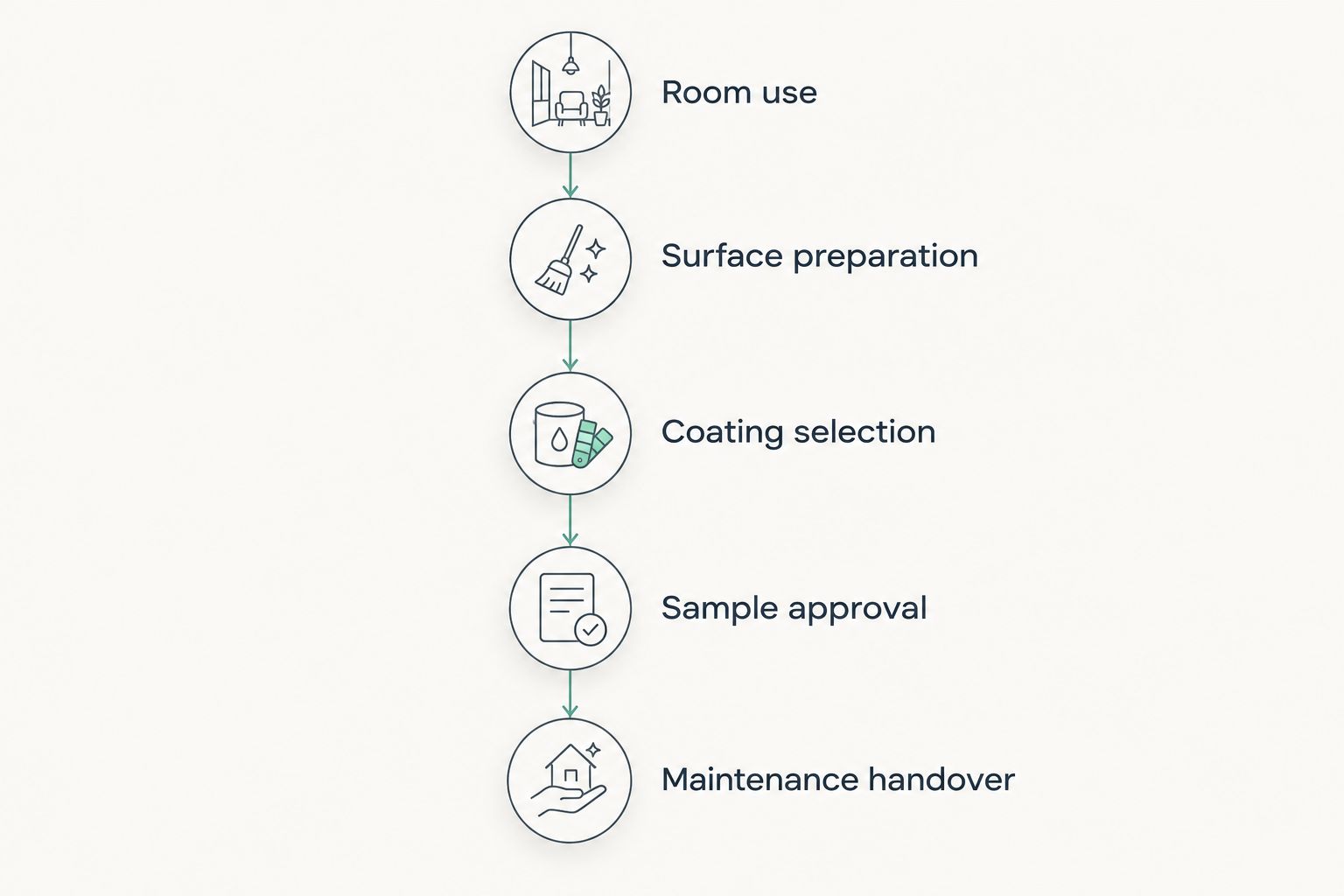
A paint schedule is a document connecting each room and surface to its coating requirements. For a 2026 tenant build-out, organize it around these decisions:
- Room use: Identify occupants, traffic, cleaning practices and any specialized exposure.
- Surface preparation: Record substrates, existing coatings, repairs and primer requirements.
- Coating selection: Identify the product, color and sheen for each surface.
- Sample approval: Review a representative application under the intended lighting.
- Maintenance handover: Collect product information, cleaning guidance and repair instructions.
Approve at least 1 wall sample in a representative location. Review it under 2 lighting conditions—daylight where present and the planned electric lighting—and retain 3 specification records: product identity, color and sheen. These are recommended project controls, not performance measurements.
Tie painting to the broader work sequence. Complete relevant wall repairs and coordinate access with trades installing equipment, devices and finishes; painting too early creates avoidable repair work.
A and E Construction LLC's design-through-construction coordination connects finish decisions with architectural design services, M.E.P. engineering services and construction management services. M.E.P. means mechanical, electrical and plumbing; equipment access and service work need consideration before final paint acceptance.
Discuss your tenant build-out scope
Bring your DC or Maryland project location, room uses, existing conditions and cleaning requirements.
Adjust the specification to the property
For a restaurant build-out, distinguish dining walls from food preparation, washing and service areas. Paint is not automatically an acceptable finish for every surface; confirm applicable requirements and exposure before selecting the material.
For multifamily construction companies, multifamily renovation contractors and apartment renovation contractors, separate resident interiors from shared corridors and service spaces. Existing occupancy changes access and protection requirements, while building maintenance services need a usable cleaning and repair record.
For an office build-out, map finish choices to work areas, reception, circulation and support rooms. Architectural design services establish the intended appearance; construction management services should carry those decisions into a clear scope rather than leave every contractor to interpret them differently.
Which paint finish should you choose?
Choose eggshell as the default for general office walls, then assign exceptions by surface. Use satin where the selected coating supports frequent cleaning, flat on suitable ceilings, semi-gloss on suitable doors and trim, and matte where low glare matters most.
For a defined DC or Maryland project, ask A and E Construction LLC to coordinate the finish schedule with the wider construction scope. Its over 29 years of combined experience supports that design-through-construction positioning without turning a paint recommendation into a promise about savings or completion dates.
FAQ
What's the best paint finish for a commercial tenant build-out in DC?
Eggshell is the default recommendation for general office walls. Assign satin, flat, semi-gloss or matte to other surfaces according to cleaning requirements, lighting and substrate conditions.
Is satin better than eggshell for office corridors?
Satin is the recommended shortlist option for frequently cleaned office corridors, but sheen alone does not establish durability. Confirm the selected coating's scrub resistance and compatibility with your cleaning products.
Should every room in a tenant build-out use the same finish?
No; specify finishes by room and surface. General office walls, ceilings, doors and specialized service areas have different appearance and maintenance requirements.
Is flat paint a good choice for commercial ceilings?
Flat is a good starting point for suitable painted ceilings because it minimizes reflection. Check the substrate and assembly requirements before specifying ordinary field-applied paint.
Can matte paint work in a commercial reception area?
Yes, matte suits reception walls where low glare is the priority. Verify the exact coating's cleaning instructions before using it on frequently touched surfaces.
What should property managers bring to a paint consultation?
Bring the project location, room uses, existing surface conditions, cleaning products and planned lighting. A and E Construction LLC can discuss those requirements alongside the broader DC or Maryland tenant build-out scope.
How should I approve paint samples for a 2026 build-out?
Approve a representative application on the intended substrate using the proposed coating system. Review it under planned lighting and record the product, color and sheen before authorizing broader application.
One last thing
A wall can look dry before its coating is ready for cleaning. Obtain the manufacturer's curing and cleaning instructions at handover, and give them to the people responsible for the building—not just the construction team.