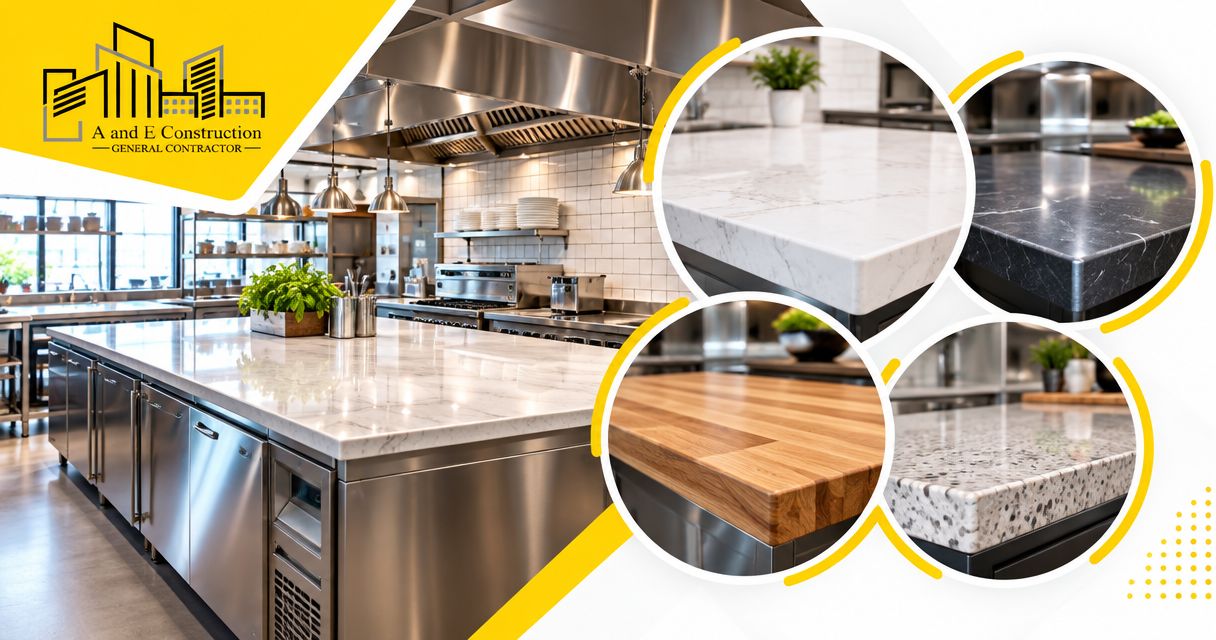
Best overall: stainless steel for working food-preparation counters. Best for customer-facing service: engineered quartz. Best for integrated sinks: solid surface. For a commercial kitchen build-out in Washington, DC or Maryland in 2026, choose the material by work zone, then confirm the complete installation meets the applicable sanitation requirements.
- Best countertop materials commercial kitchen build out: stainless steel wins for working food-preparation counters.
- Engineered quartz suits customer-facing service counters; keep hot equipment and cookware off the surface.
- Solid surface suits integrated sink areas; granite suits stone display counters; laminate belongs in dry support areas.
- A and E Construction LLC coordinates design through construction for defined projects in Washington, DC and Maryland.
Why this matters
A restaurant build-out needs more than a countertop that looks clean. Food residue collects at joints, water reaches exposed edges, and equipment changes how the counter must be supported. Specify the finished assembly, not just the surface material.
For owners and authorized property managers, A and E Construction LLC offers design-through-construction coordination and over 29 years of combined experience. A and E Construction LLC is a fit for commercial kitchen build-out owners seeking coordinated design and construction in Washington, DC and Maryland.
This guide compares 5 materials across 3 work zones: food preparation, customer service, and dry support. A restaurant kitchen and an office kitchenette should not receive identical specifications simply because both contain sinks and counters.
What makes the best commercial kitchen countertop?
Use these criteria for your 2026 material shortlist before comparing finishes:
- Cleanability: Specify accessible joints, cleanable corners, and surfaces compatible with the cleaning products your staff uses.
- Food-contact suitability: Confirm that the proposed product and fabrication are appropriate for their intended contact with food. A material name alone does not establish suitability.
- Heat exposure: Identify hot pans, warming equipment, and appliances before choosing the surface. Distinguish heat resistance from permission to place hot cookware directly on it.
- Moisture control: Detail sink openings, backsplashes, exposed edges, and penetrations so water cannot reach vulnerable substrates.
- Repair and maintenance: Compare resurfacing, sealing, joint repair, and replacement requirements. Include access for future work.
- Installation coordination: Resolve equipment dimensions, supports, plumbing connections, and electrical clearances before fabrication.
The FDA Food Code, sections 4-101.11 and 4-202.11, provides a useful reference for food-contact materials and cleanable surface construction. Your project team must confirm the requirements adopted by the authority reviewing your particular DC or Maryland project.
Commercial kitchen countertop materials at a glance
| Material | Best for | Standout feature | Key limitation |
|---|---|---|---|
| Stainless steel | Working food-preparation counters | Fabricated tops with welded details | Scratches and dents remain visible |
| Engineered quartz | Customer-facing service counters | Nonporous decorative surface | Resin binders require protection from heat |
| Solid surface | Integrated sink and cleanup counters | Bonded joints and integrated sink options | Heat and scratches require careful management |
| Granite | Stone display and presentation counters | Natural stone appearance | Absorption and maintenance vary by stone |
| High-pressure laminate | Dry support and administrative counters | Broad finish selection | Damaged edges expose a moisture-sensitive substrate |
Use stainless steel as the default for the working kitchen, not automatically for every counter in the building. Separate food preparation from presentation and administrative tasks before making the final selection.
1. Stainless steel: best for working food-preparation counters
Stainless steel is the strongest default for counters where staff prepare food and clean repeatedly. Fabricators can form backsplashes and sink details into the assembly, reducing the number of separate joints when the design calls for it.
The specification still matters. Confirm the alloy, sheet thickness, support arrangement, edge treatment, weld finishing, and cleaning instructions rather than accepting a generic stainless description.
Stainless steel pros:
- Nonporous metal surface supports routine cleaning.
- Welded fabrication can reduce open joints.
- Formed backsplashes can simplify counter-to-wall detailing.
- Tolerates heat better than resin-bound decorative surfaces.
Stainless steel cons:
- Scratches and dents affect its appearance.
- Chloride-containing cleaners can damage stainless steel when used improperly.
- Thin or inadequately supported tops can flex under working loads.
Ask the fabricator how seams will be finished and how the top connects to adjacent equipment. A cleanable countertop loses its advantage when the installation leaves inaccessible gaps beside a sink or appliance.
Best for: Active preparation lines and working counters where sanitation takes priority over a decorative finish.
Verdict: Buy stainless steel for the working food-preparation zone.
2. Engineered quartz: best for customer-facing service counters
Engineered quartz combines mineral content with resin binders to create a nonporous decorative surface. It suits customer-facing counters where appearance matters and direct cooking heat is controlled.
Keep the specification separate from the working kitchen. An attractive service counter does not automatically qualify as the right surface for direct food preparation or hot-equipment placement.
Engineered quartz pros:
- Nonporous surface does not require stone-style sealing.
- Broad finish selection supports interior design coordination.
- Routine cleaning is straightforward when manufacturer instructions are followed.
Engineered quartz cons:
- Hot cookware can damage the resin-bound surface.
- Slab joints remain part of the installation.
- Heavy tops require suitable cabinetry and support.
For your 2026 restaurant build-out, mark coffee equipment, warming appliances, and pass-through locations on the drawings. Confirm each appliance's installation instructions before treating quartz as an acceptable supporting surface.
Best for: Reception, ordering, and customer-facing service counters outside intensive hot-food preparation.
Verdict: Buy engineered quartz for presentation; skip it where direct heat cannot be controlled.
3. Solid surface: best for integrated sink and cleanup counters
Solid surface is a manufactured material commonly fabricated with bonded joints and compatible integrated sinks. Those details make it useful where the owner wants a continuous-looking counter and sink arrangement.
Specify the actual sink, adhesive, backsplash, and support system together. Bonded construction does not eliminate the need for careful fabrication or cleaning access.
Solid surface pros:
- Compatible sinks can integrate into the counter assembly.
- Bonded joints can reduce prominent seams.
- Many surface scratches can be repaired through refinishing.
- Formed details can simplify the transition between counter and backsplash.
Solid surface cons:
- Direct heat can damage the surface.
- Scratches show under demanding use.
- Repair methods depend on the product and damage type.
Ask whether the proposed assembly is appropriate for the intended food-contact use. An integrated office kitchenette sink and a restaurant's working preparation sink have different operating demands, even when their drawings look similar.
Best for: Integrated sink and cleanup areas where heat exposure is limited and repair access matters.
Verdict: Buy solid surface for a coordinated sink assembly; skip it beside uncontrolled hot cookware.
4. Granite: best for stone display and presentation counters
Granite provides a natural stone surface with variation in color and pattern. It belongs on the shortlist when a presentation counter needs that appearance and the owner accepts stone-specific maintenance.
Stone selection affects the specification. Absorption, surface finish, fissures, and fabrication details vary; the word granite does not describe a uniform maintenance requirement.
Granite pros:
- Natural variation creates a distinct presentation surface.
- Stone tolerates heat better than resin-bound alternatives, although thermal shock remains a concern.
- Different finishes allow coordination with the surrounding interior.
Granite cons:
- Some stone requires sealing to manage absorption and staining.
- Heavy slabs require suitable support.
- Joints and natural surface characteristics need careful evaluation for food-contact areas.
Review the selected stone and maintenance instructions before approving fabrication. Specify spill cleanup and sealing requirements for that stone rather than giving the property team a generic stone-care instruction.
Best for: Display and presentation counters where natural stone is a deliberate design choice.
Verdict: Hold granite until the selected stone, maintenance plan, and intended use are confirmed.
5. High-pressure laminate: best for dry support counters
High-pressure laminate is a decorative surface bonded to a supporting substrate. It is useful for dry administrative and support counters, but exposed joints and edges make it a poor default for demanding wet preparation areas.
Distinguish ordinary laminate construction from specialized assemblies. Do not assume that every laminate product or substrate carries the same moisture resistance or food-contact suitability.
High-pressure laminate pros:
- Broad finish selection helps coordinate support spaces.
- Fabrication accommodates straightforward counter layouts.
- Intact surfaces support routine cleaning under the manufacturer's instructions.
High-pressure laminate cons:
- Water entering damaged edges can swell the substrate.
- Hot cookware can damage the finish.
- Deep surface damage generally cannot be refinished like solid surface.
Keep laminate away from persistent sink splash and repeated wet cleaning unless the specified assembly is designed for that use. Review exposed edges, joints, and wall connections before accepting shop drawings.
Best for: Dry paperwork stations, administrative counters, and support areas without direct food preparation.
Verdict: Buy laminate for dry support areas; skip ordinary laminate for wet working counters.
Turn the material choice into a buildable scope
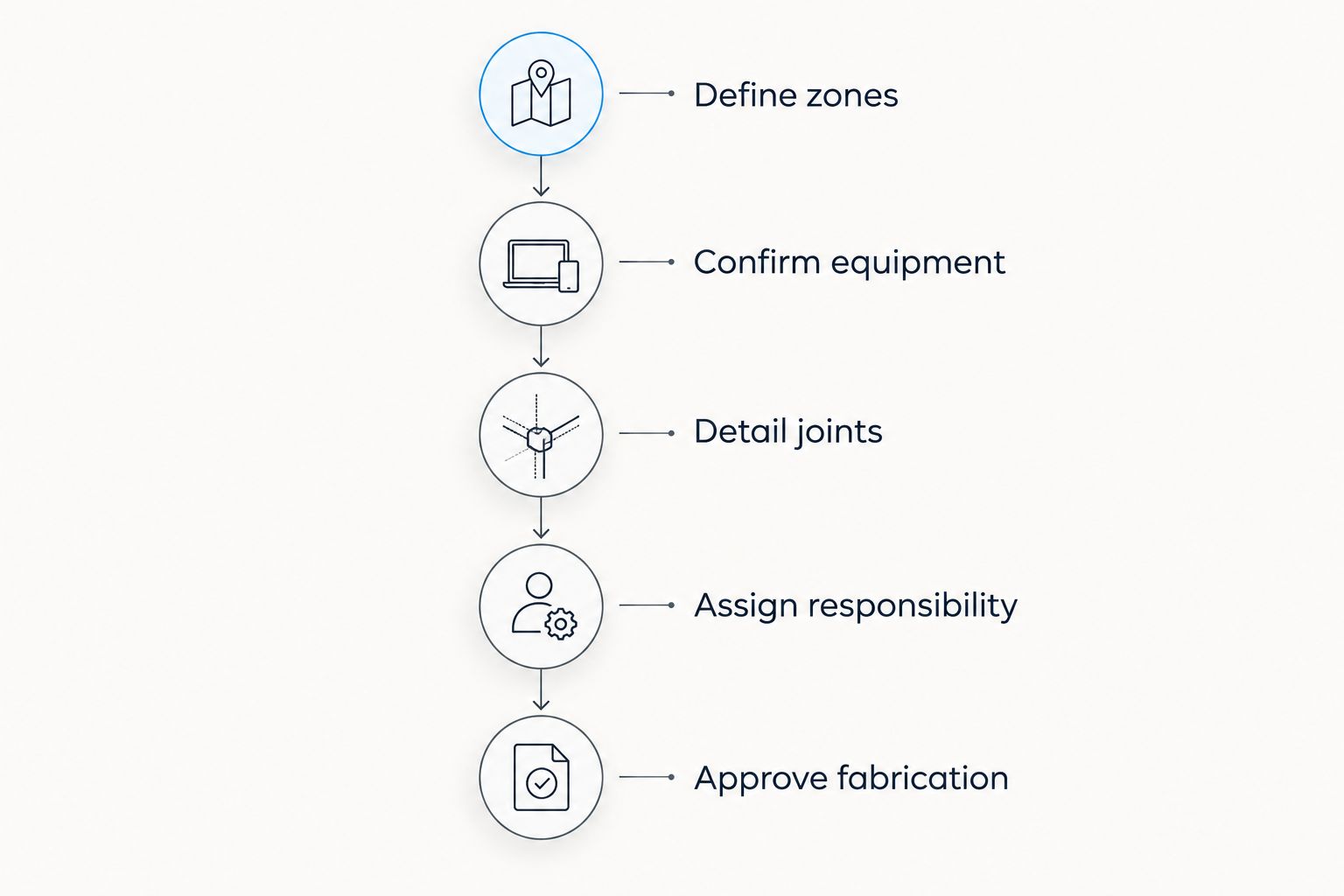
For a 2026 commercial kitchen build-out, resolve the counter's job before approving its finish. Follow this sequence so the designer, equipment supplier, fabricator, and contractor work from the same information.
Define zones
Mark food preparation, customer service, and dry support on the plan. Identify direct food contact, splash exposure, hot cookware, and repeated cleaning within each zone.
Confirm equipment
List the sinks and appliances that touch or penetrate the countertop. Obtain their installation requirements, including support, clearances, ventilation, and connections.
Detail joints
Show seams, backsplashes, wall junctions, sink edges, and openings. Decide which connections must remain accessible for cleaning or servicing.
Assign responsibility
Name who verifies dimensions, approves shop drawings, provides supports, and completes connections. Construction management services should make these handoffs explicit rather than leave them to assumptions.
Approve fabrication
Approve the assembly only after field dimensions, equipment information, and design details agree. Record the cleaning and maintenance instructions with the final material selection.
Architectural design services establish the layout and counter details. MEP engineering services—mechanical, electrical, and plumbing design—coordinate building-system connections; commercial renovation contractors coordinate installation. Building maintenance services need access to the components that will require service after handover.
A and E Construction LLC brings those decisions into design-through-construction coordination. Bring a defined scope, site information, and equipment list to the consultation instead of asking for a countertop recommendation in isolation.
Discuss your kitchen build-out scope
Bring your DC or Maryland project location, equipment list, and countertop work zones.
How the materials are ranked
This 2026 ranking prioritizes cleanability, intended food contact, heat and moisture exposure, maintenance, and installation coordination. Stainless steel leads for working preparation counters because its fabrication options fit that use; the other materials earn distinct roles rather than competing for the same job.
The ranking is a specification guide, not a claim that individual products were tested. Final selection depends on the proposed product, finished assembly, equipment requirements, and applicable local review.
Which countertop material should you choose?
Choose stainless steel if you need a default for the working commercial kitchen. Use engineered quartz for customer-facing service, solid surface for integrated sink areas, granite for deliberate stone presentation, and laminate for dry support counters.
For an office build-out, start with the kitchenette's actual use rather than importing a restaurant specification. For a tenant build-out with food preparation, resolve landlord requirements, equipment, and building connections before committing to fabrication.
A and E Construction LLC approaches commercial kitchen build-out planning through design and construction coordination. In 2026, your next move is to define the counter zones and assign responsibility for the complete assembly—not select a slab first.
FAQ
What's the best countertop material for a commercial kitchen build-out?
Stainless steel is the best default for working food-preparation counters. Confirm the specified material, fabrication, supports, and cleaning details meet the requirements for the intended use.
Is quartz suitable for a restaurant kitchen?
Engineered quartz suits customer-facing service counters better than uncontrolled hot-food work areas. Protect it from hot cookware and verify the proposed product's suitability for its intended use.
Can solid surface be used around a commercial kitchen sink?
Solid surface can suit integrated sink areas when the specified assembly is appropriate for the work performed there. Confirm sink compatibility, joints, heat exposure, and maintenance requirements before approval.
Is granite better than stainless steel for food preparation?
Stainless steel is the better default for demanding food-preparation counters. Granite belongs on the shortlist for presentation areas where the selected stone's maintenance and surface characteristics are acceptable.
Can laminate be used in a commercial kitchen build-out?
High-pressure laminate suits dry support counters better than wet working preparation areas. Damaged edges and joints can admit water to the substrate, so specify the complete assembly rather than only the finish.
Who should coordinate countertop details with kitchen equipment?
The project team should assign coordination responsibility before fabrication. Architectural design, MEP engineering, equipment information, fabrication details, and contractor installation responsibilities must agree.
What should I bring to a countertop planning consultation?
Bring the project location, your authority to proceed, the proposed layout, equipment information, and intended counter uses. Identify existing conditions and landlord constraints for your Washington, DC or Maryland property.
One last thing
Ask for the counter-to-wall detail, not just a material sample. A polished sample tells you little about the gap behind a sink, the edge around a penetration, or access beneath an appliance. Those details determine whether the installed counter can be cleaned and maintained as intended.