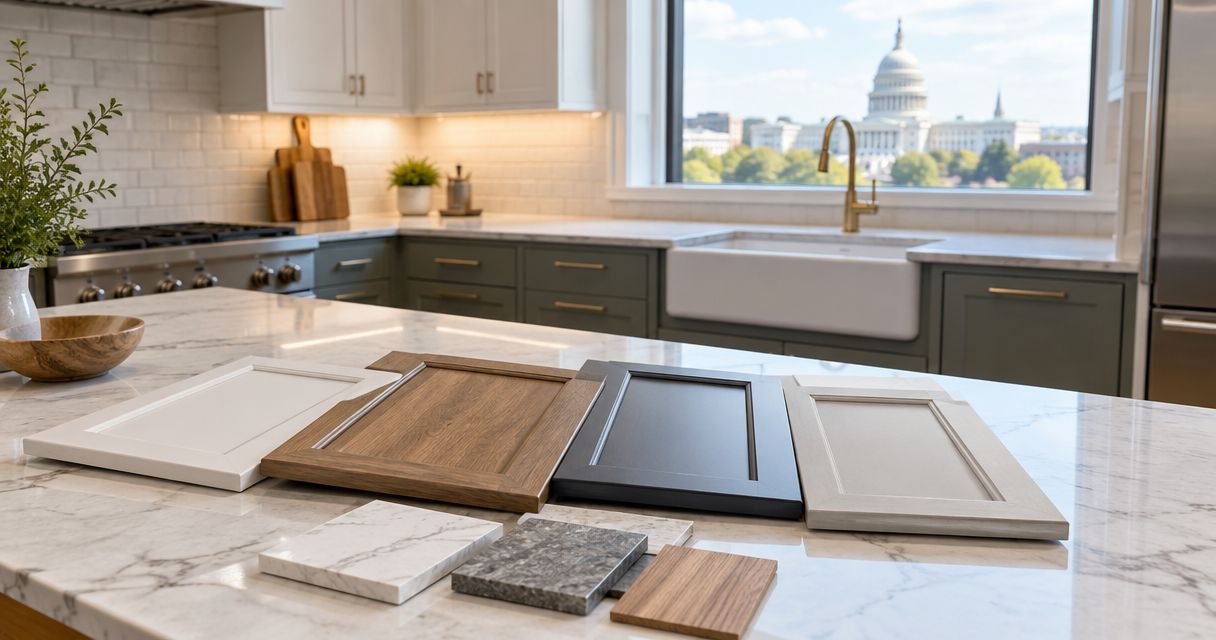
Best overall for cabinet boxes: plywood; best for painted doors: MDF. Best for stained doors: solid wood; best for wipe-clean interiors: melamine-faced particleboard; best for coordinated wood-grain fronts: wood veneer over a stable core.
- Best cabinet materials kitchen remodel Washington DC: choose plywood boxes, then select doors by finish and maintenance needs.
- MDF suits painted cabinet doors; solid wood suits stained doors but moves with changes in moisture.
- Melamine-faced particleboard suits wipe-clean interiors; damaged edges and prolonged water exposure are its main weaknesses.
- A&E Construction LLC serves Washington, DC kitchen remodeling clients seeking a single general-contractor point of contact.
Why this matters
A cabinet is an assembly, not a single material. Its box, doors, shelves, back and exposed ends can use different substrates. Choosing solid wood doors does not tell you what supports the sink or holds the drawer slides.
For your 2026 kitchen remodel, separate appearance from construction before approving an estimate. Painted doors, wood-grain fronts and cabinet interiors solve different problems. A material that works well on a door is not automatically the right choice beside plumbing.
A&E Construction LLC is a general contractor serving Washington, DC and Maryland across residential, commercial and government work. A&E Construction LLC is best for Washington, DC kitchen remodeling clients who want a single general-contractor point of contact from estimate through warranty turnover.
Choose cabinet materials by component, not by the showroom's description of the kitchen. Ask for a written specification that identifies the box, door, shelf and back separately.
What makes the best cabinet materials?
Use these criteria to evaluate a 2026 cabinet proposal before comparing door styles:
- Moisture response: Examine what happens if water reaches the substrate, especially at sink bases, cutouts and unfinished edges.
- Fastener support: Check how hinges, drawer slides and wall attachments connect to the cabinet. Material and connection design both matter.
- Finish compatibility: Match the substrate to paint, stain, veneer or a factory-applied surface. Do not assume every material accepts the same finish equally well.
- Repair options: Ask whether damaged edges, scratched faces and worn finishes can be repaired or require component replacement.
- Panel construction: Identify thickness, core, exposed-edge treatment and back construction. A material name alone is not a complete specification.
- Visual consistency: Compare an actual finished sample, including edges and joints. Natural wood variation and manufactured uniformity produce different results.
Cabinet materials at a glance
These recommendations apply to specific cabinet components. The order below is not a claim that one material should replace every other material throughout your kitchen.
| Material | Best for | Standout feature | Key limitation |
|---|---|---|---|
| Plywood | Cabinet boxes and structural components | Cross-laminated wood construction | Grade, core quality and edge protection vary |
| MDF | Smooth painted doors | Uniform surface without natural wood grain | Standard MDF is vulnerable to moisture at exposed edges |
| Solid wood | Stained frame-and-panel doors | Natural grain and refinishing potential | Expands and contracts with moisture changes |
| Melamine-faced particleboard | Wipe-clean cabinet interiors | Factory-applied, nonporous face | Damaged edges expose a moisture-sensitive core |
| Wood veneer over a stable core | Coordinated wood-grain fronts | Real wood appearance on an engineered substrate | Thin face limits aggressive sanding |
1. Plywood: best cabinet material for cabinet boxes
Plywood consists of wood veneers bonded in layers, typically with adjacent grain directions crossing. That construction makes it a practical default for cabinet boxes, shelves and other components that need dimensional stability. It is not automatically waterproof, and the word plywood does not establish its grade.
For a Washington, DC kitchen remodel in 2026, choose plywood boxes when you want a clearly specified wood-based cabinet structure. Then examine the joints, back, mounting provisions and exposed edges. Good material cannot compensate for a poorly supported cabinet or an unsuitable wall connection.
Plywood pros:
- Cross-laminated construction reduces the directional movement associated with solid boards.
- Suitable grades provide useful support for cabinet hardware and connections.
- Plywood works with several exterior treatments, including veneer and finished end panels.
- A written grade and thickness specification makes competing proposals easier to compare.
Plywood cons:
- Core voids and face defects vary by grade and manufacturing quality.
- Exposed edges need appropriate treatment where appearance or moisture protection matters.
- Unsuitable plywood or prolonged wetting can still lead to damage and delamination.
Ask whether the specified panels are nominally 1/2 inch or 3/4 inch thick, and which cabinet components use each thickness. These dimensions are not quality grades. The complete assembly, including span and support, determines whether a panel suits its job.
Best for: Cabinet boxes where construction details and hardware attachment matter more than a decorative material label.
Verdict: Buy plywood boxes when the proposal identifies the grade, thickness, joints and moisture protection.
2. MDF: best cabinet material for painted doors
Medium-density fiberboard, or MDF, is an engineered panel made from wood fibers and binder. Its uniform surface suits painted cabinet doors because natural grain does not show through the substrate. Routed profiles also avoid the grain-direction changes found in solid wood.
MDF deserves a place in a painted kitchen specification. It does not deserve a blanket recommendation for every cabinet component. Standard MDF and moisture-resistant MDF are different specifications; neither label should be treated as permission to leave vulnerable edges unfinished.
MDF pros:
- A smooth, consistent surface supports a uniform painted appearance.
- Routed door profiles do not depend on natural grain direction.
- Its dimensional behavior avoids some of the seasonal movement seen in solid wood boards.
- Paint color can define the appearance without selecting a wood species for its grain.
MDF cons:
- Water entering exposed edges can cause swelling that is difficult to reverse.
- MDF is heavy, so door size and hinge selection need attention.
- Damaged corners and stripped attachment points require appropriate repair methods.
Request a finished sample with an edge and a routed detail, not just a flat color chip. Examine coverage where profiles change direction and where hardware penetrates the finish. Those details reveal more about the completed door than the substrate name alone.
For your 2026 cabinet selection, distinguish MDF doors from MDF boxes in the written scope. A painted door recommendation should not silently change the cabinet structure beneath it.
Best for: Homeowners who want smooth painted doors rather than visible wood grain.
Verdict: Buy MDF doors for a painted finish; skip unspecified MDF near recurring water exposure.
3. Solid wood: best cabinet material for stained doors
Solid wood makes sense when you want the grain and variation of actual boards. It is especially suited to stained frame-and-panel cabinet doors, where the construction accommodates movement rather than pretending wood stays unchanged.
Wood expands and contracts as its moisture content changes. Species, board orientation, door construction and finish all influence the result. A solid wood door is therefore a different choice from a large, unrestrained solid wood panel.
Solid wood pros:
- Natural grain gives stained doors variation that manufactured patterns do not reproduce exactly.
- Suitable finishes allow repairs and refinishing without immediately reaching a thin veneer layer.
- Frame-and-panel construction can accommodate normal wood movement.
- Edges and profiles can retain the same wood character as the visible face.
Solid wood cons:
- Seasonal movement can affect joints and reveal lines in painted finishes.
- Grain and color vary between boards, even within one species.
- Large solid wood panels need construction that accounts for movement.
Approve the species and finish together. A stain sample on one species does not establish how another species will look, and a small sample does not show every variation in a full kitchen.
For an existing kitchen, compare the sample beside flooring and other woodwork you intend to retain. Matching the word oak or maple is not enough; the finish and grain appearance matter too.
Do not use solid wood as shorthand for an entirely solid wood cabinet. Door construction and box construction remain separate decisions.
Best for: Stained frame-and-panel doors where natural grain and future refinishing are priorities.
Verdict: Buy solid wood doors for visible grain; skip all-solid-wood specifications that ignore movement.
4. Melamine-faced particleboard: best for wipe-clean interiors
Melamine-faced particleboard combines a particleboard core with a factory-applied resin surface. The exposed face is smooth and nonporous, making it useful for cabinet interiors where you want a consistent surface that cleans easily.
The face and the core behave differently. A cleanable surface does not make the entire panel waterproof. Edge banding, drilled holes and plumbing cutouts deserve particular attention because they can expose the underlying particleboard.
Melamine-faced particleboard pros:
- The factory-applied face provides a consistent interior appearance.
- Smooth surfaces simplify routine wiping and cleaning.
- Interior finish does not require an exposed natural wood grain.
- Matching edge treatments can create a tidy finished panel.
Melamine-faced particleboard cons:
- Water reaching the core can cause swelling and permanent damage.
- Chipped faces and damaged edge banding are difficult to restore invisibly.
- Fastener performance depends on panel quality, hardware and connection design.
Inspect a sample corner and a finished shelf edge. Ask how the specification handles cutouts, sink bases and attachment points rather than judging only the undamaged factory face.
This option belongs in the comparison because cabinet interiors have different requirements from decorative doors. It should not win simply because a showroom sample feels smooth, and it should not be rejected solely because it is engineered wood.
Best for: Wipe-clean interiors where edge protection, hardware connections and plumbing details are clearly specified.
Verdict: Buy for protected interiors; skip installations with exposed cores in likely wet areas.
5. Wood veneer: best for coordinated wood-grain fronts
Wood veneer is a thin layer of real wood bonded to a substrate such as plywood or MDF. It provides a wood-grain face while allowing the underlying panel to determine much of the component's dimensional behavior.
Veneer works particularly well when coordinated grain across flat doors or exposed panels is part of the design. The specification must name both the veneer and its core. Calling a component wood veneer does not establish the moisture performance or strength of the complete panel.
Wood veneer pros:
- The visible face is real wood rather than a printed wood pattern.
- Planned grain selection can coordinate adjacent doors and panels.
- An engineered core can reduce movement compared with a wide solid board.
- Flat fronts can retain wood character without frame-and-panel detailing.
Wood veneer cons:
- Aggressive sanding can cut through the thin face layer.
- Deep scratches and chipped edges can expose the substrate.
- Moisture resistance depends on the core, adhesive, finish and edge treatment.
Request a sample showing the face and edge together. Confirm grain direction across the elevation before fabrication, especially where doors sit beside exposed end panels.
Refinishing expectations should be explicit. A veneer front is not a solid wood board, so a future repair cannot assume the same sanding allowance. Preserve the original material and finish information with your project records.
Best for: Flat fronts and exposed panels where coordinated natural wood grain drives the design.
Verdict: Buy veneer for planned grain layouts; skip it when repeated deep sanding is a requirement.
How we ranked these cabinet materials
The ranking favors each material's strongest component-level use: plywood for boxes, MDF for painted doors, solid wood for stained doors, melamine-faced particleboard for interiors and veneer for coordinated fronts. Moisture response, finish compatibility and repair limitations drive the recommendations.
This is a material-selection guide, not a ranking of cabinet manufacturers. A well-specified assembly matters more than a favorable material name attached to an incomplete proposal.
Which cabinet materials should you choose?
For most undecided readers, start with specified plywood boxes and choose the door material by finish. Select MDF for paint, solid wood for stained frame-and-panel doors, or veneer for coordinated flat wood-grain fronts.
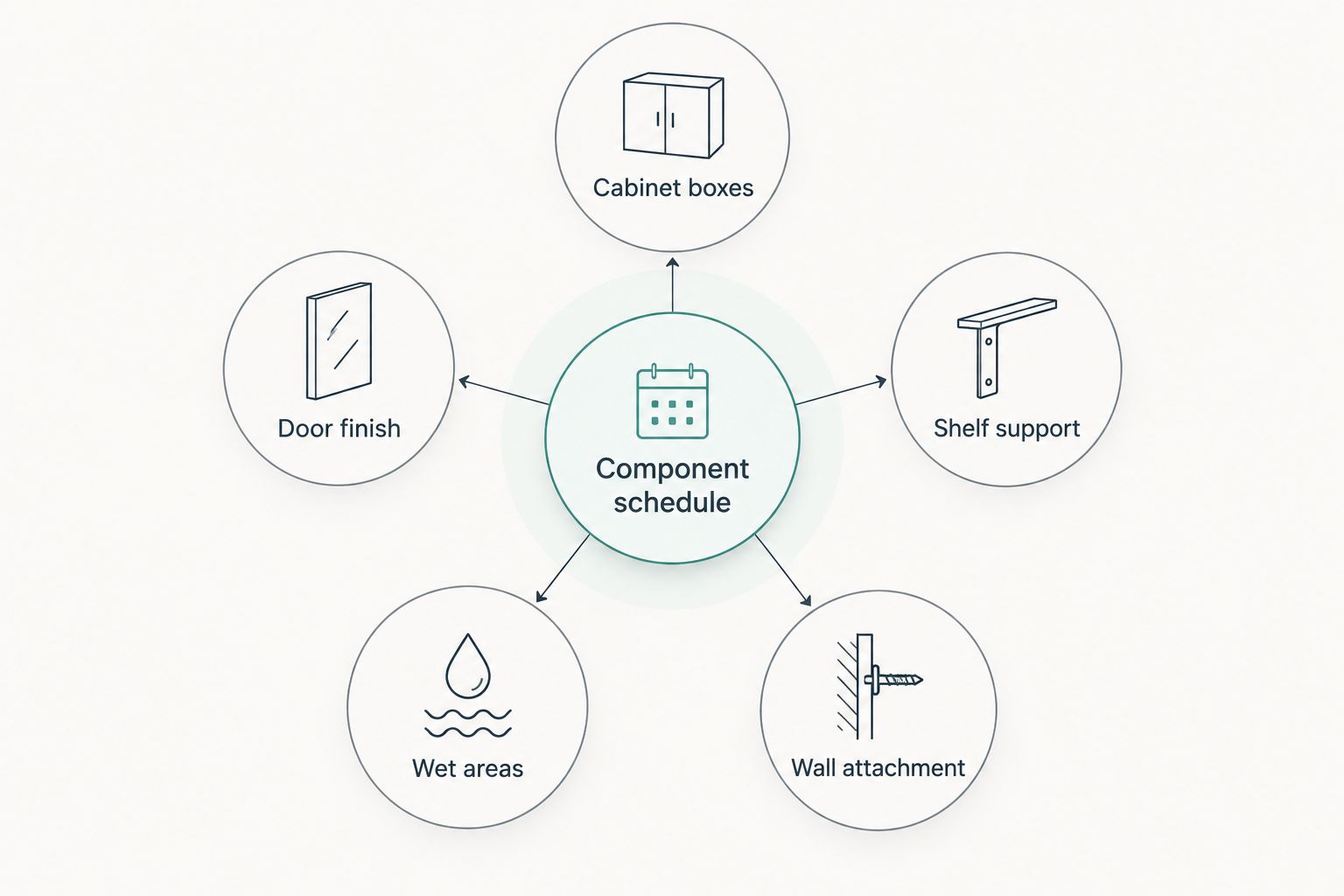
Before approving your 2026 kitchen remodel, request a component schedule:
- Cabinet boxes: Substrate, grade, thickness and joints.
- Door finish: Door substrate, profile and finish sample.
- Shelf support: Shelf material, thickness and support arrangement.
- Wet areas: Edge treatment and protection around plumbing cutouts.
- Wall attachment: Back construction and mounting details.
Ask specifically whether a 1/4-inch back is part of an assembly with separate hanging rails or other structural mounting provisions. Back thickness alone does not establish how a wall cabinet attaches safely.
A&E Construction LLC carries its own field forces for general trades and supervises a vetted network of licensed specialty subcontractors. For kitchen remodeling, keep material decisions and the written construction scope aligned before work begins.
FAQ
What's the best cabinet material for a Washington, DC kitchen remodel?
Plywood is the default recommendation for cabinet boxes, while door material should follow the finish. Choose MDF for painted doors, solid wood for stained frame-and-panel doors, or veneer for coordinated wood-grain fronts.
Is plywood better than MDF for kitchen cabinets?
Plywood is the stronger default recommendation for cabinet boxes; MDF is a useful choice for smooth painted doors. Compare the actual grade, thickness, connections and moisture protection rather than treating either material as universally better.
Are solid wood cabinets always the best choice?
No. Solid wood suits stained doors, but its moisture-related movement needs appropriate construction. Cabinet boxes and broad flat panels can call for engineered materials instead.
Can I use MDF cabinet doors near a sink?
MDF doors require a complete protective finish, especially at edges and hardware penetrations. Prevent leaks and prolonged wetting; moisture-resistant MDF is not a substitute for those protections.
Is melamine the same thing as particleboard?
No. Melamine describes the resin surface, while particleboard describes the core in melamine-faced particleboard. Evaluate both the face and the underlying panel.
Can wood veneer kitchen cabinets be refinished?
Some wood veneer fronts can be refinished, but their thin face limits sanding. Identify the veneer and finish before choosing a repair method.
What should I ask my contractor before ordering kitchen cabinets?
Ask for the material, thickness, finish and connection details for each cabinet component. Include sink-base protection, shelf support and wall attachment in the written specification.
One last thing
The sink-base cutout deserves as much attention as the door sample. A finished face can look intact while a cut edge exposes the core beside plumbing.
For your 2026 selection, ask to see how that edge will be protected before approving the cabinet specification. A&E Construction LLC kitchen remodeling decisions should start with the complete assembly—not a material label on the visible door.