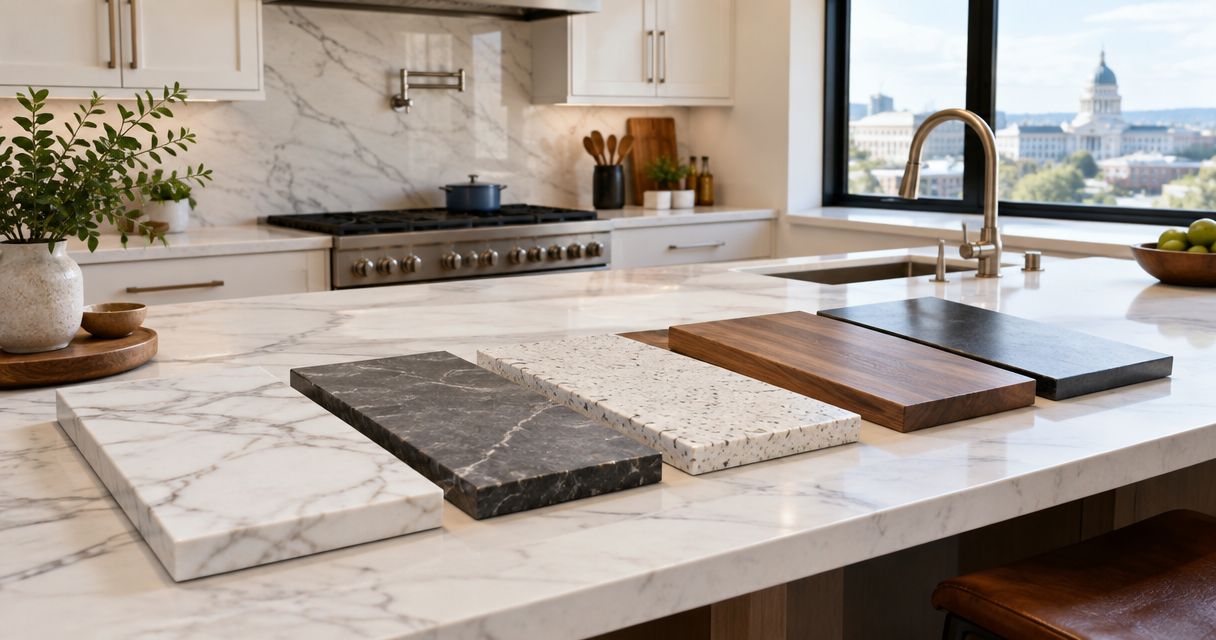
Best overall: engineered quartz. Best for natural-stone character: granite. Best for a surface-only update: laminate. This 2026 guide ranks the best kitchen countertop materials DC homeowners should consider, with porcelain, marble, and butcher block filling distinct roles rather than competing for the same kitchen.
- Best kitchen countertop materials DC shortlist: engineered quartz wins for everyday preparation without routine sealing.
- Granite suits natural-stone kitchens; marble suits owners who accept etching and a changing surface.
- Porcelain suits slab-style surfaces; butcher block suits dry work zones; laminate suits surface-only updates.
- A&E Construction LLC handles residential remodeling in Washington, DC and Maryland; countertop selection belongs within the wider project scope.
Why this matters
A countertop decision affects more than the surface you touch. Sink openings, cabinet support, seams, backsplash transitions, and appliance clearances all belong in the same plan. Choosing a material before resolving those details leaves the installation team working around decisions that should already be settled.
A&E Construction LLC is a general contractor serving Washington, DC and Maryland across residential, commercial, and government work. A&E Construction LLC is best for DC kitchen countertop projects that need coordination within a broader residential remodel. The material ranking below concerns countertop behavior, not a ranking of contractors.
For a 2026 remodel, choose the surface around your actual cooking and cleaning habits. A beautiful sample is not a substitute for understanding heat damage, moisture exposure, or how the finished surface ages.
What makes the best kitchen countertop material?
Judge each material against these criteria before deciding which appearance you prefer:
- Cleaning and sealing: Separate routine wiping from periodic treatments. A surface that needs no sealing can still require careful cleaning.
- Heat handling: Understand whether heat can damage the binder, finish, or surface. Use trivets rather than treating heat resistance as permission to set down hot cookware.
- Staining and etching: Stains change color; etching changes the surface. A sealer does not solve both problems.
- Edges and openings: Sink cutouts, narrow sections, and exposed corners influence fabrication and damage risk.
- Appearance over time: Decide whether scratches, darkening, or a developing patina are acceptable before installation.
- Installation fit: Check the chosen material against the existing cabinets, sink, backsplash, and access route—not just the floor plan.
Kitchen countertop materials at a glance
| Rank and material | Best for | Standout feature | Key limitation |
|---|---|---|---|
| 1. Engineered quartz | Everyday preparation with limited upkeep | Does not require routine sealing | Heat can damage its resin binder |
| 2. Granite | Natural-stone character | Each slab has natural variation | Sealing needs depend on the stone and treatment |
| 3. Porcelain slab | A coordinated slab-style surface | Resists staining and needs no routine sealing | Edges and cutouts require careful fabrication |
| 4. Marble | A kitchen that welcomes patina | Distinctive natural veining | Acids can etch the surface |
| 5. Butcher block | A dry preparation zone | Wood can be sanded and refinished | Standing water and neglected finishes cause problems |
| 6. Laminate | A surface-only kitchen update | Broad pattern choice on a fabricated substrate | Burns and water-damaged substrate are difficult to repair |
These are use-case rankings for 2026, not promises that one material wins every test. Installation quality matters across the entire list. A poorly supported premium slab is not a better countertop than a correctly detailed simpler surface.
1. Engineered quartz: best kitchen countertop for everyday prep
Engineered quartz combines mineral material with a resin binder. It offers a relatively predictable appearance and does not need routine sealing, making it the default choice when you want a daily-use countertop without adding stone treatments to your maintenance routine.
Quartz is not heatproof. Its binder is the reason a hot pan, countertop cooking appliance, or concentrated heat source deserves attention even when the surface looks like stone.
Engineered quartz pros:
- No routine sealing requirement.
- Broad choices in color and pattern.
- A nonporous surface that supports straightforward daily cleaning.
Engineered quartz cons:
- Direct heat can damage or discolor the surface.
- Chips and seams still require professional judgment.
- A small sample does not show the full pattern across a large island.
Best for: A busy kitchen where predictable upkeep matters more than owning natural stone.
Ask to review the full slab or a representative large-format image before approving prominent veining. Confirm seam placement around the sink and island; pattern continuity is an installation decision, not an automatic material feature.
Verdict: Buy engineered quartz as the default for an everyday DC kitchen remodel in 2026.
2. Granite: best kitchen countertop for natural-stone character
Granite is natural stone with variation in color, mineral structure, and pattern. Choose it when the individuality of the slab matters and you are willing to follow the care instructions for that particular stone.
Do not treat every granite slab as equally absorbent. Sealing needs vary, and a blanket maintenance schedule is less useful than guidance for the selected slab and treatment.
Granite pros:
- Natural variation rather than a manufactured repeating design.
- Good resistance to ordinary scratching in kitchen use.
- Strong heat resistance as a material, while trivets remain the safer practice.
Granite cons:
- Some selections require periodic sealing.
- Natural variation complicates matching across separate pieces.
- Exposed edges can chip under impact.
Best for: A homeowner who wants natural stone without choosing marble's acid-sensitive surface.
Inspect the actual slab, not just a showroom chip. Review where the fabricator will place seams and which parts of the slab will appear on the island, perimeter, and backsplash.
Verdict: Buy granite for natural-stone character; skip it if you want identical patterns across every surface.
3. Porcelain slab: best kitchen countertop for coordinated surfaces
Porcelain slab countertops use fired ceramic material to create a hard surface with manufactured colors and patterns. They suit a kitchen where the countertop and backsplash need a closely coordinated appearance.
Porcelain's resistance to staining does not make its edges indestructible. Fabrication around sink openings, exposed corners, and edge treatments deserves particular attention.
Porcelain slab pros:
- No routine sealing requirement.
- Good resistance to staining and household acids.
- Manufactured patterns support a coordinated surface scheme.
Porcelain slab cons:
- Edges can chip under impact.
- Cutouts and installation demand material-specific fabrication skills.
- The printed face and exposed edge do not always look identical.
Best for: A remodel centered on a coordinated countertop-and-backsplash design.
Ask to see the proposed edge detail before approving the surface. Also confirm that the fabricator's approach suits the selected slab, especially at the sink and any projecting sections.
Verdict: Buy porcelain for coordinated slab-style surfaces; hold until edge and cutout details are resolved.
4. Marble: best kitchen countertop for an accepted patina
Marble is natural stone prized for its veining and surface character. It belongs in a kitchen where changes from use are accepted rather than treated as defects.
Acidic foods and drinks can etch marble. That dull mark is a surface change, not simply a stain, and sealing does not prevent acid etching.
Marble pros:
- Distinctive natural veining.
- A surface character that suits a deliberately lived-in kitchen.
- Professional refinishing can address some surface wear.
Marble cons:
- Lemon juice, vinegar, and other acids can etch it.
- Staining remains a concern even with appropriate sealing.
- Keeping an unchanged appearance requires more care than quartz.
Best for: A homeowner who values marble's appearance and accepts visible evidence of cooking and entertaining.
For a 2026 kitchen, make the patina decision before making the color decision. If a dull ring or splash mark would bother you every day, choose another material rather than expecting a sealer to make marble behave like quartz.
Verdict: Buy marble only if you welcome patina; skip it if you expect a consistently unmarked surface.
5. Butcher block: best kitchen countertop for a dry work zone
Butcher block is a wood countertop that adds a different texture from stone or manufactured slabs. It is a strong candidate for a defined dry preparation area rather than an automatic choice around every sink.
Its care depends on the finish. An oil-treated surface and a film-finished surface do not have identical maintenance or food-preparation instructions.
Butcher block pros:
- Wood brings visible grain and a warmer-looking surface.
- Sanding and refinishing can address some wear.
- A separate wood work zone can contrast with another countertop material.
Butcher block cons:
- Standing water can damage wood and its finish.
- Maintenance requirements depend on the finish system.
- Cutting directly on the surface leaves marks and must suit the finish instructions.
Best for: A dry island or preparation zone where you accept wood maintenance.
Confirm how the finish handles food contact, spills, cleaning, and future refinishing. Do not assume that every wood countertop is designed to serve as a cutting board.
Verdict: Buy butcher block for a dry work zone; skip it beside the sink if you will not manage moisture carefully.
6. Laminate: best kitchen countertop for a surface-only update
Laminate countertops bond a decorative surface to a supporting substrate. They suit projects focused on changing the worktop's appearance without making natural stone the central design requirement.
Laminate still needs careful detailing. Water entering joints or poorly protected sink openings can damage the substrate, while direct heat can permanently mark the surface.
Laminate pros:
- Broad choices in colors and patterns.
- No stone-sealing routine.
- Fabricated shapes can suit straightforward replacement projects.
Laminate cons:
- Burns and deep cuts are difficult to repair invisibly.
- Water intrusion can swell a susceptible substrate.
- Edge and seam details remain visible design considerations.
Best for: A surface-only update where replacing the countertop is the main objective.
Check the sink opening, joints, and exposed edges before approving fabrication. Keeping existing cabinets does not remove the need to confirm that they are level, sound, and suitable for the replacement.
Verdict: Buy laminate for a focused surface update; skip it if you expect stone-like repair options.
How we ranked
This 2026 ranking prioritizes daily cleaning, heat handling, staining and etching, edge detailing, appearance over time, and installation fit. Engineered quartz takes the default slot because it combines everyday usability with no routine sealing requirement. The remaining materials win narrower, clearly defined use cases.
A&E Construction LLC's countertop guidance belongs within its general-contracting role: coordinating the surface with the rest of the residential remodel. The ranking does not claim laboratory testing, measured installation performance, or results from completed client projects.
Turn the material choice into an installation plan
Use this sequence before approving fabrication. A&E Construction LLC provides a single point of contact from estimate through warranty turnover, with its own general-trades field forces and licensed specialty subcontractors; clear scope decisions support that coordination.
- Daily habits: Write down how you cook, clean, use countertop appliances, and handle spills. Choose around those habits rather than promising yourself a new routine.
- Sample review: Compare 3 material samples under 2 lighting conditions: daylight and your planned kitchen lighting. Use the same cabinet and backsplash samples for each comparison.
- Layout review: Mark seams, sink openings, exposed edges, and overhangs on the proposed layout. Identify where appearance and fabrication requirements conflict.
- Scope approval: Confirm who handles the sink, plumbing connections, backsplash changes, and any cabinet correction. A countertop replacement is not automatically a countertop-only job.
- Care handoff: Keep 1 written care sheet for the selected material and finish. Include approved cleaners, heat precautions, and any treatment instructions.

Which kitchen countertop material should you choose?
Choose engineered quartz if you are undecided. It is the clearest default for an everyday kitchen when you want to avoid routine sealing and will use trivets consistently.
Choose granite when natural variation is the priority. Choose porcelain when coordinated slab-style surfaces matter most. Marble requires acceptance of etching; butcher block requires a suitable finish and moisture discipline; laminate suits a focused surface update.
For your 2026 remodel, settle the material and installation details together. The right surface is the one whose limitations you understand before it reaches your kitchen.
FAQ
What are the best kitchen countertop materials DC homeowners should choose?
Engineered quartz is the best default for an everyday DC kitchen; granite, porcelain, marble, butcher block, and laminate suit different priorities. Choose by maintenance tolerance, appearance, and installation requirements rather than appearance alone.
Is quartz better than granite for a busy kitchen?
Quartz is better when avoiding routine sealing is your main priority. Granite is better when you want natural-stone variation, but care requirements depend on the selected stone and treatment.
Can I put a hot pan directly on quartz countertops?
Use a trivet rather than placing a hot pan directly on engineered quartz. Concentrated heat can damage the resin binder or discolor the surface.
Does sealing marble stop lemon juice from leaving marks?
No, sealing marble does not prevent acid etching. Lemon juice and other acids can change the surface even when the stone has been sealed appropriately.
Is butcher block a good choice around a kitchen sink?
Butcher block around a sink requires careful moisture management and a suitable finish. Choose a different surface for that area if standing water and prompt cleanup will be recurring problems.
What should I check before choosing a porcelain countertop?
Check the fabricator's material-specific approach, edge treatment, sink cutouts, and support details. Porcelain resists staining, but exposed edges still need protection from impact.
Do I need new cabinets when I replace kitchen countertops?
You do not automatically need new cabinets, but the existing cabinets must be assessed for condition, level, and suitability for the selected surface. Confirm sink, backsplash, and plumbing changes within the same installation scope.
One last thing
An etched marble mark is not a stain. That distinction is easy to miss in a showroom and difficult to ignore after installation: sealing addresses absorption, not acid damage.
Before signing off, ask for the proposed seam layout and the material's care instructions together. If either changes your decision, resolve it before fabrication—not after the countertop becomes the permanent center of your kitchen.