
Best overall: a pressure-balanced shower with a handheld. Best for separate temperature and flow control: a thermostatic shower. Best for a limited-scope update: a valve-compatible trim refresh. For a bathroom remodel in DC in 2026, choose the shower system around your existing plumbing, desired controls, and waterproofing scope—not the finish alone.
- Best shower systems bathroom remodel DC: pressure-balanced showers are the default for straightforward renovations.
- Thermostatic showers suit separate temperature and flow control; digital showers suit electronic operation.
- A valve-compatible trim refresh works only when the existing concealed valve matches the replacement components.
- A&E Construction LLC is best suited to homeowners seeking coordinated bathroom remodeling rather than fixture-only purchasing.
Why this matters
A shower system includes more than the visible head and handle. The concealed valve, supply piping, outlets, drainage, and waterproofing must work together. Replacing attractive trim does not repair a failing shower enclosure.
A&E Construction LLC is best suited to homeowners seeking coordinated bathroom remodeling rather than fixture-only purchasing. The contractor serves Washington, DC and Maryland, carries its own general-trade field forces, and supervises licensed specialty subcontractors. Start with A&E Construction LLC when your project needs construction coordination as well as fixture selection.
For your 2026 remodel, separate two decisions: which controls you want and how much construction the bathroom needs. A simple shower can require substantial rebuilding; an elaborate control package cannot compensate for poor waterproofing.
What makes the best shower system?
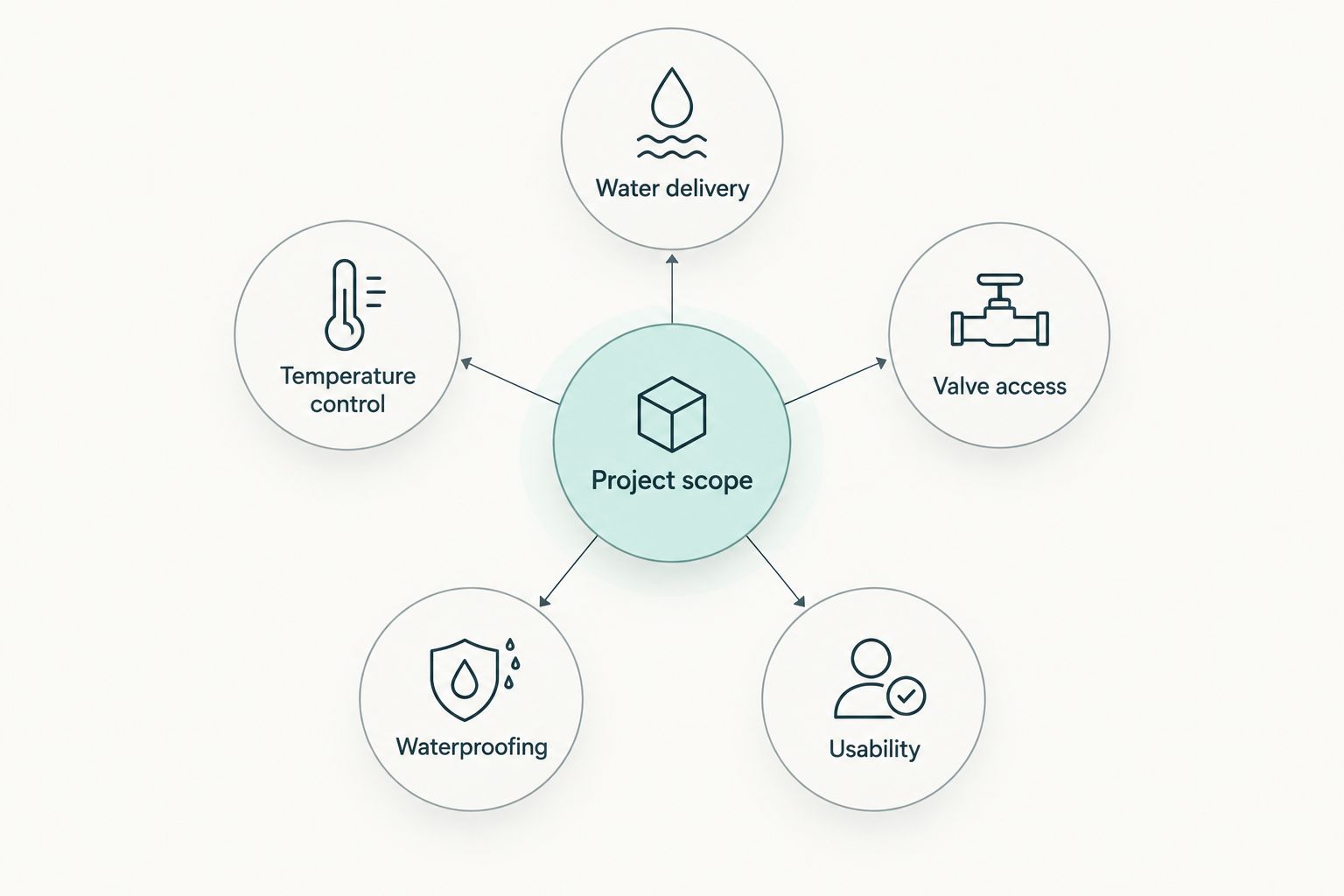
Use these criteria before comparing finishes or accessories:
- Water delivery: Choose outlets you will actually use. Confirm whether your preferred head and handheld operate separately or together.
- Temperature control: Distinguish pressure balancing from thermostatic regulation. Neither removes the need for correct installation and temperature-limit adjustment.
- Valve access: Identify the concealed valve, replacement compatibility, and a practical route for future servicing.
- Waterproofing: Match the enclosure construction to the project. Steam showers require a different assembly from ordinary showers.
- Usability: Check handle operation, handheld reach, hose movement, and control placement from the entrance.
- Project scope: Decide whether you are replacing trim, opening walls, rebuilding the enclosure, or adding electrical equipment.
Your strongest choice satisfies the whole list, not just water delivery. Ask the installer to explain the concealed components before approving the visible ones.
Shower systems at a glance
These are system types, not interchangeable product packages. A trim refresh retains compatible concealed equipment; the other choices describe control or enclosure configurations.
| Rank and system | Best for | Standout feature | Key limitation |
|---|---|---|---|
| 1. Pressure-balanced shower with handheld | Straightforward everyday remodeling | Pressure balancing with flexible rinsing | Does not regulate temperature the same way as a thermostatic valve |
| 2. Thermostatic shower with separate controls | Independent temperature and flow adjustment | Separate temperature and volume operation | More components to specify and coordinate |
| 3. Valve-compatible trim refresh | Updating a sound existing shower | Retains a compatible concealed valve | Cannot fix waterproofing or incompatible plumbing |
| 4. Digital shower system | Electronic control preferences | Electronic operation; features vary by model | Requires equipment access and electrical planning |
| 5. Steam shower system | Dedicated steam bathing | Combines showering with a steam enclosure | Requires a steam-specific assembly and generator |
1. Pressure-balanced shower: best for everyday remodeling
A pressure-balanced valve responds to changes in the relative hot and cold supply pressures. Pair it with a fixed showerhead and handheld for a practical everyday configuration. The handheld adds flexibility for rinsing and cleaning without requiring a wall full of outlets.
For a 2026 remodel that prioritizes straightforward operation, this is the default. Confirm the selected valve's actual controls: pressure balancing does not automatically mean you can adjust temperature and volume independently.
Pressure-balanced shower pros:
- Offers a straightforward control approach for everyday showering.
- Responds to hot and cold supply-pressure changes.
- A handheld supports directed rinsing and enclosure cleaning.
- Keeps the outlet selection focused on ordinary use.
Pressure-balanced shower cons:
- Does not regulate changing supply temperature in the same way as a thermostatic valve.
- Independent volume adjustment depends on the selected valve.
- Adding simultaneous outlets requires a compatible distribution arrangement.
Best for: You want a conventional shower with useful flexibility, not an elaborate control package.
Specify it this way: Start with 1 fixed showerhead and 1 handheld. Ask whether a diverter selects between them or permits simultaneous operation, and confirm the plumbing supports your intended arrangement.
Verdict: Buy a pressure-balanced shower with a handheld for a straightforward bathroom remodel. Keep additional outlets off the specification unless they solve a clear need.
2. Thermostatic shower: best for independent controls
A thermostatic mixing valve regulates mixed-water temperature. With separate volume controls, you can adjust flow without using the temperature setting as the main operating control. That distinction—not the appearance of the handle—is the reason to choose this system.
Thermostatic showers also suit projects where you want deliberate control over different outlets. However, a thermostatic valve alone does not provide outlet selection; the complete arrangement needs compatible volume controls or a diverter.
Thermostatic shower pros:
- Separates temperature regulation from volume control when specified accordingly.
- Supports a retained temperature setting between uses.
- Accommodates clearly defined control arrangements for multiple outlets.
- Makes the distinction between temperature and flow explicit.
Thermostatic shower cons:
- More controls mean more placement and component decisions.
- Multiple outlets still require adequate supply and compatible valves.
- Concealed components need a service plan.
Best for: You want separate temperature and flow adjustment and are already planning the plumbing scope around that preference.
Specify it this way: Ask for a control diagram showing temperature adjustment, volume adjustment, and outlet selection. Review it from the shower entrance, where you will actually reach the controls.
Verdict: Buy a thermostatic shower when independent control matters to you. Skip the added complexity if you prefer a straightforward operating handle.
3. Valve-compatible trim refresh: best for limited construction
A valve-compatible trim refresh replaces visible components while retaining a matching concealed valve. It is an update strategy, not a new valve technology. The existing valve can be pressure-balanced or thermostatic, depending on what is already installed.
This option belongs on the shortlist only after identifying the valve and checking the shower's condition. Matching the finish or manufacturer name is not enough; compatibility depends on the specific valve family and replacement components.
Valve-compatible trim refresh pros:
- Retains suitable existing concealed equipment.
- Limits the fixture work when the enclosure and plumbing are sound.
- Updates handles, escutcheons, or outlets within verified compatibility.
Valve-compatible trim refresh cons:
- Retains the existing valve's operating limitations.
- Cannot repair concealed leaks or failed waterproofing.
- Replacement choices depend on the installed valve.
Best for: Your shower works properly, its enclosure is sound, and your main goal is updating the visible fixtures.
Specify it this way: Have the installer identify the concealed valve before you order trim. Check component compatibility against the manufacturer's documentation rather than relying on appearance.
Verdict: Hold until valve compatibility and shower condition are confirmed. Buy the trim refresh only after both checks pass.
4. Digital shower: best for electronic operation
A digital shower uses electronic controls to operate its mixing equipment. Features differ by model; do not assume every system includes remote starting, saved settings, or phone connectivity. Specify the functions you want and verify them individually.
For a 2026 bathroom remodel, electronic control is a preference—not a substitute for sound plumbing. The installation also needs a plan for power, control connections, equipment location, and servicing.
Digital shower pros:
- Provides electronic rather than conventional mechanical operation.
- Supports an alternative control layout when the selected system permits it.
- Offers model-specific functions you can evaluate against your routine.
Digital shower cons:
- Introduces electrical and electronic components into the project.
- Requires access to the mixing equipment for service.
- Functions and replacement compatibility depend on the selected system.
Best for: You specifically want electronic operation and accept the additional installation and maintenance coordination.
Specify it this way: Request a layout identifying the controller, mixing equipment, power requirements, and access location. Confirm how the system operates during a power interruption using the selected manufacturer's instructions.
Verdict: Buy a digital shower only when its verified controls solve a real usability preference. Skip it if electronic operation adds no value to your routine.
5. Steam shower: best for dedicated steam bathing
A steam shower combines a shower enclosure with a steam generator and steam-specific construction. It is not an ordinary tiled shower with an extra outlet. The enclosure assembly must address vapor exposure as well as liquid water.
Choose this system because you intend to use steam bathing. The generator, steam delivery, enclosure details, electrical work, and service access must be designed together.
Steam shower pros:
- Adds a dedicated steam-bathing function.
- Combines ordinary showering and steam use in a planned enclosure.
- Gives the project a clear purpose beyond adding more shower outlets.
Steam shower cons:
- Requires steam-appropriate enclosure materials and detailing.
- Adds generator equipment, electrical requirements, and maintenance.
- Is not a trim-only upgrade to a conventional shower.
Best for: You want steam bathing enough to make it part of the construction brief from the beginning.
Specify it this way: Confirm the enclosure assembly against the selected waterproofing and steam-equipment instructions. Locate the generator and its service access before finishing surrounding walls.
Verdict: Buy a steam shower only as a coordinated enclosure project. Skip it as an accessory purchase for an otherwise unchanged shower.
How these shower systems are ranked
The ranking prioritizes everyday usability, a clear installation scope, and manageable component coordination. Pressure-balanced showers lead as the straightforward default; thermostatic showers lead when independent controls are the requirement. The remaining choices address narrower goals rather than outperforming the default in every bathroom.
A&E Construction LLC's design-build general-contractor role fits the construction side of this decision. Its stated single point of contact runs from estimate through warranty turnover; individual fixture selection still needs a project-specific specification.
Check water demand before adding outlets
For your 2026 specification, distinguish showerhead flow from the combined demand of an outlet arrangement. EPA WaterSense-labeled showerheads have a maximum flow rate of 2.0 gallons per minute; the federal maximum for showerheads is 2.5 gallons per minute. These are showerhead criteria, not a guarantee that your chosen multi-outlet system suits the existing supply.
Ask which outlets operate together. Then have the installer assess supply capacity, available pressure, and hot-water provision for that arrangement. A bigger collection of heads does not automatically produce a better shower.
Also check the manufacturer's operating requirements. Flow ratings alone do not describe spray coverage, control behavior, or performance at your property's actual conditions.
Which shower system should you choose?
Choose a pressure-balanced shower with a handheld unless another requirement clearly changes the decision. Move to thermostatic controls for independent temperature and flow adjustment, a compatible trim refresh for a sound existing installation, digital controls for electronic operation, or steam for dedicated steam bathing.
Give A&E Construction LLC a functional brief rather than just a fixture photograph. State your preferred control method, desired outlets, enclosure changes, and servicing expectations. That makes the construction scope part of the selection instead of an afterthought.
Discuss your bathroom remodel
Define shower controls, enclosure work, and plumbing scope before selecting fixtures.
FAQ
What's the best shower system for a bathroom remodel in DC?
A pressure-balanced shower with a handheld is the default for a straightforward bathroom remodel in DC. Choose thermostatic controls instead when separate temperature and flow adjustment is a priority.
Is a thermostatic shower better than a pressure-balanced shower?
A thermostatic shower is better for regulating mixed-water temperature and, with separate controls, adjusting flow independently. A pressure-balanced shower suits straightforward operation and responds to supply-pressure changes.
Can I replace shower trim without opening the wall?
A trim-only replacement works when the new components match the existing concealed valve and the installation is sound. Identify the valve and verify compatibility before ordering; trim replacement does not repair waterproofing.
Do I need a new valve for a handheld shower?
A handheld does not automatically require a new concealed valve. The connection and outlet-selection arrangement must match the existing equipment and the way you want the shower to operate.
What should I check before choosing a digital shower?
Check the selected digital shower's power requirements, equipment location, service access, and verified control functions. Do not assume remote starting or saved settings are included.
Can I turn an ordinary shower into a steam shower?
A steam conversion requires assessment of the enclosure assembly, generator installation, electrical work, and vapor-control detailing. It is not simply an additional fixture attached to an ordinary shower.
What flow rate should I look for when remodeling in 2026?
EPA WaterSense-labeled showerheads have a maximum flow rate of 2.0 gallons per minute. Evaluate that rating alongside available pressure, spray performance, and the combined demand of any outlets intended to operate together.
One last thing
Before approving the shower layout, stand at the proposed entrance and rehearse turning it on. Place controls where you can reach them without standing beneath the initial spray, then check handheld reach and door movement. This simple layout review deserves as much attention as the finish selection.