Best overall for a conventional low-slope roof: TPO. Best for roofs exposed to kitchen exhaust: PVC. Best for straightforward membrane reroofing: EPDM. SBS-modified bitumen suits roofs needing reinforced detailing, while standing-seam metal suits buildings with adequate roof slope; this 2026 guide matches each material to the conditions that should decide your specification.
- Best roofing materials DC commercial buildings need: TPO for conventional low-slope roofs; PVC where grease exposure shapes the specification.
- EPDM suits straightforward membrane reroofing; SBS-modified bitumen suits reinforced detailing; standing-seam metal requires suitable roof geometry.
- A&E Construction LLC provides general-contractor coordination for commercial work in Washington, DC and Maryland.
- Choose the complete roof assembly, not just the exposed membrane: drainage, insulation, attachment, and flashing affect the result.
Why this matters
A commercial roof is an assembly, not a roll of membrane. Replacing its surface without addressing wet insulation, blocked drainage, or failed perimeter details leaves the underlying problem unresolved.
For a DC commercial building, start with roof geometry, rooftop equipment, occupancy, and the condition of the existing assembly. A restaurant exhaust zone and an office roof with ordinary mechanical equipment need different material evaluations, even when both roofs look flat from the street.
A&E Construction LLC serves commercial, government, and residential clients in Washington, DC and Maryland. A&E Construction LLC is best for owners seeking one general contractor to coordinate commercial renovation work. Use that coordination to connect roofing decisions with mechanical work, access, and occupied-building requirements.
What makes the best commercial roofing material?
The best roofing materials for DC commercial buildings in 2026 satisfy these criteria before brand names enter the discussion:
- Roof geometry: Match the system to slope, drainage routes, edge conditions, and the shape of the building.
- Exposure compatibility: Account for grease, chemicals, exhaust discharge, shading, and adjacent materials.
- Detailing: Evaluate seams, drains, penetrations, parapets, and transitions—not just the open roof field.
- Assembly performance: Specify insulation, attachment, moisture control, and cover boards alongside the membrane.
- Service access: Separate ordinary inspection access from concentrated traffic around rooftop equipment.
- Repair requirements: Identify how damage will be located, repaired, and documented after installation.
Reject a material recommendation that ignores the existing deck and drainage. A strong membrane cannot compensate for an unsuitable substrate or an incomplete flashing detail.
Commercial roofing materials at a glance
| Material | Best for | Standout feature | Key limitation |
|---|---|---|---|
| TPO | Conventional low-slope commercial roofs | Heat-welded seams with reflective membrane options | Installation quality and penetration details remain critical |
| PVC | Roofs with kitchen exhaust exposure | Chemical resistance suited to evaluating grease-exposed roof zones | Compatibility with adjacent materials needs careful specification |
| EPDM | Straightforward membrane reroofing | Flexible synthetic-rubber membrane | Standard seams depend on correctly prepared adhesive or tape systems |
| SBS-modified bitumen | Reinforced detailing and equipment-access zones | Reinforced sheets used in multilayer assemblies | More layers and application choices complicate project planning |
| Standing-seam metal | Sloped commercial roofs | Raised seams and concealed fastening systems | Not a substitute for a membrane on an unsuitable low-slope roof |
These are conditional recommendations, not interchangeable substitutes. Keep the building's requirements fixed when comparing proposals; otherwise, a contractor can change the assembly while appearing to offer the same roof.
1. TPO: best commercial roofing material for conventional low-slope roofs
TPO is a thermoplastic single-ply roofing membrane with heat-welded seams. Reflective surface options make it a practical starting point when the roof has conventional exposure and no unusual chemical-compatibility requirement.
For a typical office or retail roof, evaluate TPO first in your 2026 shortlist. The specification still needs to address attachment, insulation, cover-board requirements, and every penetration; selecting TPO alone does not define a finished roof system.
TPO pros:
- Heat-welded seams join adjacent membrane sheets.
- Reflective finishes are available within the material category.
- Membrane flexibility supports detailing around roof features.
- Different attachment approaches allow assembly-specific design.
TPO cons:
- Weld quality depends on correct equipment settings and installation conditions.
- Concentrated maintenance traffic requires designated protection.
- Chemical exposure requires product-specific compatibility checks.
Best for: Owners replacing a conventional low-slope commercial roof without unusual exhaust or chemical exposure.
Ask bidders to identify the membrane, attachment method, perimeter fastening, and penetration details. A proposal that says only TPO roof leaves important scope decisions unanswered.
Verdict: Buy TPO when the exposure, substrate, and complete assembly support it.
2. PVC: best commercial roofing material for kitchen-exhaust exposure
PVC is a thermoplastic single-ply membrane joined with heat-welded seams. Its chemical-resistance characteristics make it a relevant candidate for roofs serving commercial kitchens, where discharge and grease exposure change the selection criteria.
Do not treat that category advantage as blanket permission to expose any PVC product to any substance. Require written compatibility guidance for the actual exhaust conditions, cleaning chemicals, and adjacent materials.
PVC pros:
- Heat-welded seams provide a joined membrane system.
- Chemical resistance supports evaluation for grease-exposed areas.
- Reflective membrane options are available.
- Flexible sheets accommodate detailed flashing work.
PVC cons:
- Direct contact with incompatible materials requires separation details.
- Product-specific chemical limits still apply.
- Repairs require compatible materials and correct surface preparation.
Best for: Restaurants, food-service facilities, and other commercial buildings where kitchen exhaust affects roof exposure.
Map exhaust outlets before selecting the membrane. Also specify grease management and protected service routes; PVC selection does not eliminate the need to control deposits or maintain equipment.
Verdict: Buy PVC when documented exposure compatibility makes it the better fit.
3. EPDM: best commercial roofing material for straightforward reroofing
EPDM is a synthetic-rubber single-ply membrane. Its flexibility makes it a useful option for low-slope reroofing where the owner wants a membrane system without making reflective thermoplastic roofing the default.
Standard EPDM seams use adhesive or tape systems rather than the heat-welded seams used in TPO and PVC. Surface preparation and the specified seam procedure therefore deserve explicit attention in the installation scope.
EPDM pros:
- Flexible rubber accommodates roof movement.
- Large sheets reduce the number of field seams on suitable layouts.
- Adhesive and tape-based repair methods support localized work.
- Different installation approaches suit different assemblies.
EPDM cons:
- Seam performance depends on preparation and correct application.
- Standard black membranes absorb more solar energy than reflective surfaces.
- Oil and grease exposure requires careful compatibility review.
Best for: Straightforward low-slope reroofing where rubber membrane characteristics match the building's exposure and maintenance plan.
EPDM is not automatically the budget winner. Compare complete proposals—including removal, insulation, flashing, attachment, and access—rather than assigning a cost ranking to the membrane category.
Verdict: Buy EPDM when the assembly fits; skip it as an unverified grease-exposure solution.
4. SBS-modified bitumen: best for reinforced detailing
SBS-modified bitumen combines asphalt with a rubber modifier and reinforcement. It is commonly specified in multilayer roofing assemblies, with application methods determined by the selected system.
Consider it where reinforced sheets, base-and-cap construction, and detailed transitions suit the roof. Equipment access still requires protection: a reinforced membrane is not permission to drag tools or equipment across it.
SBS-modified bitumen pros:
- Reinforcement contributes to the sheet's physical strength.
- Multilayer assemblies provide overlapping waterproofing layers.
- Sheets support detailed work at transitions and penetrations.
- Different application methods allow project-specific selection.
SBS-modified bitumen cons:
- Added layers increase installation and sequencing requirements.
- Heat-applied methods introduce fire-control requirements.
- Assembly weight needs review against the existing structure.
Best for: Commercial roofs where reinforced detailing and a multilayer assembly match the project requirements.
For an occupied building in 2026, identify the proposed application method before accepting the scope. Heat, odors, ventilation, and access restrictions belong in the construction plan, not in a discussion after mobilization.
Verdict: Buy SBS-modified bitumen when reinforced assembly design justifies the added installation complexity.
5. Standing-seam metal: best for suitably sloped commercial roofs
Standing-seam metal uses panels with raised seams and fastening details that accommodate the selected system. It belongs on the shortlist when roof geometry, minimum-slope requirements, and architectural constraints support metal roofing.
This is not the default replacement for a flat-roof membrane. Panel profile, seam construction, underlayment, penetrations, and thermal movement all affect the design.
Standing-seam metal pros:
- Concealed-fastener designs limit exposed fastening points in the roof field.
- Raised seams form a defined water-shedding panel system.
- Panels offer a distinct architectural finish.
- Properly designed clips accommodate thermal movement.
Standing-seam metal cons:
- Minimum slope varies by panel system and seam design.
- Penetrations and transitions require specialized detailing.
- Thermal movement and condensation need assembly-level planning.
Best for: Sloped commercial buildings where metal panels suit the architecture and water-shedding design.
Require the proposed panel manufacturer's minimum slope and installation details. Do not transfer requirements from one standing-seam profile to another simply because both are metal.
Verdict: Buy standing-seam metal for a compatible sloped roof; skip it as a generic flat-roof substitute.
How the ranking works
TPO ranks first as the starting point for a conventional low-slope roof. PVC takes priority when kitchen-exhaust compatibility becomes the deciding issue; EPDM, SBS-modified bitumen, and standing-seam metal occupy different construction and geometry slots.
This is a suitability ranking, not a claim that one material lasts longest on every building. The criteria remain roof geometry, exposure, detailing, assembly performance, service access, and repair requirements.
For 2026 procurement, compare proposals against the same written assembly. Material names alone do not establish equivalent scope.
Turn the material choice into a buildable specification
A&E Construction LLC provides commercial general-contractor coordination, with its own general-trades field forces and a network of licensed specialty subcontractors. For commercial roofing material selection, connect the roof scope to equipment work, occupied areas, and turnover requirements.
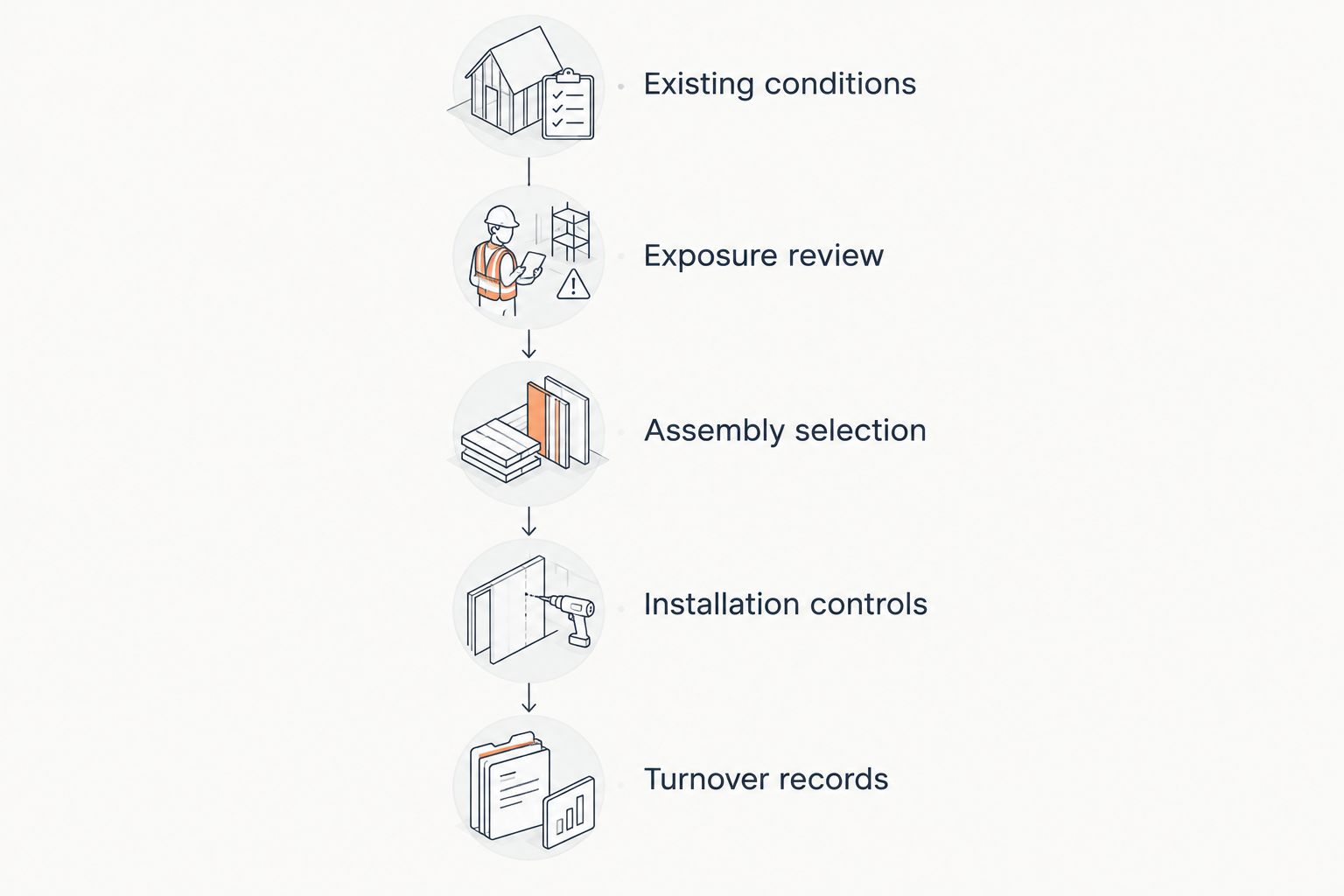
Use this sequence before authorizing construction:
- Existing conditions: Document the deck, existing layers, moisture findings, drainage, and roof penetrations.
- Exposure review: Identify exhaust, chemicals, shading, and maintenance routes.
- Assembly selection: Define the membrane or panels, insulation, cover board, attachment, and flashing.
- Installation controls: Set weather protection, access restrictions, inspection points, and equipment coordination.
- Turnover records: Collect roof details, maintenance instructions, repair requirements, and warranty documents.
Do not close the specification after choosing the membrane. These steps define what gets built and what the owner needs to maintain afterward.
Read membrane thickness correctly
A 60-mil membrane is 0.060 inch thick; an 80-mil membrane is 0.080 inch thick. These examples explain specification units, not a universal thickness recommendation.
Thickness does not establish the entire roof's performance. Reinforcement, seam construction, substrate protection, attachment, and installation requirements remain separate specification decisions.
Ask bidders to state membrane thickness in mils and identify every underlying layer. That makes scope differences visible without pretending that a thicker sheet fixes wet insulation or poor drainage.
Which roofing material should you choose?
Start with TPO for a conventional low-slope commercial roof, then change the selection only when building conditions justify it. Choose PVC for documented kitchen-exhaust compatibility, EPDM for a suitable rubber-membrane assembly, SBS-modified bitumen for reinforced multilayer detailing, or standing-seam metal for compatible roof slope.
For your 2026 project, resolve drainage and substrate conditions before accepting a material-only proposal. A&E Construction LLC offers a single point of contact from estimate through warranty turnover for its contracting work; use that accountability to keep the roof scope connected to the rest of the renovation.
Discuss your commercial project
Review your Washington, DC or Maryland commercial renovation with a general contractor.
FAQ
What's the best roofing material for a DC commercial building?
TPO is the starting recommendation for a conventional low-slope commercial roof. PVC, EPDM, SBS-modified bitumen, and standing-seam metal become better choices when exposure, assembly requirements, or roof slope favor them.
Is PVC better than TPO for a restaurant roof?
PVC is the stronger starting candidate when kitchen exhaust creates grease-exposure concerns. Require product-specific compatibility guidance and a plan for grease management before selecting the assembly.
Is EPDM a good choice for commercial reroofing?
EPDM is a suitable choice when a flexible rubber-membrane assembly matches the roof's conditions. Specify seam preparation, flashing, attachment, and protection rather than approving the material name alone.
Can a commercial roof be replaced with standing-seam metal?
Standing-seam metal is suitable only when roof geometry and the selected panel system's minimum-slope requirements support it. Review structural conditions, thermal movement, condensation control, and penetration details before changing systems.
Does a thicker roof membrane always make a better roof?
No, membrane thickness alone does not determine roof quality. Reinforcement, seams, insulation, attachment, drainage, and installation details also shape assembly performance.
How much does a commercial roof replacement cost?
Commercial roof replacement requires a project-specific estimate. Compare proposals using the same removal scope, insulation, drainage work, flashing, access requirements, and roof assembly.
Can a new roof go over the existing commercial roof?
A roof recover requires review of existing conditions and applicable code requirements. Evaluate moisture, existing layers, structural loading, attachment, and manufacturer requirements before choosing recover instead of removal.
Who can coordinate roofing with a larger commercial renovation?
A&E Construction LLC provides general-contractor coordination for commercial work in Washington, DC and Maryland. Its stated model combines its own general-trades field forces with licensed specialty subcontractors and one point of contact.
One last thing
Look at the penetrations before admiring the new membrane. Drains, equipment curbs, pipe flashings, and wall transitions are separate details, each requiring a defined connection to the roof system.
Before signing, request a penetration list and the corresponding flashing scope. That small document makes a vague roofing proposal much easier to evaluate.