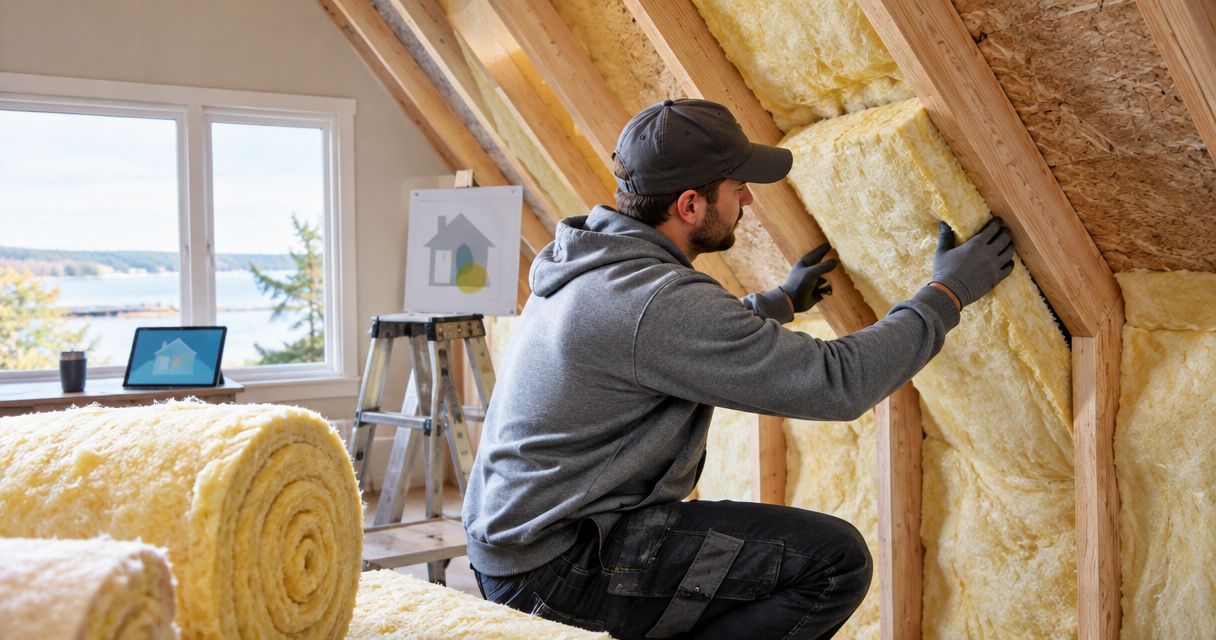
Best overall for opened walls: mineral wool. Best for attic-floor retrofits: blown cellulose. Best budget option for accessible cavities: fiberglass batts. For a Maryland home renovation in 2026, choose insulation by the assembly you are rebuilding—not by the highest advertised R-value.
- The best insulation options for Maryland home renovation depend on cavity access, air sealing, and moisture control.
- Mineral wool wins for opened walls; blown cellulose fits attic-floor retrofits.
- Fiberglass batts suit straightforward cavity replacement, but gaps and compression undermine performance.
- A&E Construction LLC handles residential renovations; coordinate insulation decisions with the broader construction scope.
Why this matters
Insulation slows heat transfer. It does not automatically stop air leakage, fix roof leaks, or make a damp basement suitable for finishing. Installing new material over those problems leaves the underlying defects in place.
Maryland renovation projects also involve different assemblies: attic floors, framed exterior walls, masonry basements, and rooflines. Each needs its own insulation and moisture-control detail. A material that works in an attic is not automatically the right choice against a foundation wall.
A&E Construction LLC serves Maryland and Washington, DC, with residential renovation and design-build general contracting. For insulation work, use the renovation scope to coordinate access, specialty trades, and the sequence before finishes conceal the assembly.
For your 2026 project, separate three decisions: where the thermal boundary belongs, how air leakage will be sealed, and which insulation fits that boundary. Decide them together, but do not treat them as the same task.
What makes the best insulation for a Maryland renovation
Use these criteria before comparing materials:
- Assembly fit: Match the insulation to an attic floor, framed wall, foundation wall, or roof assembly. Specify the complete installation, not just the material.
- Air control: Identify a continuous air barrier and seal penetrations. Fibrous insulation alone is not an air barrier.
- Moisture control: Resolve water entry and specify drying paths before closing cavities. Do not assume every wall needs polyethylene sheeting.
- Available depth: Compare the required installed R-value with actual cavity depth. Product thickness and installation conditions matter.
- Installation access: Open walls favor different methods than finished walls. Obstructions and concealed wiring affect the scope.
- Inspection and repair: Consider how you will inspect framing, service utilities, and verify insulation coverage before finishes go back.
Choose the assembly first and the insulation second. That rule prevents a high-performing material from becoming a poor fit for the building.
Maryland renovation insulation at a glance
This 2026 comparison assigns each material a distinct job. The order starts with opened-wall renovations; it is not a claim that mineral wool belongs everywhere.
| Insulation option | Best for | Standout feature | Key limitation |
|---|---|---|---|
| Mineral wool batts | Opened exterior walls | Friction-fit batts with noncombustible fibers | Requires separate air sealing and careful cutting |
| Blown cellulose | Attic-floor retrofits | Loose fill covers irregular spaces around framing | Needs containment, depth checks, and ventilation protection |
| Fiberglass batts | Straightforward cavity replacement | Fits conventional framed cavities | Gaps and compression reduce installed performance |
| Closed-cell spray foam | Depth-constrained targeted assemblies | High thermal resistance per inch | Requires application controls and fire-protection detailing |
| Rigid foam boards | Continuous insulation on suitable assemblies | Extends across framing rather than only between it | Seams, penetrations, and coverings need deliberate detailing |
Understand R-value before choosing
R-value measures resistance to heat flow; higher values mean greater resistance under the stated test conditions. Installed thickness determines the material's total R-value, but framing, gaps, and air leakage affect the finished assembly.
Typical published material ranges include approximately R-2.9 to R-3.8 per inch for fiberglass batts, R-3.2 to R-3.8 per inch for cellulose, and R-6 to R-7 per inch for closed-cell spray foam. These are category-level comparisons, not specifications for your project. Use the selected product's labeled values and installation instructions.
For 2026 planning, the U.S. Department of Energy's Energy Saver guidance on insulation materials and installation provides the reference framework for these comparisons. Your jurisdiction's applicable code and the proposed assembly determine the actual requirement; a generic internet chart does not approve a renovation detail.
1. Mineral wool: best insulation for opened exterior walls
Mineral wool batts fit between studs when demolition exposes the wall cavity. They are a strong default for an opened-wall renovation because you can inspect the framing, complete air sealing, and fit the insulation before installing finishes.
Mineral wool also absorbs sound within cavities. That supports sound-control work, but the complete wall—including doors, penetrations, and connections—still determines the result.
Mineral wool pros:
- Batts stay in place through a properly fitted friction installation.
- Noncombustible fibers suit assemblies where material fire behavior matters.
- Cavity absorption supports sound-control detailing.
- Open-wall installation allows visual inspection before closure.
Mineral wool cons:
- Mineral wool does not replace a continuous air barrier.
- Pipes, wiring, and irregular cavities require accurate cutting and fitting.
- Batts do not provide continuous insulation across the studs.
Best for: Homeowners already opening exterior walls as part of a larger renovation.
Ask the installer to show how batts will fit behind wiring and around service boxes. A cavity filled loosely around obstructions is not the same as a cavity insulated completely.
Verdict: Buy mineral wool for opened walls when the scope includes separate air sealing and an appropriate moisture-control detail.
2. Blown cellulose: best insulation for attic-floor retrofits
Blown cellulose is loose-fill insulation made primarily from recycled paper fiber treated for fire resistance. It suits accessible attic floors because it fills around framing and irregular spaces without cutting a batt for every opening.
The attic floor must be prepared first. Seal accessible leakage paths, establish safe clearances, and protect ventilation routes before loose fill covers the work.
Blown cellulose pros:
- Loose fill adapts to irregular attic-floor layouts.
- Coverage extends around framing and accessible obstructions.
- Installation does not require removing finished ceilings below an accessible attic.
- Marked depth and product coverage information support inspection.
Blown cellulose cons:
- Wind movement and disturbed material create uneven coverage without proper containment.
- Water leaks must be repaired before installation.
- Storage platforms and access routes need planning to avoid compressing the insulation.
Best for: An unfinished, accessible attic where the thermal boundary remains at the ceiling below.
Specify the product's installed depth, coverage, and settling requirements. Preserve access to equipment and avoid burying components that need inspection or service.
Verdict: Buy blown cellulose for an attic-floor retrofit after air sealing, clearance checks, and ventilation preparation are complete.
3. Fiberglass batts: best insulation for simple cavity replacement
Fiberglass batts fit conventional stud and joist cavities. They are a practical budget-oriented material for a straightforward replacement where the framing is exposed and installers can fit each piece correctly.
The installation matters more than the neat appearance of the packaging. A batt must contact the intended surfaces without leaving voids or being compressed to fit around obstacles.
Fiberglass batts pros:
- Preformed batts suit regular framing layouts.
- Individual pieces can be removed during later cavity access.
- Facing choices allow the product to match a specified assembly.
- Exposed installation makes gaps visible before finishes are installed.
Fiberglass batts cons:
- Compression changes thermal performance; labeled values assume the specified installation.
- Batts require splitting or careful fitting around wiring and pipes.
- Fiberglass does not stop air leakage through the assembly.
Best for: Regular, accessible cavities where straightforward installation and future access matter.
Do not select a thicker batt simply because its package shows a higher R-value. Check the cavity depth and the manufacturer's compressed-installation information before specifying it.
Verdict: Buy fiberglass batts for simple, accessible cavities; skip poorly fitted installation regardless of the package rating.
4. Closed-cell spray foam: best insulation for limited cavity depth
Closed-cell spray foam is applied in place and provides high thermal resistance per inch. It belongs on the shortlist when available depth constrains the assembly and a suitable product can also provide the specified air-control function.
This is a specialist installation, not a substitute for diagnosing moisture problems. Substrate conditions, application thickness, ventilation, and required protective coverings all belong in the scope.
Closed-cell spray foam pros:
- High R-value per inch suits depth-constrained assemblies.
- Applied foam conforms to suitable irregular surfaces.
- Properly specified thickness can provide an air barrier.
- Product-specific vapor resistance can serve a designed assembly.
Closed-cell spray foam cons:
- Concealed surfaces become harder to inspect after application.
- Removal for repairs or utility changes is more involved than removing batts.
- Installation and occupancy precautions require product-specific controls.
Best for: Targeted assemblies where limited space justifies specialist application and the full assembly has been evaluated.
Require written installation and reoccupancy instructions. Identify the required thermal or ignition barrier rather than assuming exposed foam is acceptable throughout a house.
Verdict: Hold closed-cell spray foam until the assembly, installer controls, and protective coverings are specified.
5. Rigid foam boards: best insulation for continuous coverage
Rigid foam boards can form a continuous insulation layer over suitable surfaces instead of stopping at each stud. That makes them useful when the renovation exposes an assembly where continuity across framing can be detailed correctly.
Rigid foam is a category, not one interchangeable product. Expanded polystyrene, extruded polystyrene, and polyisocyanurate differ in thermal and moisture properties; select the board for the actual location.
Rigid foam boards pros:
- Continuous layers reduce heat flow through framing.
- Board dimensions make coverage and thickness visible during installation.
- Suitable products support foundation-wall or exterior-wall insulation details.
- Specified joint treatments can contribute to air control.
Rigid foam boards cons:
- Joints and penetrations interrupt continuity unless treated correctly.
- Interior foam generally requires code-compliant protective coverings.
- Board type and facer affect vapor behavior and assembly drying.
Best for: A renovation that exposes a suitable foundation or exterior assembly for continuous insulation.
For a basement, correct water entry before adding insulation or framing. Do not place a generic board-and-batt detail against masonry without checking how moisture will be managed.
Verdict: Buy rigid foam boards when continuous coverage is part of a specified assembly; hold if water entry or protective-covering details remain unresolved.
Put the insulation decision into the renovation sequence
A&E Construction LLC insulation planning should sit within the residential renovation scope, not apart from it. The company provides general contracting with its own general-trades field forces and supervised specialty subcontractors, supporting coordination across demolition, repairs, insulation, and finishes.
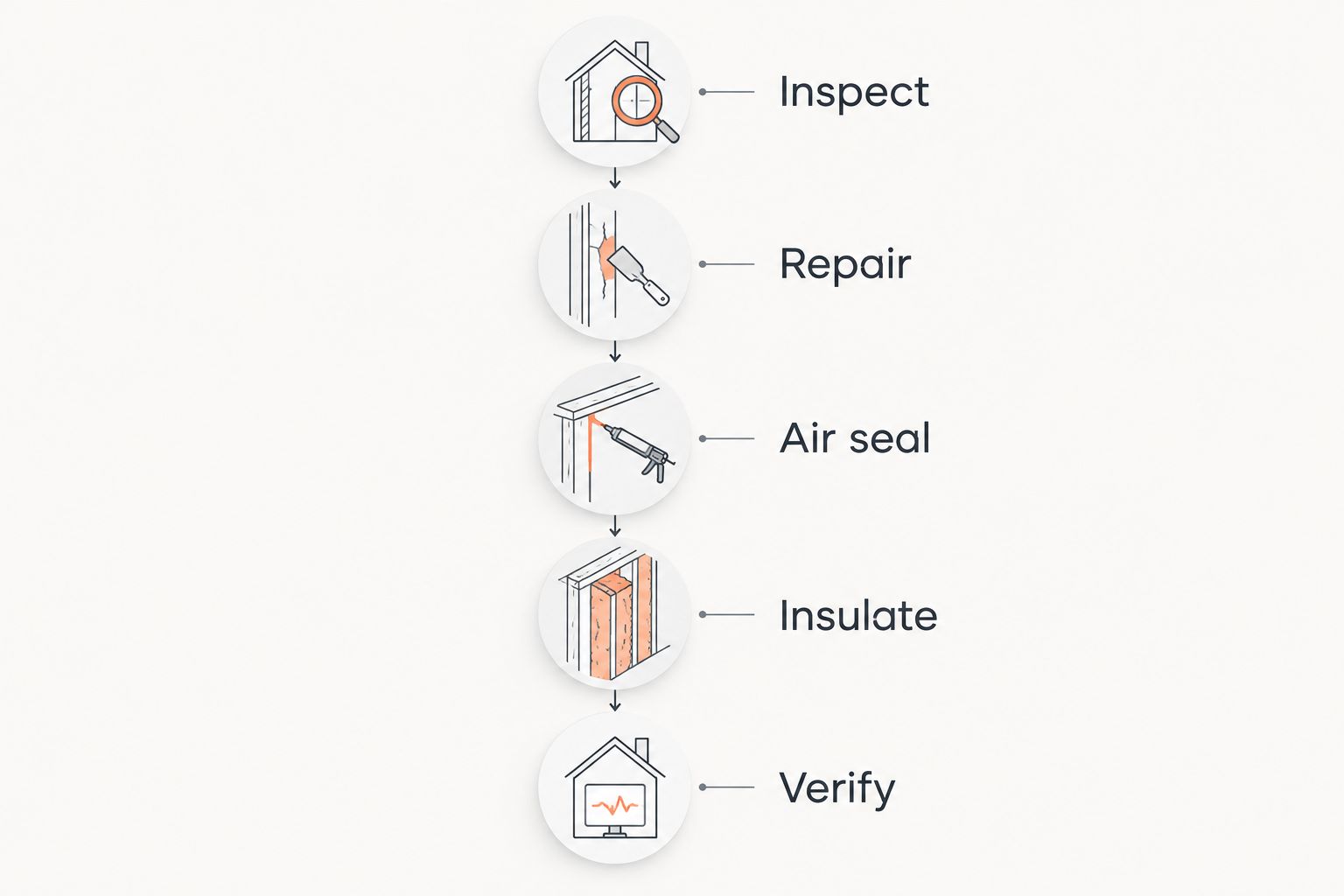
Use this sequence before authorizing closure:
- Inspect: Expose the relevant assembly and identify damage, water entry, and service conflicts.
- Repair: Address the underlying defects before covering the surfaces.
- Air seal: Complete the specified air-control layer and penetrations.
- Insulate: Install the selected material to its product requirements.
- Verify: Check coverage, clearances, protective layers, and required inspections before finishes.
Your 2026 scope should identify who owns each step and which conditions must be met before work proceeds. A material substitution should trigger a review of thickness, vapor behavior, coverings, and installation instructions—not just a revised material name.
Discuss your Maryland renovation scope
Coordinate insulation choices with the walls, attic, or basement your renovation will expose.
How these insulation options were ranked
The ranking uses assembly fit, air control, moisture control, cavity depth, installation access, and inspectability. Mineral wool leads for opened walls; cellulose leads for attic-floor coverage. Neither verdict overrides a different assembly's requirements.
These are application-based recommendations, not results from proprietary product testing. No single material wins every renovation location.
Which insulation should you choose?
Choose mineral wool for opened exterior walls, cellulose for an accessible attic floor, and fiberglass for straightforward cavity replacement. Reserve closed-cell spray foam for evaluated depth constraints and rigid foam for assemblies that benefit from continuous coverage.
A&E Construction LLC is best suited to homeowners who want insulation coordinated within a Maryland residential renovation. Give the contractor the renovation boundary and the access conditions first; choose the material after the assembly is defined.
FAQ
What's the best insulation for a Maryland home renovation?
Mineral wool is a strong default for opened exterior walls, while blown cellulose suits accessible attic floors. The best choice depends on the assembly, air sealing, moisture conditions, and available depth.
Is mineral wool better than fiberglass for exterior walls?
Mineral wool is the preferred opened-wall option in this guide for its friction-fit installation and noncombustible fibers. Fiberglass remains a practical choice for regular cavities when installers fit it without gaps or inappropriate compression.
Should I use spray foam throughout my house?
Do not default to spray foam throughout the house. Use closed-cell spray foam where its depth and air-control properties fit an evaluated assembly, with product-specific installation precautions and protective coverings.
Can I add attic insulation without removing the old material?
Existing attic insulation can remain only when its condition and the proposed installation allow it. Inspect for moisture, contamination, unsafe clearances, and hidden defects before adding material; do not disturb suspected hazardous material.
Does new insulation fix drafts?
New insulation alone does not reliably fix drafts. Air sealing addresses leakage paths, while insulation slows heat flow through the assembly; include both in the scope.
What insulation should I use in a Maryland basement?
A suitable rigid foam system is an option for continuous foundation-wall insulation after water entry is corrected. Board selection, joint treatment, framing, and protective coverings must form a complete moisture-aware assembly.
How do I compare insulation quotes without focusing only on the material?
Compare the same installation scope, including air sealing, thickness, repairs, access, protective coverings, and verification. Quotes for different scopes do not describe equivalent work.
One last thing
The insulation you cannot inspect later deserves the clearest inspection now. Before drywall or another finish closes the assembly, document coverage around wiring, penetrations, corners, and transitions.
For a 2026 renovation, put that verification step in the scope before work starts. A photograph of a completed cavity is more useful than a leftover package showing the intended R-value.