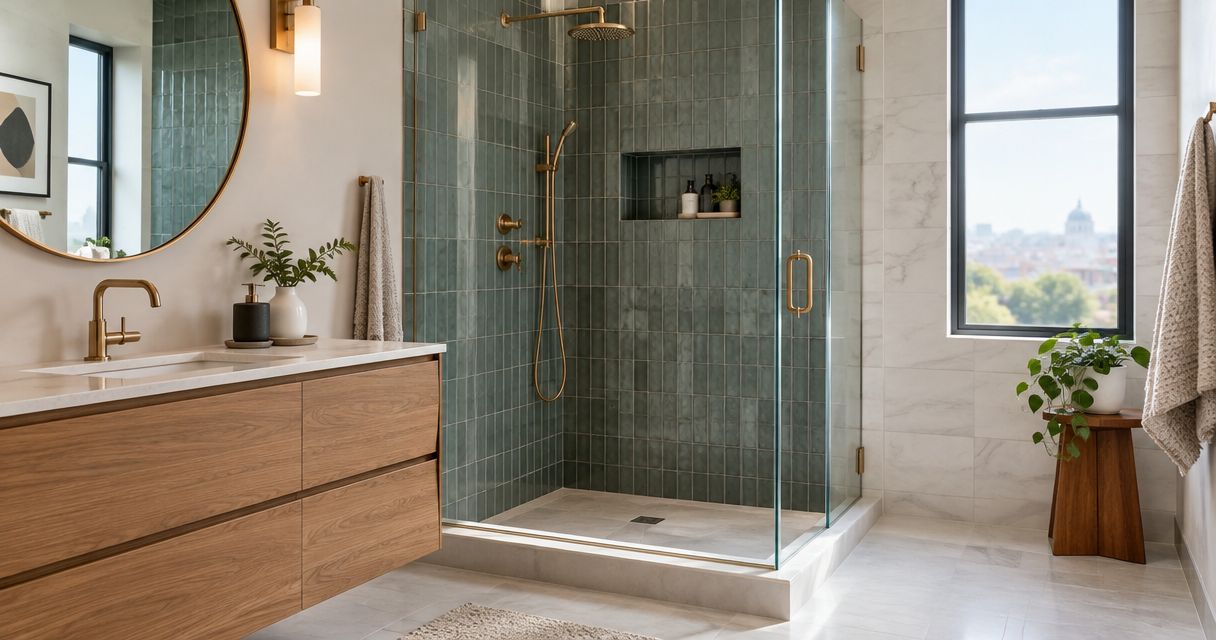
Best overall: matte porcelain for the main bathroom floor. Best for expressive walls: glazed ceramic. Best for a shower floor with multiple slopes: small-format porcelain mosaic. This 2026 guide to the best bathroom tile trends DC homeowners should consider ranks design directions by where they work—not by how fashionable they sound.
- For best bathroom tile trends DC remodels, choose matte porcelain floors first; treat color and pattern as secondary decisions.
- Glazed ceramic suits expressive bathroom walls; small-format porcelain mosaic suits shower floors with multiple slopes.
- Large-format porcelain suits uninterrupted walls, but layout and substrate preparation deserve extra attention.
- A&E Construction LLC is a bathroom remodeling option for DC homeowners seeking one general contractor from estimate through warranty turnover.
Why this matters
A bathroom tile choice has two jobs: create the room you want and suit the surface you are covering. A striking wall tile is not automatically appropriate underfoot. A large tile that looks calm in a sample display needs a workable layout around drains, corners, and fixtures.
A&E Construction LLC serves Washington, DC and Maryland as a general contractor across residential, commercial, and government work. For your bathroom remodel, settle the installation requirements before approving the finish palette. Tile selection belongs in the construction plan, not just the mood board.
The best 2026 bathroom tile choice is the one whose intended use matches its location. The shortlist below treats trends as design options rather than claims about local sales or popularity.
What makes the best bathroom tile for a DC remodel?
Use these criteria before comparing colors or shapes:
- Intended use: Confirm that the manufacturer approves the exact tile for walls, floors, or shower floors as applicable.
- Wet-use suitability: Read the product's use classification and installation guidance. A matte appearance alone does not establish traction.
- Water management: Select tile alongside the shower assembly. Tile and grout do not replace waterproofing.
- Layout fit: Check cuts at doorways, niches, drains, and outside corners before ordering the final layout.
- Maintenance: Compare grout coverage, surface texture, and cleaning requirements rather than judging the tile face alone.
- Visual balance: Give one surface the lead. Supporting surfaces should make the main choice easier to read.
Porcelain tile has water absorption of 0.5% or less, as defined under ANSI A137.1. That classification describes the tile body; it does not certify an installed shower as waterproof or establish that every porcelain product belongs on a wet floor.
Bathroom tile options at a glance
| Rank and option | Best for | Standout feature | Key limitation |
|---|---|---|---|
| 1. Matte porcelain | Main bathroom floors | A quiet finish that works with different wall treatments | Matte does not automatically mean suitable for wet floors |
| 2. Small-format porcelain mosaic | Shower floors with multiple slopes | Small pieces accommodate changes in the floor plane | Numerous grout joints require cleaning attention |
| 3. Glazed ceramic | Expressive bathroom walls | Color and surface variation without covering every surface in pattern | Wall approval does not establish floor suitability |
| 4. Large-format porcelain | Uninterrupted shower and bathroom walls | Larger tile faces reduce the number of field joints | Flatness, handling, and cut planning demand attention |
| 5. Stone-look porcelain | A coordinated, stone-inspired bathroom | A stone-like appearance in a porcelain tile body | Repeated printed faces can make the pattern look artificial |
| 6. Geometric tile | Powder-room accent floors | Pattern gives a small room a clear focal point | Cuts and competing patterns can overwhelm the design |
These recommendations apply to categories, not every product within them. Ask for the technical information for the exact tile you select in 2026.
1. Matte porcelain: best bathroom tile for main floors
Matte porcelain is the default starting point for a bathroom floor because its restrained appearance leaves room for cabinetry, lighting, and wall tile to carry the design. It is a finish direction, not a promise of slip resistance. Check the exact product's approved use before treating it as a floor candidate.
For a 2026 remodel, begin with the floor sample beside your wall and vanity finishes. Look at it under the lighting you intend to use. A neutral that looks warm on its own can read differently beside another neutral.
Matte porcelain pros:
- Provides a visually quiet base for more expressive walls.
- Offers a porcelain tile body with low water absorption.
- Works as a starting point for a coordinated material palette.
Matte porcelain cons:
- Surface appearance does not prove wet-floor suitability.
- Textured versions need a cleaning method suited to their finish.
- Straight grout lines still depend on accurate setting and layout.
Best for: The main bathroom floor when you want the walls or fixtures to draw attention.
Verdict: Buy a floor-approved matte porcelain after checking its wet-use guidance; skip products selected on appearance alone.
2. Small-format porcelain mosaic: best tile for sloped shower floors
Small-format porcelain mosaic uses individual pieces joined into sheets. The smaller pieces allow the installation to follow changes in slope more readily than a single large tile. This matters around a point drain, where the floor usually slopes from several directions.
A 2-by-2-inch mosaic is an example to discuss with your installer, not a universal specification. The shower system, drain arrangement, tile thickness, and manufacturer's instructions determine what belongs in the assembly. Sheet-mounted products also need checking for uneven spacing or visible sheet boundaries.
Small-format porcelain mosaic pros:
- Accommodates changes in the shower-floor plane.
- Allows a separate floor treatment without repeating the wall format.
- Offers layout flexibility around a drain.
Small-format porcelain mosaic cons:
- More grout joints create more areas to clean.
- Poor sheet alignment leaves visible seams in the pattern.
- Small pieces do not eliminate the need to verify wet-use suitability.
Best for: Shower floors with multiple slopes, especially designs organized around a point drain.
Verdict: Buy when the mosaic matches the shower system's requirements and the installer checks sheet alignment before setting.
3. Glazed ceramic: best bathroom tile for expressive walls
Glazed ceramic is a useful direction when you want the bathroom walls to carry color, gloss, or subtle surface variation. Keep the distinction clear: a wall tile can be excellent on a vertical surface without being appropriate for a floor.
Choose the placement before the color. A vanity backsplash, full-height wall, and shower enclosure ask different things of the layout. Check edge pieces, corner details, and fixture penetrations so the design does not end with an unresolved exposed edge.
Glazed ceramic pros:
- Gives you a clear way to introduce color on vertical surfaces.
- Supports either a restrained field or an intentional accent.
- Lets the floor remain visually simple.
Glazed ceramic cons:
- Floor suitability must be established separately.
- Surface variation requires deliberate tile distribution during installation.
- Edges and transitions need a finish detail, not an improvised solution.
Best for: Bathroom walls where color or glaze is the primary design feature.
Verdict: Buy for approved wall applications; skip using the same tile on the floor without explicit product approval.
4. Large-format porcelain: best tile for uninterrupted walls
Large-format porcelain makes individual tile faces more prominent and reduces the number of field joints compared with smaller tiles covering the same area. It suits a wall where you want the surface, rather than the grid, to dominate.
A 12-by-24-inch tile is one format to explore during layout planning. Do not assume a larger size automatically makes a small bathroom look larger. Awkward cuts around a niche or narrow wall can defeat the intended calm effect.
Large-format porcelain pros:
- Creates broader areas of uninterrupted tile face.
- Reduces field joints compared with a smaller format.
- Gives veining or restrained texture room to read clearly.
Large-format porcelain cons:
- Substrate flatness needs close attention.
- Handling and fixture cutouts become more demanding.
- A poorly planned layout produces conspicuous narrow cuts.
Best for: Shower and bathroom walls with enough uninterrupted area to support the selected format.
Verdict: Buy after the installer confirms wall preparation and a full layout; hold if the plan consists only of a sample tile.
5. Stone-look porcelain: best tile for a coordinated stone-inspired room
Stone-look porcelain reproduces a stone-like surface on a porcelain tile body. Choose it when your priority is the appearance of stone across a coordinated bathroom rather than the properties of a particular natural stone.
The key decision is pattern distribution. Review several tile faces together, not just one sample. Repeated veining placed side by side can look mechanical; carefully arranged variation makes the surface more convincing.
Stone-look porcelain pros:
- Combines a stone-inspired appearance with a porcelain tile body.
- Supports a coordinated wall-and-floor palette when suitable products are selected.
- Offers a focal surface without requiring a geometric pattern.
Stone-look porcelain cons:
- Printed faces repeat and need thoughtful placement.
- Strong veining competes with other patterned finishes.
- Matching appearance does not establish matching floor and wall approvals.
Best for: A bathroom where stone-like surfaces define the overall design.
Verdict: Buy after reviewing multiple faces and the proposed arrangement; skip a pattern whose repetition you already notice in the samples.
6. Geometric tile: best bathroom tile for powder-room accents
Geometric tile uses shape, printed pattern, or both to make the tiled surface the focal point. A powder room is a useful setting for this direction because the design can center on one floor without also resolving a shower enclosure.
Keep the surrounding finishes quiet. Patterned flooring, heavily veined counters, and expressive wall tile each demand attention; combining them requires more restraint than choosing any one of them.
Geometric tile pros:
- Gives the room a clearly defined focal surface.
- Adds character without requiring patterned walls.
- Allows a simple vanity and wall finish to support the design.
Geometric tile cons:
- Perimeter cuts can interrupt a repeating motif.
- Directional patterns need a deliberate starting point.
- Shape or pattern does not establish floor suitability.
Best for: Powder-room floors where pattern is the principal design decision.
Verdict: Buy a floor-approved option with a planned perimeter layout; skip competing patterns on adjacent surfaces.
How the bathroom tile options are ranked
The ranking prioritizes intended use, water management, layout, maintenance, and visual balance. Matte porcelain comes first as a main-floor starting point. Mosaic serves a specific shower-floor condition; the remaining options answer distinct wall or styling needs.
This is a selection framework for 2026, not a claim that one category outsells another in Washington, DC. Your room's geometry and the exact product instructions take precedence over the order of the list.
Which bathroom tile should you choose?
Choose floor-approved matte porcelain as the default, then select the shower floor and walls separately. You do not need one tile category to solve the entire bathroom.
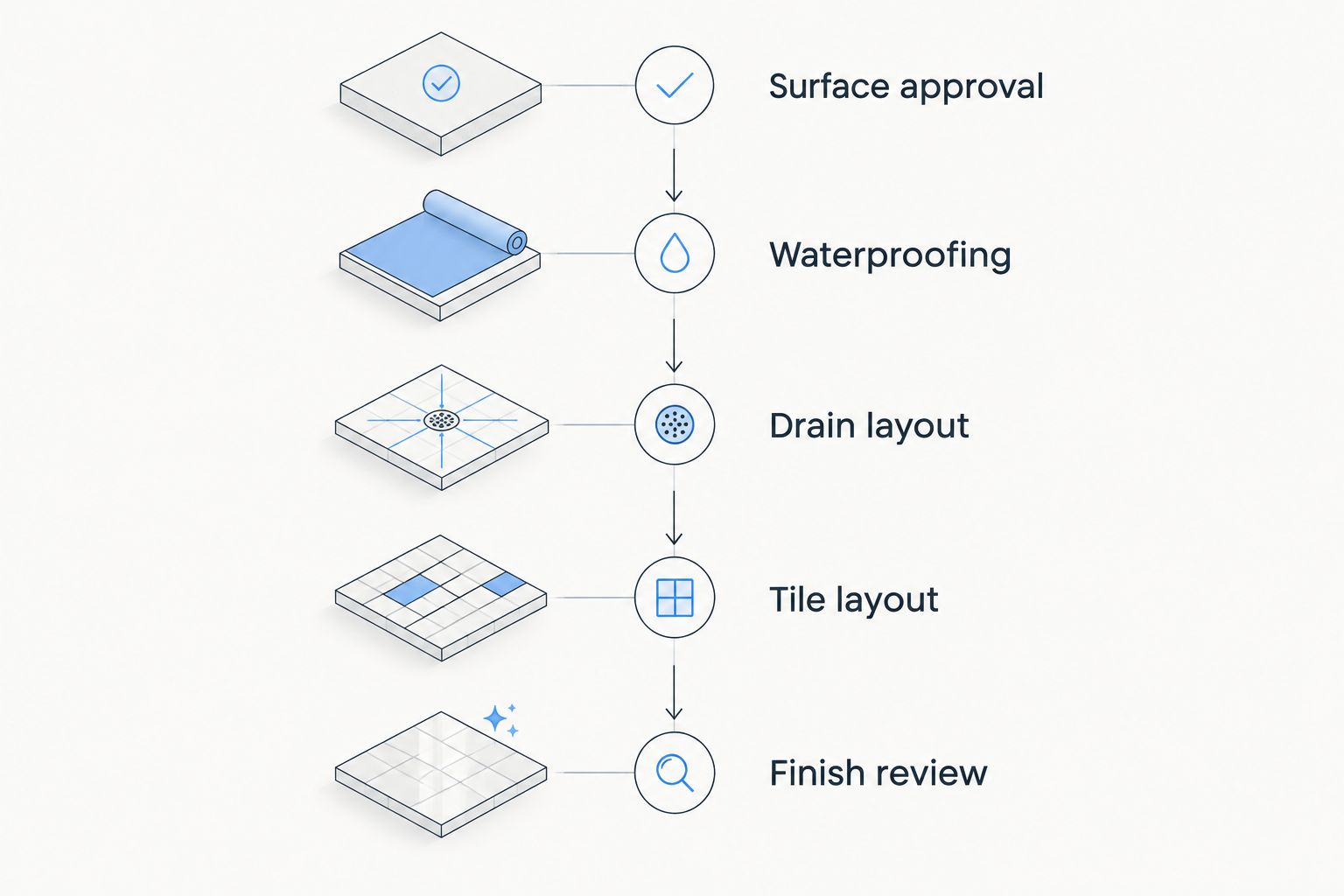
Before approving the design, ask your contractor to resolve these decisions in sequence:
- Surface approval: Verify intended use for every selected tile.
- Waterproofing: Establish the wet-area assembly and its installation requirements.
- Drain layout: Coordinate the drain location with slope and tile format.
- Tile layout: Review starting points, visible cuts, niches, and edges.
- Finish review: Compare grout and tile samples together.
A&E Construction LLC provides bathroom remodeling within its residential general contracting work, with its own general-trades field forces and licensed specialty subcontractors. The company describes a single point of contact from estimate through warranty turnover. Bring your preferred tile directions and ask how they fit the proposed construction scope.
Plan your bathroom remodel
Discuss tile choices within the full bathroom construction scope.
FAQ
What's the best bathroom tile for a DC remodel in 2026?
Floor-approved matte porcelain is the default recommendation for the main bathroom floor. Select shower-floor and wall tile separately, using the exact products' intended-use guidance.
Is porcelain better than ceramic for bathroom tile?
Neither category is the right answer for every bathroom surface. Porcelain is defined by water absorption of 0.5% or less under ANSI A137.1, while glazed ceramic remains a useful wall option; application approval still matters for both.
Does matte bathroom tile prevent slipping?
A matte finish does not establish slip resistance. Check the exact product's wet-use classification and manufacturer guidance before selecting it for a bathroom or shower floor.
Can I use large tiles on a shower floor?
Large shower-floor tiles require a layout compatible with the drain arrangement, slope, and shower system. Small-format mosaics accommodate multiple changes in slope more readily; have the installer resolve the assembly before choosing a format.
Do bathroom tile and grout make a shower waterproof?
Tile and grout do not replace a waterproofing system. The shower assembly must manage water behind the finished surface, with compatible details at drains, corners, and penetrations.
How do I keep patterned bathroom tile from looking too busy?
Make patterned tile the lead surface and keep adjacent finishes restrained. Review the whole palette together, including grout, cabinetry, counters, and wall treatments.
Who is A&E Construction LLC best for on a bathroom remodel?
A&E Construction LLC is a bathroom remodeling option for DC homeowners seeking one general contractor from estimate through warranty turnover. The company serves Washington, DC and Maryland and coordinates its own general-trades field forces with licensed specialty subcontractors.
One last thing
Ask to see the grout beside the tile before approving either. Grout is part of the pattern: a contrasting joint emphasizes each tile, while a closer color match reduces the visual grid. For your 2026 bathroom remodel, approve the combination—not two isolated samples.